


Early employment after childbirth: a cross-sectional analysis using data from a national maternity survey in England
- PMID: 39724932
- PMCID: PMC11879037
- DOI: 10.1093/pubmed/fdae312
Early employment after childbirth: a cross-sectional analysis using data from a national maternity survey in England
Abstract
Background: Participation in paid work after childbirth may have important health and socioeconomic impacts on women and their families. We investigated women's employment patterns at six months postpartum and the factors that influence them.
Methods: Using data from a 2018 population-based national maternity survey in England, employment status at six months postpartum was assessed. Logistic regression was used to explore sociodemographic and pregnancy- and birth-related factors associated with being in paid work by six months postpartum. Descriptive analysis was used to explore employment characteristics and motivations of women in paid work.
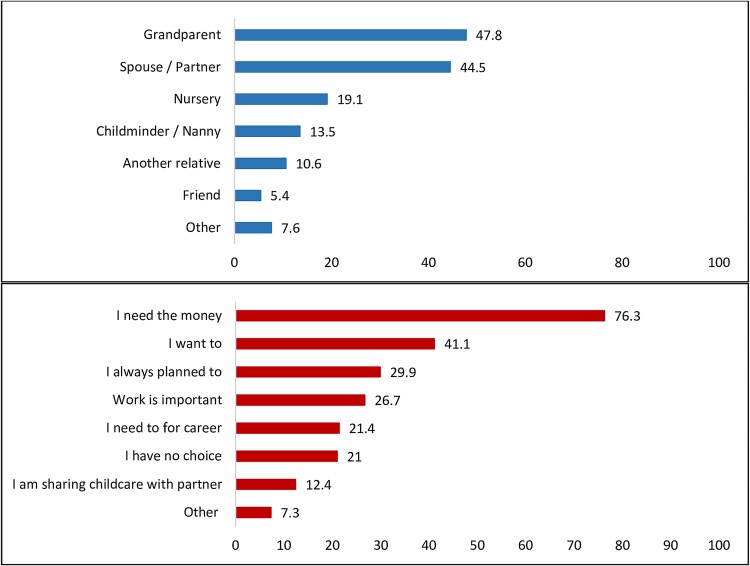
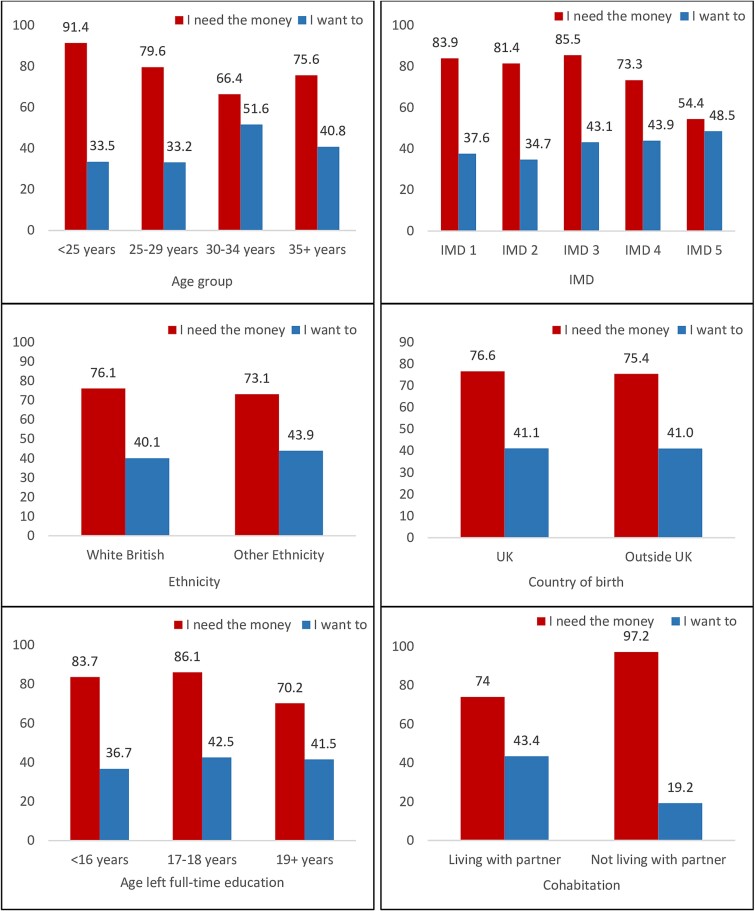
Results: Of the 4313 participants included, 7.7% were in paid work by six months postpartum. Factors associated with being in paid work were age ≥35 years [(adjusted odd ratios (aOR):1.37, 95% confidence interval (CI):1.02-1.84], not living with a partner (aOR:0.50, 95%CI:0.28-0.90), and pre-term birth (aOR:0.38, 95%CI:0.20-0.69). The most frequently reported motivation was financial need (76%), followed by wanting to work (41%). Financial need was associated with younger age, living in a more socioeconomically disadvantaged area, not living with a partner, and lower education level.
Conclusion: Postpartum employment patterns and motivations for working vary according to sociodemographic characteristics. These findings have important implications for parental leave and childcare policies, which should be equitable across different groups.
Keywords: Education; employment and skills; public health; women’s health.
© The Author(s) 2024. Published by Oxford University Press on behalf of Faculty of Public Health.
Conflict of interest statement
The authors declare that they have no competing interests.
Figures
References
-
- Harkness S, Borkowska M, Pelikh A. Employment Pathways and Occupational Change after Childbirth. London: Government Equalities Office, 2019. Available at: https://www.gov.uk/government/publications/employment-pathways-and-occup... (accessed 27 September 2024).
-
- Andrew A, Bandiera O, Costa Dias M et al. The Careers and Time Use of Mothers and Fathers. London: Institute of Fiscal Studies (IFS), 2021. Available from: https://ifs.org.uk/publications/careers-and-time-use-mothers-and-fathers (accessed 27 September 2024).
-
- Heshmati A, Honkaniemi H, Juárez SP. The effect of parental leave on parents’ mental health: a systematic review. Lancet Public Health 2023;8:e57–75. - PubMed
-
- Andres E, Baird S, Bingenheimer JB. et al. Maternity leave access and health: a systematic narrative review and conceptual framework development. Matern Child Health J 2016;20:1178–92. - PubMed
-
- McCardel RE, Loedding EH, Padilla HM. Examining the relationship between return to work after giving birth and maternal mental health: a systematic review. Matern Child Health J 2022;26:1917–43. - PubMed
MeSH terms
Grants and funding
LinkOut - more resources
Full Text Sources
Medical
