


Derivation and validation of the simplified BleedingAudit Triage Trauma (sBATT) score: a simplified trauma score for major trauma patients injured in motor vehicle collisions
- PMID: 39725425
- PMCID: PMC11683913
- DOI: 10.1136/bmjopen-2024-090517
Derivation and validation of the simplified BleedingAudit Triage Trauma (sBATT) score: a simplified trauma score for major trauma patients injured in motor vehicle collisions
Abstract
Objectives: To develop and validate a simplified Bleeding Audit Triage Trauma (sBATT) score for use by lay persons, or in areas and environments where physiological monitoring equipment may be unavailable or inappropriate.
Design: The sBATT was derived from the original BATT, which included prehospital systolic blood pressure (SBP), heart rate, respiratory rate, Glasgow Coma Scale (GCS), age and trauma mechanism. Variables suitable for lay interpretation without monitoring equipment were included (age, level of consciousness, absence of radial pulse, tachycardia and trapped status). The sBATT was validated using data from the UK Trauma Audit Research Network (TARN) registry.
Setting: Data sourced from prehospital observations from multiple trauma systems in the UK.
Participants: 70 027 motor vehicle collision (MVC) patients from the TARN registry (2012-2019). Participants included were those involved in MVCs, with exclusion criteria being incomplete data or non-trauma-related admissions.
Interventions: Not applicable.
Primary and secondary outcome measures: Death within 24 hours of MVC. Secondary: need for trauma intervention.
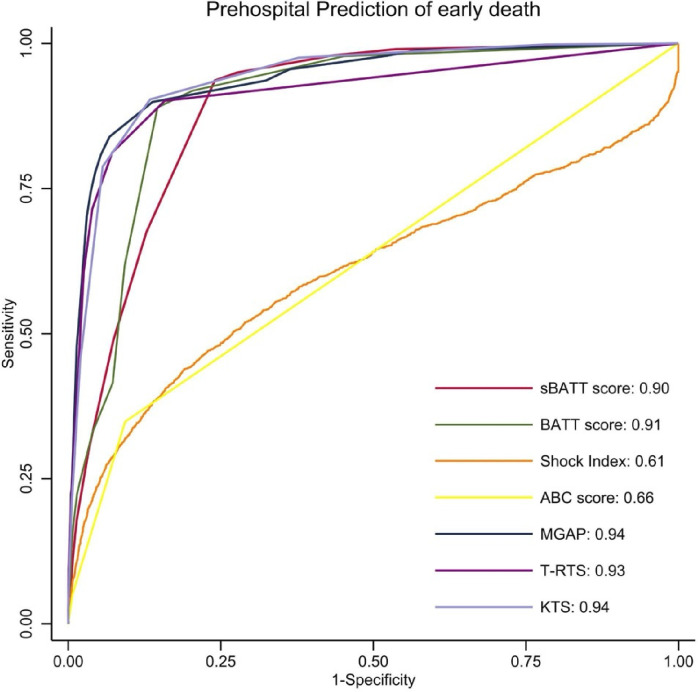
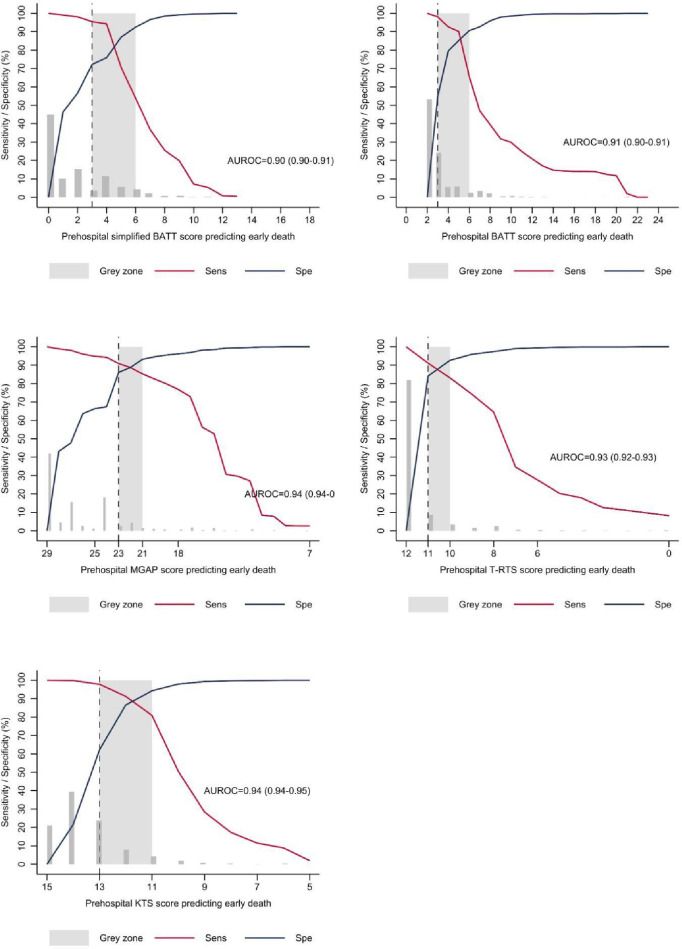
Results: In a cohort of 70 027 MVC patients, 1976 (3%) died within 24 hours. The sBATT showed an area under receiver operating characteristic curve of 0.90 (95% CI: 0.90 to 0.91) for predicting 24-hour mortality, surpassing other trauma scores such as the Shock Index and Assessment of Blood Consumption score. Sensitivity was 96% and specificity 72%, with a negative likelihood ratio below 0.1, indicating strong rule-out capability. Sensitivity analyses confirmed consistent performance across varying SBP and GCS thresholds. The sBATT was equally effective across sexes with no significant predictive discrepancies.
Conclusions: The sBATT is a novel, simplified tool that performs well at predicting early death in the TARN dataset. It demonstrates high predictive accuracy for 24-hour mortality and need for trauma intervention. Further research should validate sBATT in diverse populations and real-world scenarios to confirm its utility and applicability.
Keywords: ACCIDENT & EMERGENCY MEDICINE; TRAUMA MANAGEMENT; Triage.
© Author(s) (or their employer(s)) 2024. Re-use permitted under CC BY-NC. No commercial re-use. See rights and permissions. Published by BMJ Group.
Conflict of interest statement
Competing interests: None declared.
Figures
References
-
- World Health Organization Road traffic injuries. 2021. [31-Dec-2021]. https://www.who.int/news-room/fact-sheets/detail/road-traffic-injuries Available. Accessed.
-
- United Nations General Assembly Adopts Text Proclaiming Decade of Action for Road Safety (2011-2020), Aimed at Reducing Traffic-Related Deaths. Inj. 2010;41:461.
-
- Ndile ML, Lukumay GG, Bolenius K, et al. Impact of a postcrash first aid educational program on knowledge, perceived skills confidence, and skills utilization among traffic police officers: a single-arm before-after intervention study. BMC Emerg Med. 2020;20:21. doi: 10.1186/s12873-020-00317-y. - DOI - PMC - PubMed
Publication types
MeSH terms
LinkOut - more resources
Full Text Sources
