. 2024 Dec 13;14(12):609.
doi: 10.3390/bios14120609.

Establishment of Sample-to-Answer Loop-Mediated Isothermal Amplification-Based Nucleic Acid Testing Using the Sampling, Processing, Incubation, Detection and Lateral Flow Immunoassay Platforms

Affiliations

Establishment of Sample-to-Answer Loop-Mediated Isothermal Amplification-Based Nucleic Acid Testing Using the Sampling, Processing, Incubation, Detection and Lateral Flow Immunoassay Platforms

Lilas Pommiès et al. Biosensors (Basel). .

Abstract

Diagnostics often require specialized equipment and trained personnel in laboratory settings, creating a growing need for point-of-care tests (POCTs). Among the genetic testing methods available, Loop-mediated Isothermal Amplification (LAMP) offers a viable solution for developing genetic POCT due to its compatibility with simplified devices. This study aimed to create a genetic test that integrates all steps from sample processing to analyzing results while minimizing the complexity, handling, equipment, and time required. Several challenges were addressed to achieve this goal: (1) the development of a buffer for bacterial DNA extraction that is compatible with both LAMP and immunochromatographic tests; (2) the adaption of the LAMP protocol for use with the SPID device; and (3) the optimization of the detection protocol for specific test conditions, with a lateral flow immunoassay format selected for its POCT compatibility. Following these developments, the test was validated using Escherichia coli (E. coli) and non-E. coli strains. A portable heating station was also developed to enable amplification without costly equipment. The resulting genetic POCT achieved 100% sensitivity and 85% specificity, with results available in 60 to 75 min. This study demonstrated that our POCT efficiently performs DNA extraction, amplification, and detection for bacterial identification. The test's simplicity and cost-effectiveness will support its implementation in various settings.

Keywords: POCT; genetic detection; sample-to-answer test.


Conflict of interest statement

The SPID device is patented. Hervé Volland is the inventor of this patent (EP3528947).

Figures

Figure 1
Figure 1
Schematic representation of the test strips. The test strip comprises a sample pad, a nitrocellulose membrane, and an absorption pad. The detection zone uses immobilized anti-digoxigenin antibodies as a test line and anti-mouse antibodies or biotinylated BSA as a control line.
Figure 2
Figure 2
The SPID (Sampling, Processing, Incubation, Detection) platform elements. The SPID platform is composed of two parts: (i) the sample processing part, which includes a filtration/concentration unit consisting of a syringe adaptor, a cup, and a lower part and an extraction unit, consisting of a cap and a tank (SPID Device); and (ii) the detection part, which consists of a SPID adaptor to connect the cassette to the tank, and a plastic cassette integrating a lateral flow immunochromatographic strip.
Figure 3
Figure 3
Heating station. The heating station consists of a metal part heated by resistors and adapted to the shape of the tank. The operator has access to the on/off button and a display showing the set temperature, the real-time temperature and the station’s IP address. The IP address can be used to connect to an application to set the desired temperature. All the components are assembled inside a plastic housing.
Figure 4
Figure 4
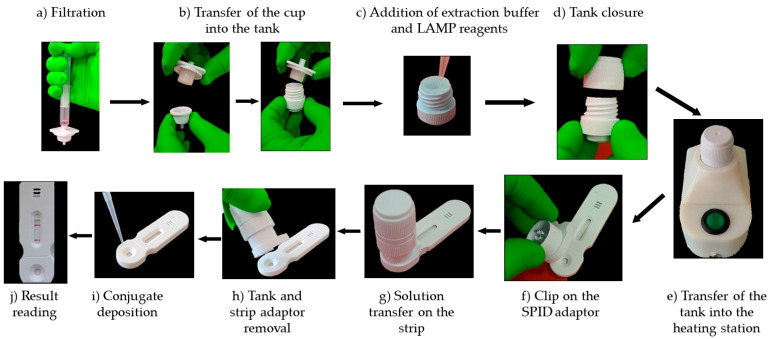
Test workflow. A 1 mL bacterial suspension at 108 CFU/mL is drawn into a syringe and attached to a filtration device. The sample is then pushed through the filter (a). The filter cup is subsequently placed in a tank (b), and 180 μL of LAMP reaction solution is added (c). After sealing the tank (d), the system is heated to 63 °C for 30 min (e). Once heated, the unit is placed onto a SPID adaptor (f,g), which punctures the operculum, allowing the liquid to flow onto a strip for migration (g). After 5 min, the adapter and reservoir are removed (h), and 100 μL of diluted conjugate is applied to the strip (i). Results are visually interpreted after 15 and 30 min (j).
Figure 5
Figure 5
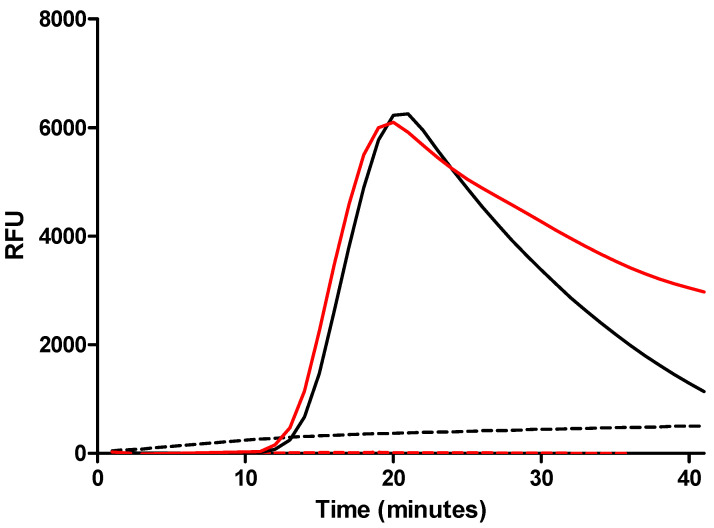
Amplification curves of the malB gene using two primer sets. Black curves: amplification using the primer set developed by Hill et al. [41]; red curves: amplification using the set primer design of the current study. The solid lines correspond to the amplification using E. coli solution at 108 cfu/mL and the dotted lines correspond to the amplification in LB broth. No amplification was observed for the LB broth. For E. coli, amplification began after 10 min of incubation for both primer sets. The amplification curves reached a peak at 20 min and then began to decrease. We observed that the decrease was faster for the primer set used by Hill et al. [41].
Figure 6
Figure 6
Amplification curves for the malB gene. Red curve: amplification of E. coli; blue curve: amplification of C. freundii. No amplification was observed for C. freundii. For E. coli, amplification began after 10 min of incubation. The amplification curve reached a peak at 15 min and then began to decrease.
Figure 7
Figure 7
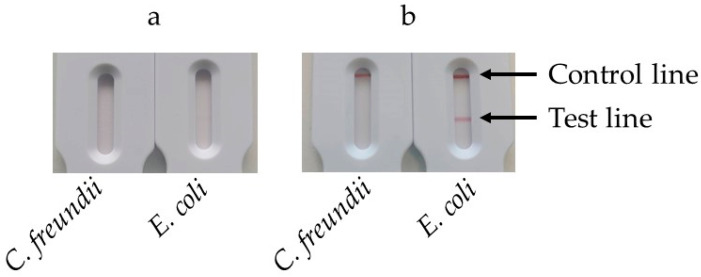
Comparison of streptavidine and mAb anti-biotin as a conjugate. After the extraction/filtration and amplification steps, 10 µL of conjugate was added to the LAMP solution in the tank. The tank was reclosed and pressed onto the SPID adaptor positioned on the cassette. After 30 min the results were read: (a) results using streptavidin–colloïdal gold; (b) results using mAb anti-biotin–colloïdal gold.
Figure 8
Figure 8
Comparison of different methods for the conjugate deposition. (a) One-stage deposition. The tank was opened and 10 µL of either streptavidin or mAb anti-biotin conjugates were added. The tank was reclosed and pressed onto the SPID adaptor positioned on the cassette. (b) Dried conjugate deposition. The conjugate was dried on a Standard 14 membrane which was inserted between the sample pad and the nitrocellulose membrane. The tank was pressed onto the SPID adaptor positioned on the cassette. (c) Two-stage deposition. The tank was pressed onto the SPID adaptor and after 5 min of migration the tank and the SPID adaptor were removed. A volume of 100 µL of diluted conjugate (prepared by mixing 10 µL of conjugate with 90 µL of conjugate buffer) was then applied to the strip. For all these conditions, the results were read after 30 min.
Figure 9
Figure 9
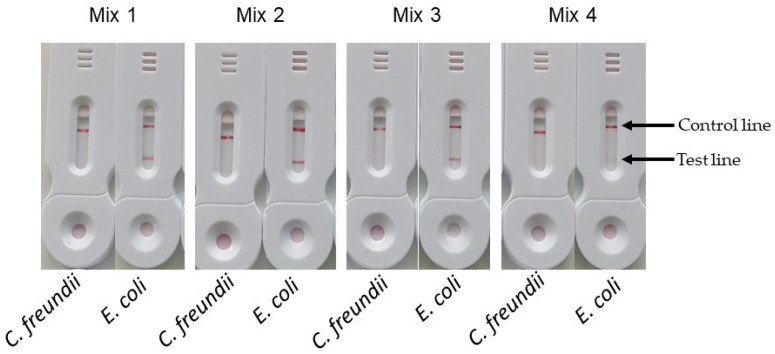
Comparison of different concentrations of FIP–digoxigenin. In this experiment all the primer mixes contained 1.6 µM of BIP–biotin, 0.2 µM of B3 and F3, and 0.4 µM of LB and LF. Mix 1 contained 1.6 µM of FIP–digoxingenin; Mix 2 contained 0.8 µM of FIP–digoxingenin and 0.8 µM of FIP; Mix 3 contained 0.4 µM of FIP–digoxingenin and 1.2 µM of FIP; and mix 4 contained 0.2 µM of FIP–digoxingenin and 1.4 µM of FIP.
Figure 10
Figure 10
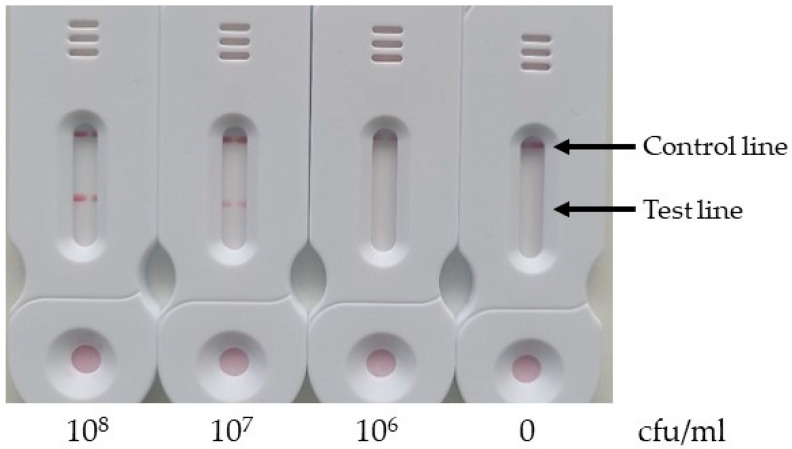
Evaluation of the limit of detection. Different concentrations of E. coli were tested for 30 min of amplification at 63 °C. A test line was visible for the 108 and 107 cfu/mL concentrations.

References

    1. Fu S., Jiang Y., Jiang X., Zhao Y., Chen S., Yang X., Man C. Probe-Free Label System for Rapid Detection of Cronobacter Genus in Powdered Infant Formula. AMB Express. 2018;8:155. doi: 10.1186/s13568-018-0689-x. - DOI - PMC - PubMed
    1. Yager P., Domingo G.J., Gerdes J. Point-of-Care Diagnostics for Global Health. Annu. Rev. Biomed. Eng. 2008;10:107–144. doi: 10.1146/annurev.bioeng.10.061807.160524. - DOI - PubMed
    1. OMS Point of Care Tests. [(accessed on 3 June 2024)]. Available online: https://www.who.int/teams/sexual-and-reproductive-health-and-research-(s....
    1. Land K.J., Boeras D.I., Chen X.-S., Ramsay A.R., Peeling R.W. REASSURED Diagnostics to Inform Disease Control Strategies, Strengthen Health Systems and Improve Patient Outcomes. Nat. Microbiol. 2019;4:46–54. doi: 10.1038/s41564-018-0295-3. - DOI - PMC - PubMed
    1. Wang S., Xu F., Demirci U. Advances in Developing HIV-1 Viral Load Assays for Resource-Limited Settings. Biotechnol. Adv. 2010;28:770–781. doi: 10.1016/j.biotechadv.2010.06.004. - DOI - PMC - PubMed

MeSH terms

Supplementary concepts

LinkOut - more resources