


Decellularized Green and Brown Macroalgae as Cellulose Matrices for Tissue Engineering
- PMID: 39728190
- PMCID: PMC11677820
- DOI: 10.3390/jfb15120390
Decellularized Green and Brown Macroalgae as Cellulose Matrices for Tissue Engineering
Abstract
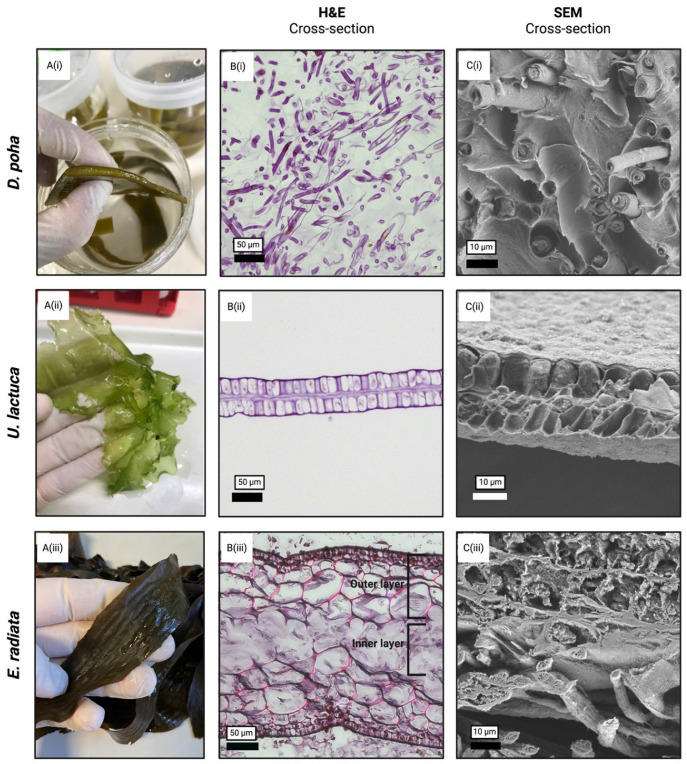
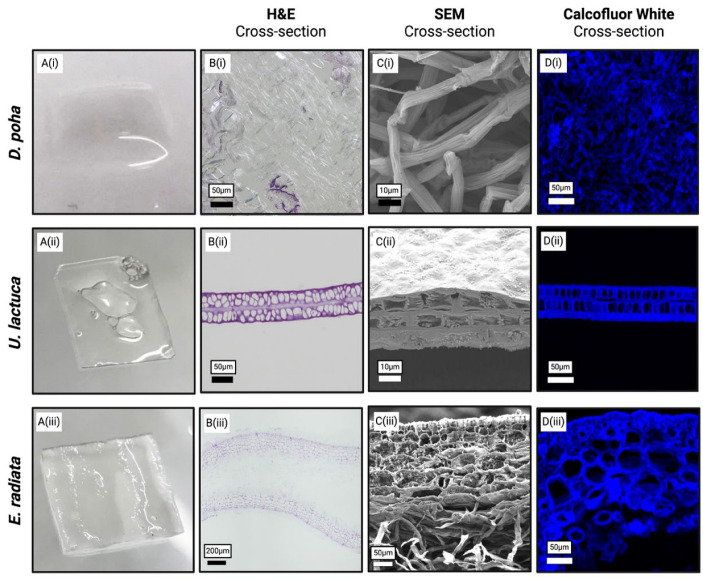
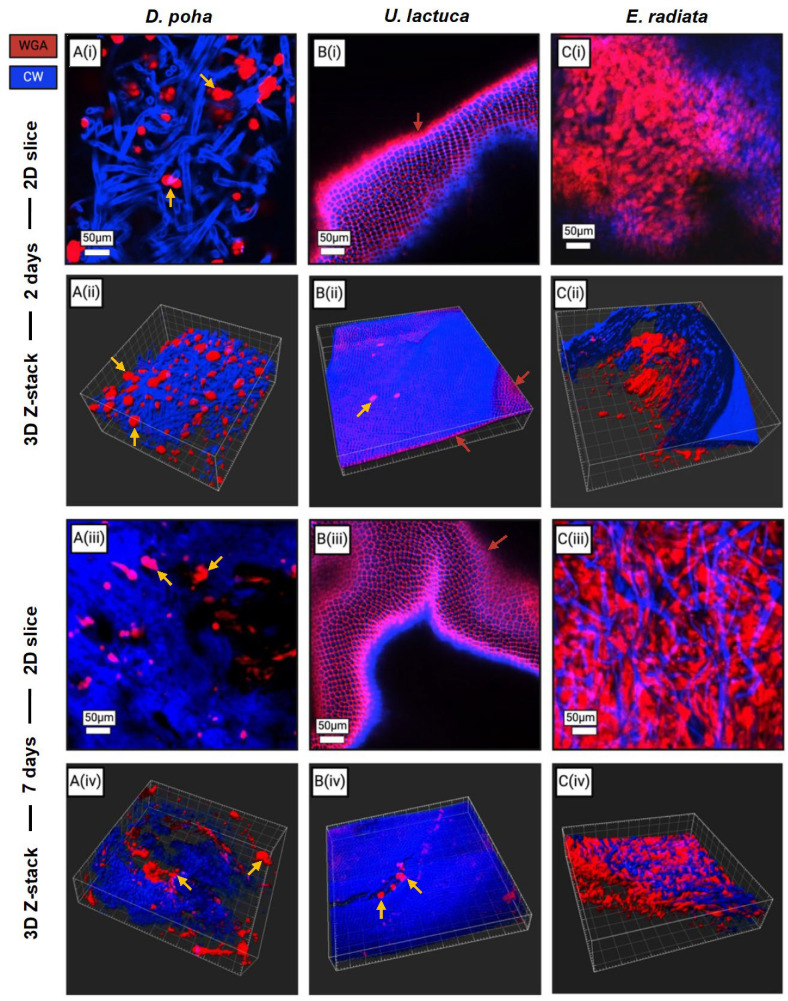
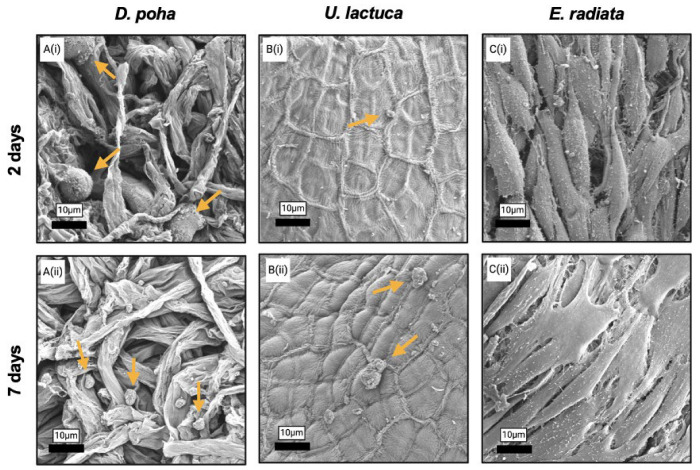
Scaffolds resembling the extracellular matrix (ECM) provide structural support for cells in the engineering of tissue constructs. Various material sources and fabrication techniques have been employed in scaffold production. Cellulose-based matrices are of interest due to their abundant supply, hydrophilicity, mechanical strength, and biological inertness. Terrestrial and marine plants offer diverse morphologies that can replicate the ECM of various tissues and be isolated through decellularization protocols. In this study, three marine macroalgae species-namely Durvillaea poha, Ulva lactuca, and Ecklonia radiata-were selected for their morphological variation. Low-intensity, chemical treatments were developed for each species to maintain native cellulose structures within the matrices while facilitating the clearance of DNA and pigment. Scaffolds generated from each seaweed species were non-toxic for human dermal fibroblasts but only the fibrous inner layer of those derived from E. radiata supported cell attachment and maturation over the seven days of culture. These findings demonstrate the potential of E. radiata-derived cellulose scaffolds for skin tissue engineering and highlight the influence of macroalgae ECM structures on decellularization efficiency, cellulose matrix properties, and scaffold utility.
Keywords: cellulose; decellularization; fibroblast; macroalgae; matrix; scaffold; seaweed; skin; tissue engineering.
Conflict of interest statement
The authors declare that the research was conducted in the absence of any commercial or financial relationships that could be construed as a potential conflict of interest.
Figures
References
-
- Lanza R., Langer R., Vacanti J.P., Atala A., editors. Principles of Tissue Engineering. 5th ed. Academic Press; Cambridge, MA, USA: 2020. pp. 1–1635.
-
- O’Brien F.J. Biomaterials & scaffolds for tissue engineering. Mater. Today. 2011;14:88–95. doi: 10.1016/S1369-7021(11)70058-X. - DOI
-
- Rahmati M., Mills D.K., Urbanska A.M., Saeb M.R., Venugopal J.R., Ramakrishna S., Mozafari M. Electrospinning for tissue engineering applications. Prog. Mater. Sci. 2021;117:100721. doi: 10.1016/j.pmatsci.2020.100721. - DOI
Grants and funding
LinkOut - more resources
Full Text Sources
