


Impact of Baseline Hypoalbuminemia on Long-Term Survival Following Acute Myocardial Infarction According to Body Mass Index
- PMID: 39728268
- PMCID: PMC11676636
- DOI: 10.3390/jcdd11120378
Impact of Baseline Hypoalbuminemia on Long-Term Survival Following Acute Myocardial Infarction According to Body Mass Index
Abstract
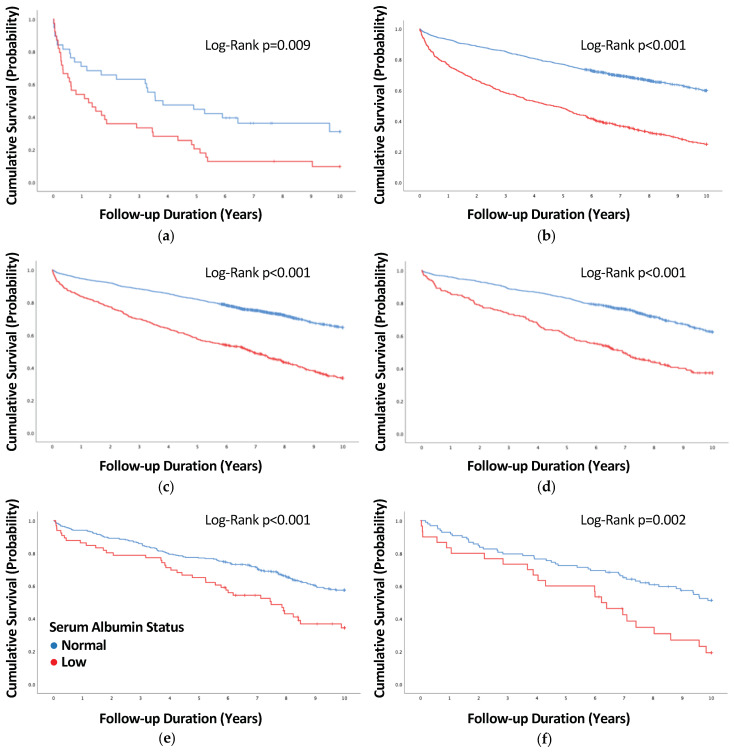
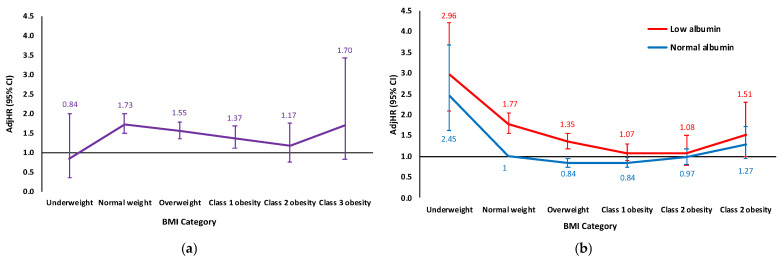
Serum albumin and body mass index (BMI, kg/m2) have been associated with outcomes following acute myocardial infarction (AMI). Aiming to assess whether the mortality risk inflicted by hypoalbuminemia (<3.5 g/dL) in this context is influenced by BMI, we conducted a retrospective analysis of AMI survivors hospitalized during 2004-2017. Stratified by admission-time albumin level and BMI, eligible cases were evaluated for all-cause mortality up to 10 years after discharge. A total of 6283 individuals (74.1% males, mean age 64.1 ± 13.1 years, 44.3% with ST-elevation MI) were included. Of them, 22.7% had hypoalbuminemia and 1.2%, 41.0%, and 28.6% were underweight (BMI < 18.5), overweight (BMI 25-30), and obese (BMI ≥ 30), respectively. Over a median of 7.9 (IQR, 4.8-10.0) years of follow-up, 42.5% of patients died. Hypoalbuminemia was independently associated with a heightened mortality risk overall (AdjHR = 1.54, 95%CI 1.42-1.67, p < 0.001), accounted for by the normal weight (AdjHR = 1.73, 95%CI 1.50-1.99, p < 0.001), overweight (AdjHR = 1.55, 95%CI 1.35-1.79, p < 0.001), and class 1 obesity (BMI 30-35) (AdjHR = 1.37, 95%CI 1.12-1.68, p = 0.002) subgroups. Upon interaction analysis, the mortality risk imposed by hypoalbuminemia was most pronounced among individuals with normal BMI. In conclusion, hypoalbuminemia constituted a negative prognostic marker for long-term survival in AMI patients with normal or mildly elevated but not reduced or severely increased BMI. Pending further research, addressing hypoalbuminemia based on BMI range may prove beneficial.
Keywords: albumin; body mass index; myocardial infarction; survival.
Conflict of interest statement
The authors declare no conflicts of interest.
Figures
References
-
- Sujino Y., Tanno J., Nakano S., Funada S., Hosoi Y., Senbonmatsu T., Nishimura S. Impact of Hypoalbuminemia, Frailty, and Body Mass Index on Early Prognosis in Older Patients (≥ 85 years) with ST-Elevation Myocardial Infarction. J. Cardiol. 2015;66:263–268. doi: 10.1016/j.jjcc.2014.12.001. - DOI - PubMed
-
- Herrmann J., Gersh B.J., Goldfinger J.Z., Witzenbichler B., Guagliumi G., Dudek D., Kornowski R., Brener S.J., Parise H., Fahy M., et al. Body Mass Index and Acute and Long-Term Outcomes After Acute Myocardial Infarction (from the Harmonizing Outcomes with Revascularization and Stents in Acute Myocardial Infarction Trial) Am. J. Cardiol. 2014;114:9–16. doi: 10.1016/j.amjcard.2014.03.057. - DOI - PubMed
-
- Nelson J.J., Liao D., Sharrett A.R., Folsom A.R., Chambless L.E., Shahar E., Szklo M., Eckfeldt J., Heiss G. Serum Albumin Level as a Predictor of Incident Coronary Heart Disease: The Atherosclerosis Risk in Communities (ARIC) Study. Am. J. Epidemiol. 2000;151:468–477. doi: 10.1093/oxfordjournals.aje.a010232. - DOI - PubMed
LinkOut - more resources
Full Text Sources
