


Heavy Metals and Associated Risks of Wild Edible Mushrooms Consumption: Transfer Factor, Carcinogenic Risk, and Health Risk Index
- PMID: 39728340
- PMCID: PMC11676395
- DOI: 10.3390/jof10120844
Heavy Metals and Associated Risks of Wild Edible Mushrooms Consumption: Transfer Factor, Carcinogenic Risk, and Health Risk Index
Abstract
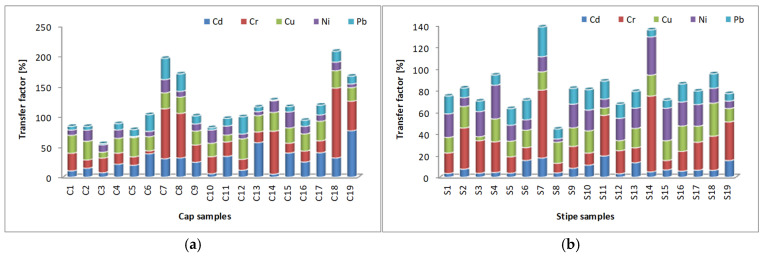
This research aims to investigate the heavy metals (i.e., Cd, Cr, Cu, Ni, and Pb) in the fruiting bodies of six indigenous wild edible mushrooms including Agaricus bisporus, Agaricus campestris, Armillaria mellea, Boletus edulis, Macrolepiota excoriate, and Macrolepiota procera, correlated with various factors, such as the growth substrate, the sampling site, the species and the morphological part (i.e., cap and stipe), and their possible toxicological implications. Heavy metal concentrations in mushroom (228 samples) and soil (114 samples) were determined by Inductively Coupled Plasma-Mass Spectrometry (ICP-MS). In the first part of the study, the soil contamination (index of geo-accumulation, contamination factor, and pollution loading index) and associated risks (chronic daily dose for three exposure pathways-ingestion, dermal, and inhalation; hazard quotient of non-cancer risks and the carcinogenic risks) were calculated, while the phytoremediation capacity of the mushrooms was determined. At the end of these investigations, it was concluded that M. procera accumulates more Cd and Cr (32.528% and 57.906%, respectively), M. excoriata accumulates Cu (24.802%), B. edulis accumulates Ni (22.694%), and A. mellea accumulates Pb (18.574%), in relation to the underlying soils. There were statistically significant differences between the stipe and cap (i.e., in the cap subsamples of M. procera, the accumulation factor for Cd was five times higher than in the stipe subsamples). The daily intake of toxic metals related to the consumption of these mushrooms with negative consequences on human health, especially for children (1.5 times higher than for adults), was determined as well.
Keywords: Bucegi National Reservation; carcinogenic risk; daily intake metals; estimated daily intake; health risk index; industrial area; touristic area; transfer factor; wild edible mushrooms.
Conflict of interest statement
The authors declare no conflicts of interest.
Figures
References
-
- Wasser S. Medicinal mushrooms as a source of antitumor and immunomodulating polysaccharides. Appl. Microbiol. Biotechnol. 2002;60:258–274. - PubMed
-
- Nowakowski P., Markiewicz-Zukowska R., Gromkowska-Kępka K., Naliwajko S.K., Moskwa J., Bielecka J., Socha K. Mushrooms as potential therapeutic agents in the treatment of cancer: Evaluation of anti-glioma effects of Coprinus comatus, Cantharellus cibarius, Lycoperdon perlatum and Lactarius deliciosus extracts. Biomed. Pharmacother. 2021;133:111090. doi: 10.1016/j.biopha.2020.111090. - DOI - PubMed
Grants and funding
LinkOut - more resources
Full Text Sources
Miscellaneous
