


Pyridoxine Prevents Postoperative Nausea and Vomiting in Gynecologic Laparoscopic Surgery: A Double-blind Randomized Controlled Trial
- PMID: 39729294
- PMCID: PMC11892996
- DOI: 10.1097/ALN.0000000000005354
Pyridoxine Prevents Postoperative Nausea and Vomiting in Gynecologic Laparoscopic Surgery: A Double-blind Randomized Controlled Trial
Abstract
Background: Postoperative nausea and vomiting are common complications after gynecologic laparoscopic surgery. Pyridoxine has been recommended as a first-line drug to prevent and treat nausea and vomiting during pregnancy; however, its efficacy in preventing postoperative nausea and vomiting remains unclear.
Methods: Patients of 18 to 65 yr old who received elective gynecologic laparoscopic surgery under general anesthesia were randomized into either the pyridoxine group or the control group. The pyridoxine group received 0.2 g of vitamin B 6 before anesthesia induction, and the control group received normal saline intravenously. Both groups received a similar regimen of combined intravenous and inhalation general anesthesia. All patients received dexamethasone (intravenous) after anesthesia induction and ondansetron (intravenous) before surgery completion. Postoperative nausea and vomiting occurrence was recorded according to the patients' self-reported data. Other clinical data were collected from hospital system, and concentrations of blood interleukin-6 and substance P were measured by enzyme-linked immunosorbent assay.
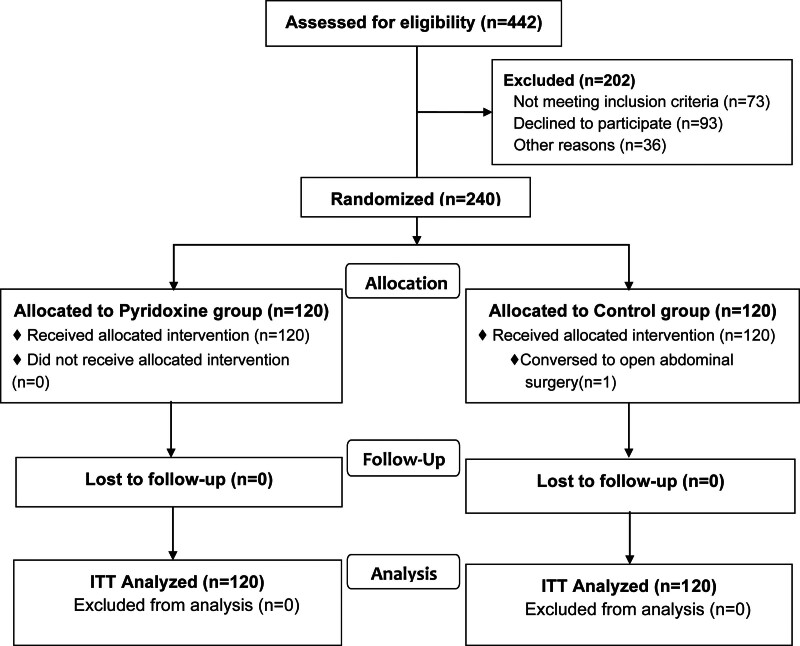
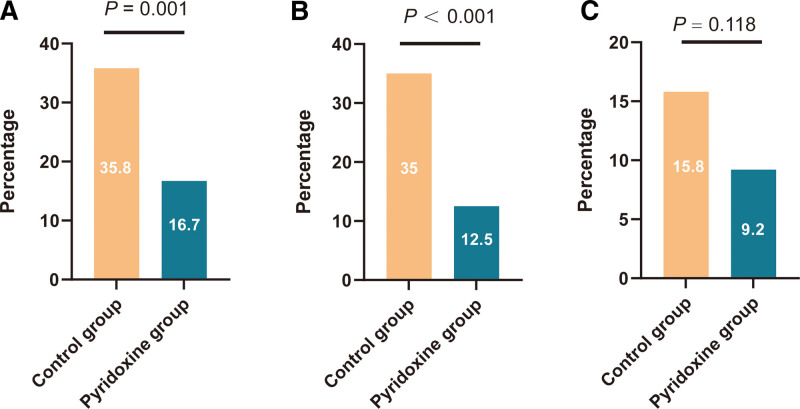
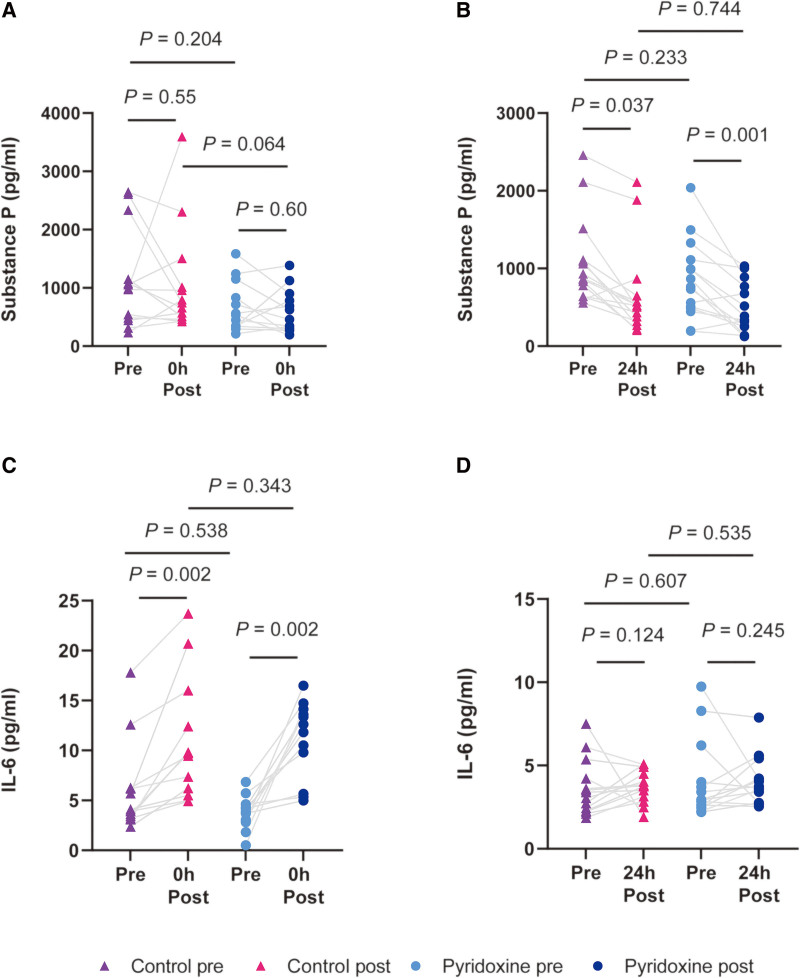
Results: A total of 442 patients were screened, and 240 patients were equally randomized to the pyridoxine or control group. The incidence of postoperative nausea and vomiting was statistically significant lower in the pyridoxine group than in the control group (16.7% [20 of 120] vs . 35.8% [43 of 120]; relative risk = 0.47 [95% CI, 0.29 to 0.74]; absolute risk reduction = 0.20 [95% CI, 0.08 to 0.30]; P = 0.001), and pyridoxine decreased the incidence of postoperative nausea (12.5% [15 of 120] vs . 35% [42 of 120]; relative risk = 0.36 [95% CI, 0.21 to 0.61]; absolute risk reduction = 0.23 [95% CI, 0.12 to 0.33]; P < 0.001). There were no statistical differences in postoperative vomiting, time to the first postoperative nausea and vomiting occurrence, pain, serum interleukin-6 and substance P, and leukocyte and neutrophil counts.
Conclusions: In this single-center randomized trial, pyridoxine plus dexamethasone and ondansetron reduced the incidence of postoperative nausea and vomiting in patients undergoing elective gynecologic laparoscopic surgery under general anesthesia. These findings need to be validated in multicenter studies in diverse populations to ensure generalizability.
Copyright © 2024 The Author(s). Published by Wolters Kluwer Health, Inc., on behalf of the American Society of Anesthesiologists.
Conflict of interest statement
The authors declare no competing interests.
The article processing charge was funded by the National Natural Science Foundation of China, Hunan Province Key Research and Development Plan, and Scientific Research Fund of Hunan Provincial Education Department.
Figures
References
-
- Meara JG, Leather AJM, Hagander L, et al. : Global Surgery 2030: Evidence and solutions for achieving health, welfare, and economic development. Lancet 2015; 386:569–624 - PubMed
-
- Apfel CC, Läärä E, Koivuranta M, Greim CA, Roewer N: A simplified risk score for predicting postoperative nausea and vomiting: Conclusions from cross-validations between two centers. Anesthesiology 1999; 91:693–700 - PubMed
-
- Gan TJ, Diemunsch P, Habib AS, et al. : Consensus guidelines for the management of postoperative nausea and vomiting. Anesth Analg 2014; 118:85–113 - PubMed
-
- Ionescu DC, Hadade AI, Mocan TA, Margarit SD: The influence of a prophylactic dose of dexamethasone for postoperative nausea and vomiting on plasma interleukin concentrations after laparoscopic cholecystectomy: A randomised trial. Eur J Anaesthesiol 2014; 31:204–11 - PubMed
Publication types
MeSH terms
Substances
LinkOut - more resources
Full Text Sources
Medical
