Clinical Trial
. 2025 Jan 21;6(1):101879.
doi: 10.1016/j.xcrm.2024.101879. Epub 2024 Dec 26.

Hormone therapy enhances anti-PD1 efficacy in premenopausal estrogen receptor-positive and HER2-negative advanced breast cancer

Affiliations
Clinical Trial

Hormone therapy enhances anti-PD1 efficacy in premenopausal estrogen receptor-positive and HER2-negative advanced breast cancer

I-Chun Chen et al. Cell Rep Med. .

Abstract

The efficacy of immunotherapy for estrogen receptor-positive/HER2-negative (ER+/HER2-) metastatic breast cancer (MBC) has not been proven. We conduct a phase 1b/2 trial to assess the efficacy of combining pembrolizumab (anti-PD1 antibody), exemestane (nonsteroidal aromatase inhibitor), and leuprolide (gonadotropin-releasing hormone agonist) for 15 patients with premenopausal ER+/HER2- MBC who had failed one to two lines of hormone therapy (HT) without chemotherapy. The primary endpoint of progression-free survival rate at 8 months (i.e., 64.3%) is achieved. Moreover, 5 of the 14 evaluable subjects exhibited partial responses (overall response rate = 35.7%). The combination of anti-PD1 antibody and anti-hormone therapy is associated with an enhanced immunoreactive microenvironment influencing treatment efficacy, as observed in pre- and post-treatment tumor samples through NanoString analysis. Post-treatment tumors are associated with increased immune response and immune cells. The findings indicate that combining HT with anti-PD1 antibody is a promising treatment strategy for patients with premenopausal ER+/HER2- MBC. This study was registered at ClinicalTrials.gov (NCT02990845).

Keywords: cancer; estrogen; estrogen suppression; gonadotropin-releasing hormone agonits; hormone therapy; immune cell infiltration; immunotherapy; luminal subtype; metastatic breast cancer; receptor positive/HER2 negative; tumor microenvironment.


Conflict of interest statement

Declaration of interests I.-C.C. received honoraria from AstraZeneca, Daiichi Sankyo, Gilead, Merck Sharp & Dohme, Novartis, Pfizer, and Sanofi and received research grants from AstraZeneca, Merck Sharp & Dohme, and Novartis. D.-Y.C. received honoraria from Amgen, AstraZeneca, Daiichi Sankyo, Eisai, Eli Lilly, MSD, Novartis, ONO Pharma, Pierre Faber, Pfizer, Roche, Sanofi, and TTY Biopharm. T.W.-W.C. received honoraria from Roche, Novartis, Eli Lilly, Eisai, Pfizer, Daiichi Sankyo, and AstraZeneca. Y.-S.L. received honoraria from Merck Sharp & Dohme and Pfizer and received research grants from Merck Sharp & Dohme and Pfizer.

Figures

None
Graphical abstract
Figure 1
Figure 1
CONSORT study flow diagram: Total number of patients screened, excluded, enrolled, and evaluable in the study Exclusion reasons were specified at different stages. HBsAg, hepatitis B surface antigen; AST, aspartate aminotransferase; ALT, alanine aminotransferase; ULN, upper limits of normal range; TNBC, triple-negative breast cancer.
Figure 2
Figure 2
Clinical outcomes of treated patients (A) PFS estimates for evaluable subjects (N = 14) from the commencement of the study, with dotted lines representing the 95% confidence intervals. (B) Waterfall plot summarizing the maximal change in tumor size from baseline among patients with evaluable disease (N = 14). Bar colors depict different best overall responses based on RECIST 1.1. Blue bars represent partial response (PR), yellow bars indicate stable disease, and red bars represent progressive disease. Additional indicators include PD-L1 (PD-L1 score %), TIL% (tumor-infiltrating lymphocyte %), Mt per Mb (mutations per megabyte), and PD@8M (progressive disease at 8 months), denoted by white (not progressed at 8 months) and gray (progressed at 8 months) boxes. PAM50 represents PAM50 subtypes; A, luminal A; B, luminal B; H, HER2− enriched; NA, not available. (C) OS estimates for evaluable subjects (N = 14) from the commencement of the study, with dotted lines representing the 95% confidence intervals. (D) Swimmer plot summarizing the duration of response for evaluable subjects (N = 14). Blue circle represents partial response (PR), yellow triangle indicates stable disease, and red square represents progressive disease. Arrow represents still alive at the time of follow-up.
Figure 3
Figure 3
Pre-treatment and post-treatment RNA profiling derived from NanoString BC360 and PanCancer IO360 panels (A) Immune-related gene signatures. (B) Immune cell-related signatures. (C) HLA-related gene expression levels. (D) CD8 T cell-related gene signatures from samples collected before treatment (Pre, n = 12) and after treatment before cycle 3 (C3, n = 5). Paired comparisons of samples collected after 2 cycles of treatment (C3, n = 5) and before treatment (baseline, n = 5) are summarized in (E–H). (E–H) Genes upregulated in samples collected before cycle 3 and at baseline; (F) CD45 expression levels; (G) NK45 dim expression levels; (H) TH1 cells expression levels.
Figure 4
Figure 4
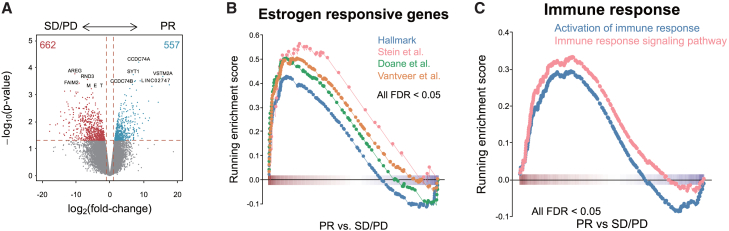
RNA-seq analysis from samples collected before treatment based on treatment response (A) Volcano plot of DEGs between responder and non-responder groups. With log2 (fold change) as the x axis and log10 (p.adj) as the y axis, the volcano plot was constructed according to the gene expression level. The red dots indicate upregulated genes in patients with SD/PD (N = 5), blue dots indicate upregulated genes in patients with PR (N = 5), and black dots indicate non-significant differentially expressed genes. Gene set enrichment analysis of DEGs. (B) Estrogen-responsive genes. (C) Immune response gene. DEGs, differentially expressed genes; PD, progressive disease; PR, partial response; SD, stable disease.

References

    1. Sun Q., Hong Z., Zhang C., Wang L., Han Z., Ma D. Immune checkpoint therapy for solid tumours: clinical dilemmas and future trends. Signal Transduct. Target. Ther. 2023;8:320. doi: 10.1038/s41392-023-01522-4. - DOI - PMC - PubMed
    1. Schmid P., Cortes J., Dent R., Pusztai L., McArthur H., Kümmel S., Bergh J., Denkert C., Park Y.H., Hui R., et al. Event-free Survival with Pembrolizumab in Early Triple-Negative Breast Cancer. N. Engl. J. Med. 2022;386:556–567. doi: 10.1056/NEJMoa2112651. - DOI - PubMed
    1. Mittendorf E.A., Zhang H., Barrios C.H., Saji S., Jung K.H., Hegg R., Koehler A., Sohn J., Iwata H., Telli M.L., et al. Neoadjuvant atezolizumab in combination with sequential nab-paclitaxel and anthracycline-based chemotherapy versus placebo and chemotherapy in patients with early-stage triple-negative breast cancer (IMpassion031): a randomised, double-blind, phase 3 trial. Lancet (London, England) 2020;396:1090–1100. doi: 10.1016/s0140-6736(20)31953-x. - DOI - PubMed
    1. Schmid P., Adams S., Rugo H.S., Schneeweiss A., Barrios C.H., Iwata H., Diéras V., Hegg R., Im S.A., Shaw Wright G., et al. Atezolizumab and Nab-Paclitaxel in Advanced Triple-Negative Breast Cancer. N. Engl. J. Med. 2018;379:2108–2121. doi: 10.1056/NEJMoa1809615. - DOI - PubMed
    1. Cortes J., Cescon D.W., Rugo H.S., Nowecki Z., Im S.A., Yusof M.M., Gallardo C., Lipatov O., Barrios C.H., Holgado E., et al. Pembrolizumab plus chemotherapy versus placebo plus chemotherapy for previously untreated locally recurrent inoperable or metastatic triple-negative breast cancer (KEYNOTE-355): a randomised, placebo-controlled, double-blind, phase 3 clinical trial. Lancet (London, England) 2020;396:1817–1828. doi: 10.1016/s0140-6736(20)32531-9. - DOI - PubMed

Publication types

MeSH terms

Associated data