


Emergence of multiple spontaneous coherent subnetworks from a single configuration of human connectome coupled oscillators model
- PMID: 39730441
- PMCID: PMC11680896
- DOI: 10.1038/s41598-024-80510-2
Emergence of multiple spontaneous coherent subnetworks from a single configuration of human connectome coupled oscillators model
Abstract
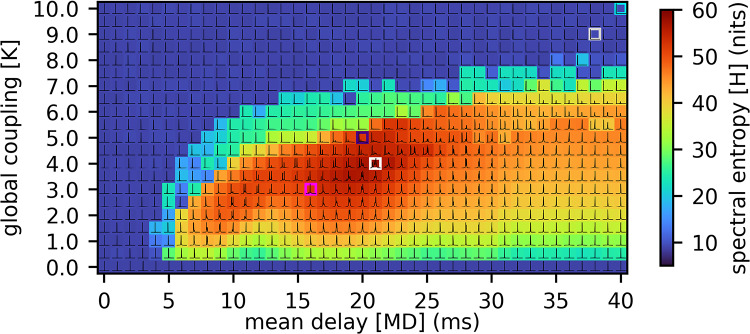
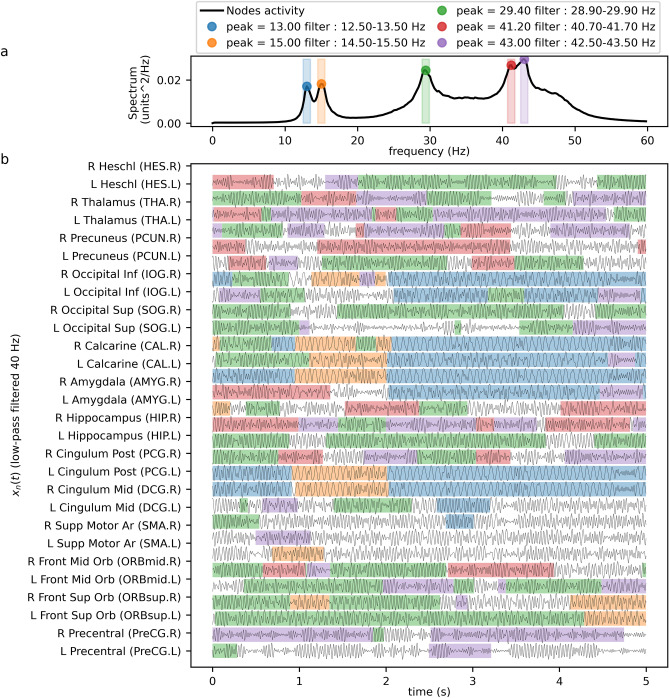
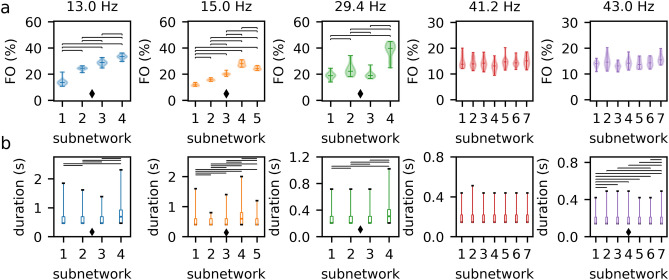
Multi-state metastability in neuroimaging signals reflects the brain's flexibility to transition between network configurations in response to changing environments or tasks. We modeled these dynamics with a Kuramoto network of 90 nodes oscillating at an intrinsic frequency of 40 Hz, interconnected using human brain structural connectivity strengths and delays. We simulated this model for 30 min to generate multi-state metastability. We identified global coupling and delay parameters that maximize spectral entropy, a proxy for multi-state metastability. At this operational point, multiple frequency-specific coherent sub-networks spontaneously emerge across oscillatory modes, persisting for periods between 140 and 4300 ms, reflecting flexible and sustained dynamic states. The topography of these sub-networks aligns with empirical resting-state neuroimaging data. Additionally, periodic components of the EEG spectra from young healthy participants correlate with maximal multi-state metastability, while dynamics away from this point correlate with sleep and anesthesia spectra. Our findings suggest that multi-state metastable functional dynamics observed in empirical data emerge from specific interactions of structural topography and connection delays, providing a platform to study mechanisms underlying flexible dynamics of cognition.
© 2024. The Author(s).
Conflict of interest statement
Declarations. Competing interests: The authors declare that they not have competing financial interests or personal relationships that could have appeared to influence this work.
Figures

References
-
- Cabral, J., Hugues, E., Sporns, O. & Deco, G. Role of local network oscillations in resting-state functional connectivity. NeuroImage57, 130–139. 10.1016/j.neuroimage.2011.04.010 (2011). - PubMed
-
- Breakspear, M. Dynamic models of large-scale brain activity. Nat. Neurosci.20, 340–352. 10.1038/nn.4497 (2017). - PubMed
-
- Menon, V. Large-scale brain networks and psychopathology: A unifying triple network model. Trends Cognit. Sci.15, 483–506. 10.1016/j.tics.2011.08.003 (2011). - PubMed
-
- Bullmore, E. & Sporns, O. Complex brain networks: Graph theoretical analysis of structural and functional systems. Nat. Rev. Neurosci.10, 186–198. 10.1038/nrn2575 (2009). - PubMed
MeSH terms
Grants and funding
- FONDECYT Postdoctorado 3230682/Agencia Nacional de Investigación y Desarrollo
- BASAL FB210008/Agencia Nacional de Investigación y Desarrollo
- FONDECYT 1231132/Agencia Nacional de Investigación y Desarrollo
- Anillo ACT210053/Agencia Nacional de Investigación y Desarrollo
- NIHR203308/NIHR Manchester Biomedical Research Centre
LinkOut - more resources
Full Text Sources
