


Appnome analysis reveals small or no associations between social media app-specific usage and adolescent well-being
- PMID: 39730518
- PMCID: PMC11681177
- DOI: 10.1038/s41598-024-81665-8
Appnome analysis reveals small or no associations between social media app-specific usage and adolescent well-being
Abstract
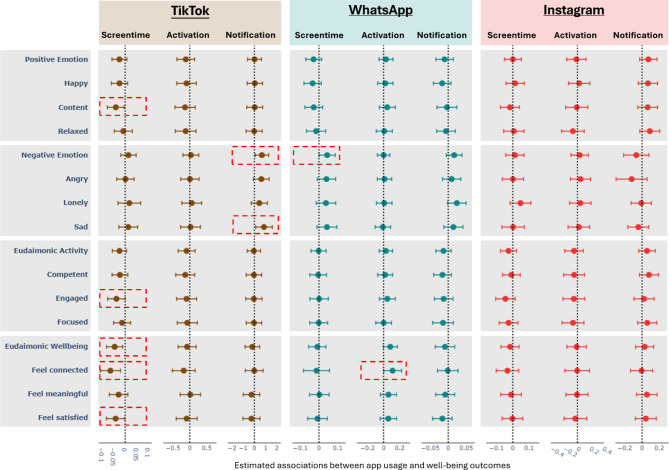
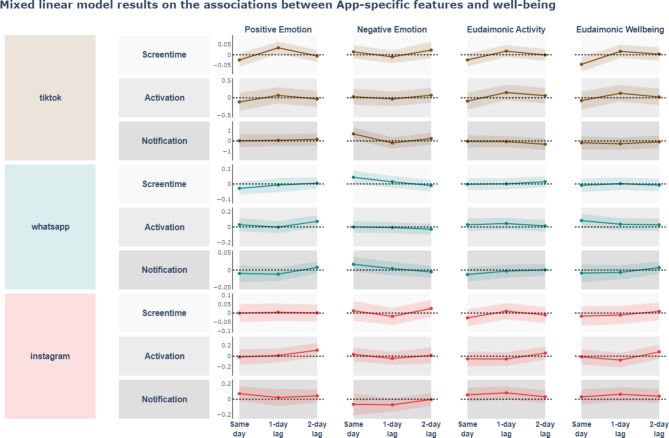
The debate on how social media use (SMU) influences adolescent well-being is mostly based on self-reports of SMU. By collecting data and screenshots donated from 374 Swiss adolescents (Meanage = 15.71; SDage = 0.82) over 2 weeks, we created "Appnomes"-app-specific usage metrics on screentime, number of activations, and number of notifications per participant per day derived, and associated them with daily hedonic and eudaimonic well-being. Longer TikTok time predicted lower eudaimonic well-being (β = - 0.08) daily but higher positive emotions (β = 0.06) the next day; longer use of WhatsApp predicted negative emotions (β = 0.06) while more screen activations for WhatsApp predicted greater feelings of connection (β = 0.08). Instagram notification was positively related to increased feeling of focused (β = 0.06) the next day. YouTube screen unlocks predicted more feeling of meaning (β = 0.07) the next day. More Snapchat screentime predicted less relaxed, less competent, and less positive emotions (with - 0.07 < β < - 0.06). Results pointed towards minimal or no effects, challenging the moral panic on the detrimental impact of SMU on teen well-being.
Keywords: Adolescents; Longitudinal; Screenshot; Social media use; Temporality; Well-being.
© 2024. The Author(s).
Conflict of interest statement
Declarations. Competing interests: The authors declare no competing interests.
Figures
References
-
- Massarat, E. A. V., Risa Gelles Watnick and Navid, Teens & Social Media and Technology. Pew Research Center: Internet, Science & Tech. August 10, 2022. Accessed March 23, 2024. https://www.pewresearch.org/internet/2022/08/10/teens-social-media-and-t... (2022).
-
- Külling, C. et al. JAMES: Jugend, Aktivitäten, Medien – Erhebung Schweiz. Published online 2022. 10.21256/zhaw-26216.
-
- Handa, S., Pereira, A. & Holmqvist, G. The Rapid decline of happiness: exploring life satisfaction among Young people across the World. Appl. Res. Qual. Life. 18(3), 1549–1579. 10.1007/s11482-023-10153-4 (2023). - DOI
-
- CDC. Youth Risk Behavior Surveillance Data Summary & Trends Report: 2011–2021. Published online 2021. https://www.cdc.gov/healthyyouth/data/yrbs/pdf/YRBS_Data-Summary-Trends_....
-
- UNICEF. Youth Mental Health, Study on the situation in Switzerland and Liechtenstein. Accessed May 20, 2024. https://www.unicef.ch/en/our-work/switzerland-liechtenstein/mental-health (2022).
MeSH terms
Grants and funding
LinkOut - more resources
Full Text Sources
