


Decoding the physicochemical basis of resurrection: the journey of lichen Flavoparmelia caperata through prolonged water scarcity to full rehydration
- PMID: 39730993
- PMCID: PMC11681686
- DOI: 10.1186/s12870-024-05751-9
Decoding the physicochemical basis of resurrection: the journey of lichen Flavoparmelia caperata through prolonged water scarcity to full rehydration
Abstract
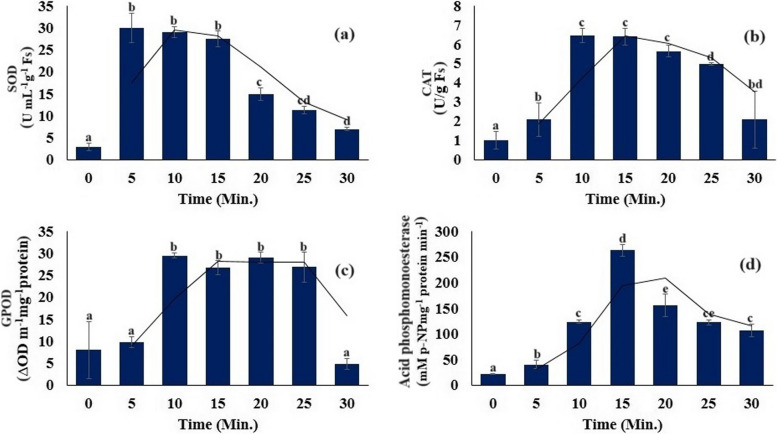
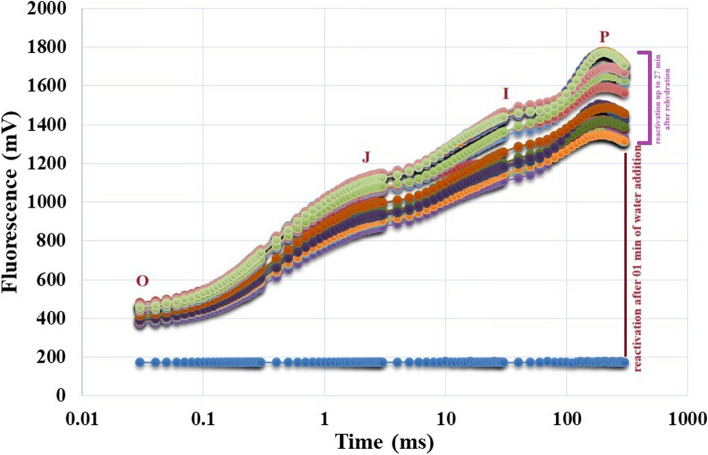
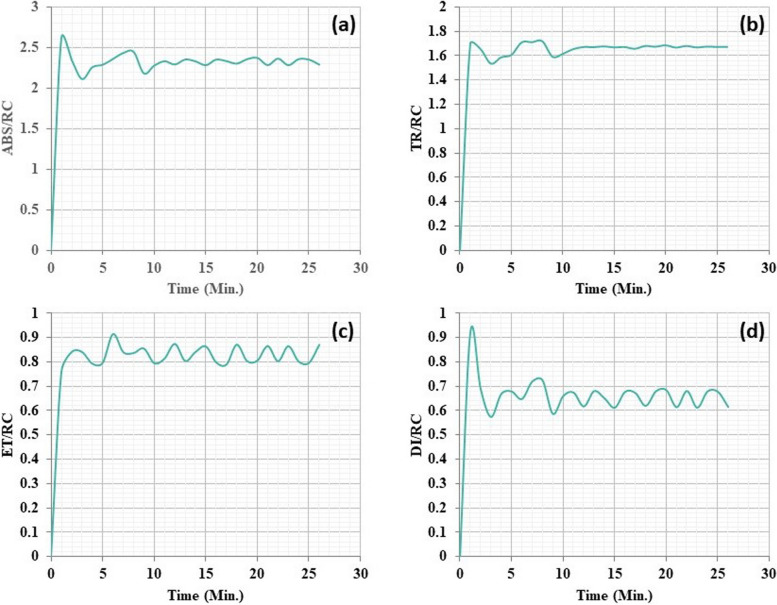
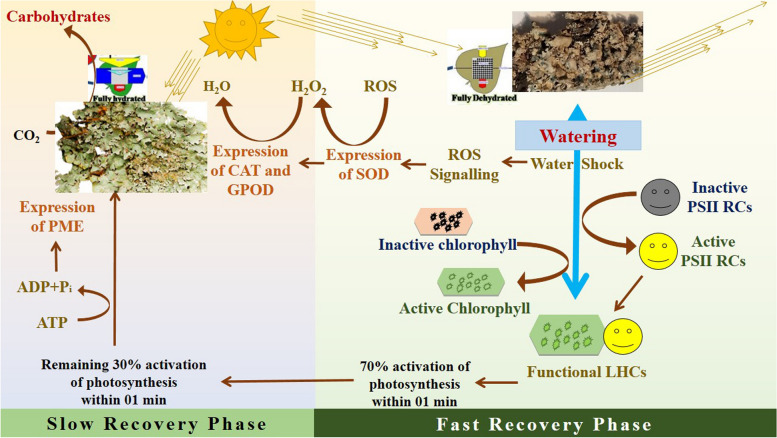
Desiccation tolerance is a complex phenomenon observed in the lichen Flavoparmelia ceparata. To understand the reactivation process of desiccated thalli, completely dried samples were rehydrated. The rehydration process of this lichen occurs in two phases. The first phase, characterized by rapid rehydration, involves the conversion of non-functional reaction centers (RCs) into functional PSII RCs, and the accumulation of ROS along with the increment in SOD antioxidant enzyme. These coordinated mechanisms initiate the light reaction of photosynthesis by forming active light-harvesting complexes (LHCs). This adaptation ensures efficient recovery, as evidenced by specific energy fluxes (ABS/RC, TR/RC, ET/RC, and DI/RC), phenomenological fluxes (ABS/CS, TR/CS, ET/CS, and DI/CS), quantum efficiencies (ФP0, ФE0, and ФD0), primary and secondary photochemistry, photochemical and non-photochemical quenching, and performance index, highlighting the essential role of rapid water uptake in restoring turgor pressure for cell structure and function maintenance. The interconnected network of antioxidant defenses, including catalase (CAT) and peroxidase (POD), underscores the plant's ability to cope with oxidative stress during resilience. The acid phosphomonoesterase (PME) enzymatic activity corresponds to its role in releasing phosphate for essential cellular functions and post-rehydration thallus growth. The activity of CAT, GPOD, and PME signifies the gradual reactivation of lichen F. caperata. Moreover, the investigation into chlorophyll a fluorescence emphasizes the efficient reactivation of the photosynthetic process in F. caperata. In conclusion, lichen F. caperata demonstrates significant potential for desiccation tolerance through the rapid transformation of chloroplasts, chlorophylls, and PSII RCs from their inactive to active states upon rehydration. This research not only enhances our understanding of desiccation tolerance in resurrection plants but also highlights the importance of lichens, particularly F. caperata, as valuable models for studying plant resilience in challenging environments.
Keywords: Antioxidant; Chlorophyll a fluorescence; Desiccation tolerance; Lichen; Photosynthesis; Resurrection plant.
© 2024. The Author(s).
Conflict of interest statement
Declarations. Ethics approval and consent to participate: Not applicable. Consent for publication: Not applicable. Competing interest: The authors declare no conflict of interest.
Figures




References
-
- Abbasi T, Abbasi SA. Biomass energy and the environmental impacts associated with its production and utilization. Renewable Sustainable Energy Rev. 2010;14:919–37.
-
- Asante FA, Amuakwa-Mensah F. Climate change and variability in Ghana: Stocktaking. Climate. 2015;3:78–99. - DOI
-
- Singh Sidhu GP, Bali AS. Plant responses to drought stress. In: Brassinosteroids in Plant Developmental Biology and Stress Tolerance. 2022;13:1006617.
MeSH terms
Substances
LinkOut - more resources
Full Text Sources
Research Materials
Miscellaneous
