


Relationship between lipid levels, TyG, TyG-BMI index and hypertension in Tibetan population in Tibet, China based on restricted cubic spline model
- PMID: 39731090
- PMCID: PMC11673320
- DOI: 10.1186/s12889-024-21160-x
Relationship between lipid levels, TyG, TyG-BMI index and hypertension in Tibetan population in Tibet, China based on restricted cubic spline model
Abstract
Background: The prevalence of hypertension among the Tibetan population in Tibet is higher than in other regions of China, and there is a lack of unified epidemiological surveys. This study aims to conduct a standardized epidemiological investigation to assess the current status of hypertension among the Tibetan population, as well as to explore the dose-response relationship between cholesterol (TC), triglyceride glucose index (TyG), triglyceride glucose-body mass index (TyG-BMI), and hypertension in this population.
Methods: From June 2020 to July 2023, a total of 5042 Tibetans aged 18 to 80 years from three cities and one region in Tibet were randomly sampled for the study. Logistic regression analysis models combined with restricted cubic splines were used to analyze the relationship between LDL-C, TC, TyG, TyG-BMI index, and HTN in the Tibetan population.
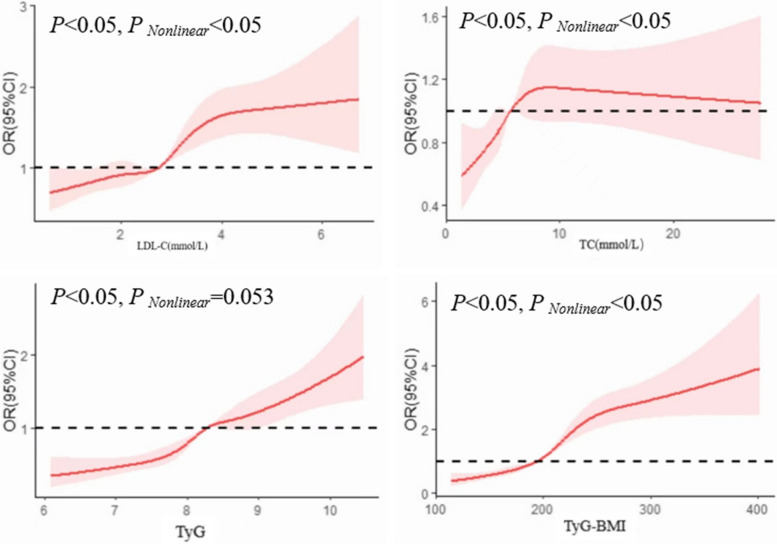
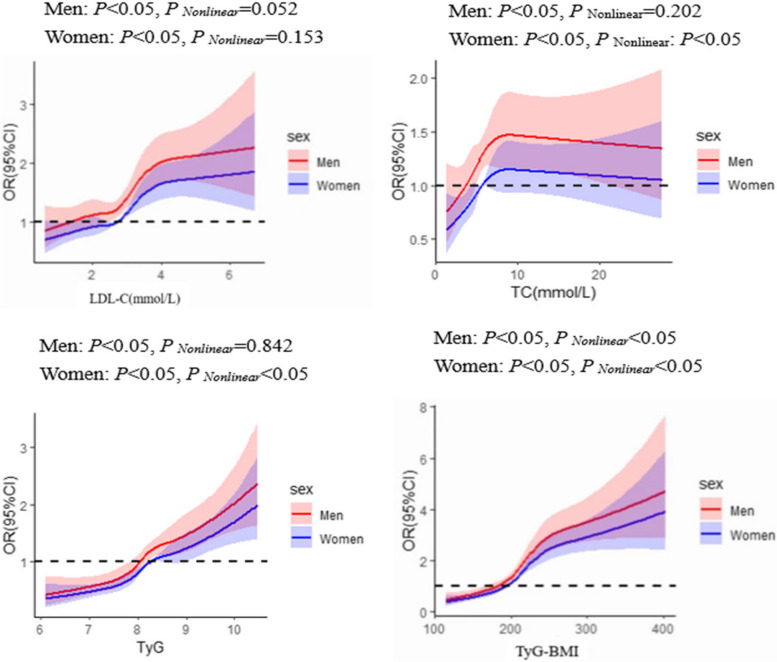
Results: (1) The prevalence of HTN in the Tibetan population in Tibet, China, was 32.35%, of which men were slightly higher than women. (2) Age, BMI, fasting blood glucose (FBG), uric acid (UA), TC, triglycerides (TG), LDL-C, homocysteine (Hcy), TyG, and TyG-BMI were higher in HTN populations compared to non-HTN populations (P < 0.05). (3) The risk of HTN was increased in individuals with borderline elevated and elevated LDL-C, borderline elevated TC, the second(Q2), third(Q3), and fourth quartile groups(Q4) of TyG as well as the third(Q3) and fourth quartile groups(Q4) of TyG-BMI. The prevalence risk of HTN gradually increased with elevated levels of LDL-C, TC, TyG, and TyG-BMI (P trend < 0.001). (4) The results of restricted cubic spline analysis showed a nonlinear dose-response relationship between LDL-C, TC, and TyG-BMI and the risk of developing HTN (P < 0.001, P Nonlinear < 0.05), and a linear dose-response relationship between TyG and the risk of developing HTN (P < 0.001, P Nonlinear > 0.05).
Conclusion: Higher LDL-C, TC, TyG, and TyG-BMI are risk factors for HTN in the Tibetan population of Tibet, China. Effective prevention can be achieved by controlling lipid and glucose indices.
Keywords: Cholesterol (TC); Hypertension; Low-density lipoprotein cholesterol (LDL-C); Tibet; TyG index; TyG-BMI index.
© 2024. The Author(s).
Conflict of interest statement
Declarations. Ethics approval and consent to participate: The Medical ethics committee of Tibet University has approved the study, and all participants provided written informed consent. Consent for publication: Not applicable. Competing interests: The authors declare no competing interests.
Figures
References
-
- Unger T, Borghi C, Charchar F, et al. 2020 International Society of Hypertension Global Hypertension Practice Guidelines[J]. Hypertension. 2020;75(6):1334–57. 10.1161/HYPERTENSIONAHA.120.15026. - PubMed
-
- Rodilla E, Garcia L, Merino C, et al. Impact of metabolic syndrome in the control of blood pressure and dyslipemia][J. Med Clin (Barc). 2004;123(16):601–5. 10.1016/s0025-7753(04)74615-1. - PubMed
-
- He L, Li G. Interpretation of the key points of the Expert Consensus on Comprehensive Management of Blood Pressure and Lipids in Chinese Hypertensive Patients[J]. Chin J Hyperten. 2022;30(01):13–5. 10.16439/j.issn.1673-7245.2022.01.005.
MeSH terms
Substances
Grants and funding
LinkOut - more resources
Full Text Sources
Medical
Miscellaneous
