


Magnitude of cesarean section and its associated factors among mothers who gave birth in public hospitals in East Wollega Zone, Oromia, Ethiopia
- PMID: 39731104
- PMCID: PMC11673670
- DOI: 10.1186/s12905-024-03518-w
Magnitude of cesarean section and its associated factors among mothers who gave birth in public hospitals in East Wollega Zone, Oromia, Ethiopia
Abstract
Background: Globally, there has been an explosive rise in the cesarean section rate that exceeds the World Health Organization rate of 10-15% and in the past fifteen years the rates was doubled in some countries including Ethiopia. Therefore, it is essential to recognize the current magnitude and the factors that contribute to increasing cesarean section rates beyond the World Health Organization recommendations and specifically in the study areas.
Objective: This study aimed to assess the magnitude of cesarean sections and its associated factors among mothers who gave birth in public hospitals in East Wollega Zone, Oromia Ethiopia 2022.
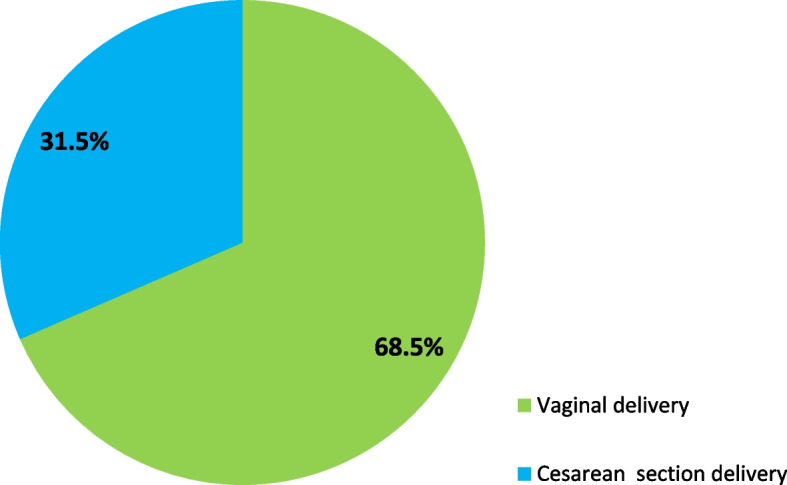
Methods: A Facility-based cross-sectional study design supplemented by the qualitative study was conducted among 403 mothers, and an in-depth interview was held with purposefully selected 18 post-cesarean section mothers who gave birth at public hospitals. The study subject for quantitative data was selected by a systematic random sampling method. Face-to-face interviews and a chart review checklist were used for data collection. Data were entered into EPI Data Version 3.1 and analyzed by SPSS version 25 for quantitative data and thematic analysis for qualitative data. Bivariate and multivariable logistic regression was used to assess the association between dependent and independent variables. Variables that were statistically significant at bivariate logistic regression with a p-value < 0.25 were entered into the multivariable logistic regression. Statistical significance was declared at a p-value less than 0.005 RESULT: The finding of this study revealed that the magnitude of the cesarean section was 31.5% (95% CI: 27.4%-36.5%). Factors such as living in an urban area (AOR = 2.87, 95%CI (1.63,5.05)), a mother who attained college and above (AOR = 3.48, 95% CI (1.72, 7.06)), being a referred mother (AO R = 2.27, 95% CI (1.31, 3.94)), being induced labor (AOR = 4.83, 95% CI (1.93,12.06)) and lack of antenatal care follow up (AOR=7.84, 95% CI (4.26, 14.44)) were significantly associated with an increased likelihood of cesarean section.
Conclusion: and Recommendation The study indicates a high cesarean section rate that exceeds the World Health Organization recommendation 10-15%. Therefore, improving antenatal care, referral systems, and labor induction management needs concern to mitigate unnecessary cesarean deliveries.
Keywords: Associated factors; Cesarean section; Ethiopia; Magnitude; Nekemte.
© 2024. The Author(s).
Conflict of interest statement
Declarations. Ethics approval and consent to participation: The work described in this study was carried out in accordance with the Code of Ethics of the World Medical Association (Declaration of Helsinki) and we confirm that the manuscript was in line with the Recommendations for the Conduct, Reporting, Editing and Publication of Scholarly Work in Medical Journals. The ethical approval was granted by the ethical review committee of Wollega University (WU|RD|496|2014), and the East Wollega Zonal Health Office issued a permission letter to all Public hospitals in East Wollega Zone. Individuals provided written informed consent and all study participants were informed about the study’s purpose through voluntary participation. Participants were assured that their decision not to participate would not impact the service they received. Moreover, personal identifiers like name and phone number were not used on the data collection questionnaire to maintain their privacy. Consent for publication: Not applicable. Competing interests: The authors declare no competing interests.
Figures
References
-
- Organization, W.H., WHO recommendations non-clinical interventions to reduce unnecessary caesarean sections. 2018: World Health Organization. - PubMed
-
- Cunningham, F.G., et al., Obstetrícia de Williams-25. 2021: McGraw Hill Brasil.
MeSH terms
LinkOut - more resources
Full Text Sources
Medical
Miscellaneous
