


College students' disciplinary expertise and their entrepreneurial intentions: an exploratory study based on foreign language majors with experience in innovation and entrepreneurship training programs
- PMID: 39731122
- PMCID: PMC11681759
- DOI: 10.1186/s40359-024-02149-y
College students' disciplinary expertise and their entrepreneurial intentions: an exploratory study based on foreign language majors with experience in innovation and entrepreneurship training programs
Abstract
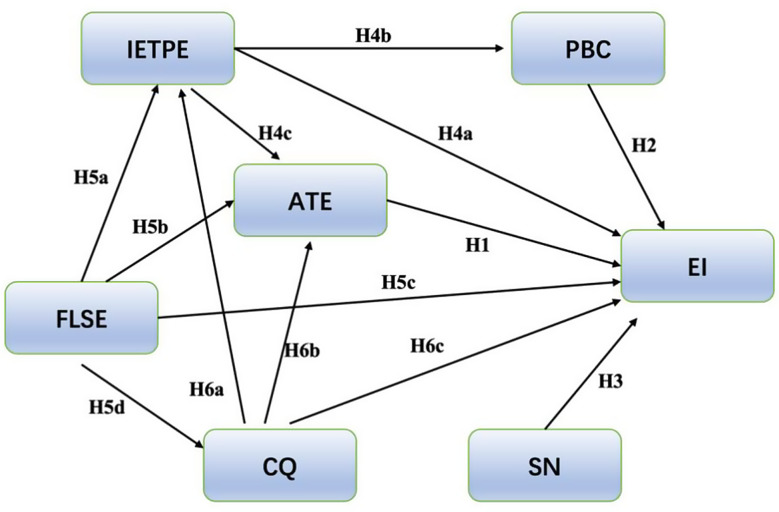
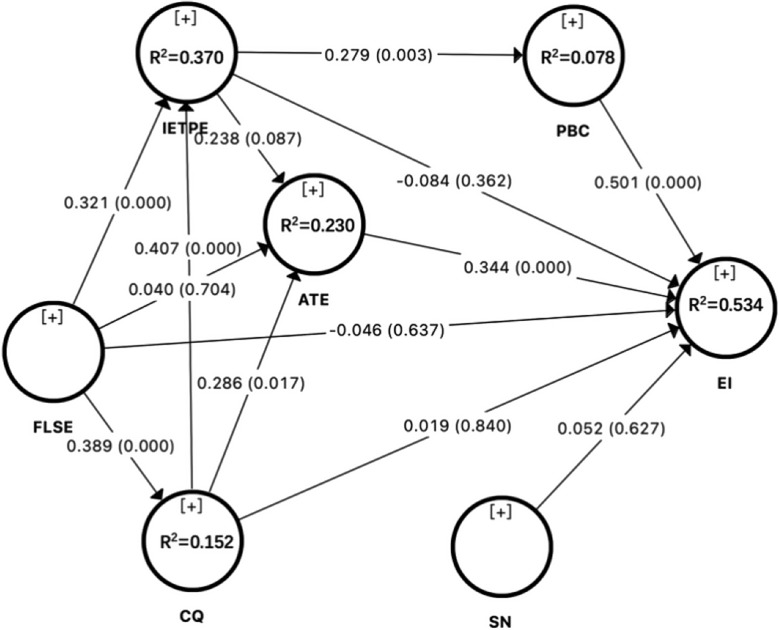
Taking foreign language majors with experience in innovation and entrepreneurship training program (IETP) as samples, this study investigates the influence of disciplinary expertise on entrepreneurial intention. Based on the theory of planned behavior (TPB), a model was designed to examine the relationships among entrepreneurial intentions, perceived behavioral control, attitude toward entrepreneurship, subjective norms, IETP experience, foreign language self-efficacy and cultural intelligence. The data were collected through questionnaires and Partial least squares structural equation modeling (PLS-SEM) was adopted to test the hypotheses. The results show that: (1) perceived behavioral control and attitude toward entrepreneurship are sound predictors of entrepreneurial intentions but the influence of subjective norms on entrepreneurial intentions is insignificant; (2) IETP experience is directly related with perceived behavioral control and indirectly related with entrepreneurial intentions; (3) indicators of participants' disciplinary expertise such as foreign language self-efficacy and cultural intelligence are directly related with IETP experience and indirectly related with entrepreneurial intentions. These six variables included in the research model account for 53.4% of the variance of entrepreneurial intentions.
Keywords: Cultural intelligence; Disciplinary expertise; Entrepreneurial intentions; Foreign language self-efficacy; Innovation and entrepreneurship training programs.
© 2024. The Author(s).
Conflict of interest statement
Declarations. Ethics approval and consent to participate: All procedures performed in the study involving human participants were in accordance with the ethical standards of the institutional and national research committee and with the 1964 Helsinki declaration and its later amendments or comparable ethical standards. The questionnaire and methodology for this study were approved by the Institutional Review Board of the School of Foreign Studies, Shaoguan University and College of International Studies, Jiaxing University prior to data collection. All participants expressed their informed consent to participate in the research. Consent for publication: Not applicable. Informed consent: Informed consent was obtained from all participants included in the study. Competing interests: The authors declare no competing interests.
Figures
References
-
- Wennekers S, Thurik R. Linking entrepreneurship and economic growth. Small Bus Econ. 1999;13(1):27–56. - DOI
-
- William B, Michael H, Emily N, Paul R. Executive forum: a study of informal investing in 29 nations composing the global entrepreneurship monitor. Venture Cap. 2003;5(2):101–16. - DOI
-
- Brockhaus RH. Risk-taking propensity of entrepreneurs. Acad Manag J. 1980;23(3):509–20. - DOI
-
- Johnson BR. Toward a multidimensional model of entrepreneurship: the case of achievement motivation and the entrepreneur. Entrep Theory Pract. 1990;14(3):39–54. - DOI
-
- Gatewood EJ, Shaver KG, Powers JB, Gartner WB. Entrepreneurial expectancy, task effort, and performance. Entrep Theory Pract. 2002;27:187–206. - DOI
MeSH terms
Grants and funding
LinkOut - more resources
Full Text Sources
