


Classification of influencing factors of speaking-up behaviour in hospitals: a systematic review
- PMID: 39732664
- PMCID: PMC11681692
- DOI: 10.1186/s12913-024-12138-x
Classification of influencing factors of speaking-up behaviour in hospitals: a systematic review
Abstract
Background: Speaking up among healthcare professionals plays an essential role in improving patient safety and quality of care, yet it remains complex and multifaceted behaviour. Despite awareness of potential risks and adverse outcomes for patients, professionals often hesitate to voice concerns due to various influencing factors. This complexity has encouraged research into the determinants of speaking-up behaviour in hospital settings. This review synthesises these factors into a multi-layered framework. It aims to provide a more comprehensive perspective on the influencing factors, which provides guidance for interventions aimed at fostering environments contributing to speaking up in hospitals.
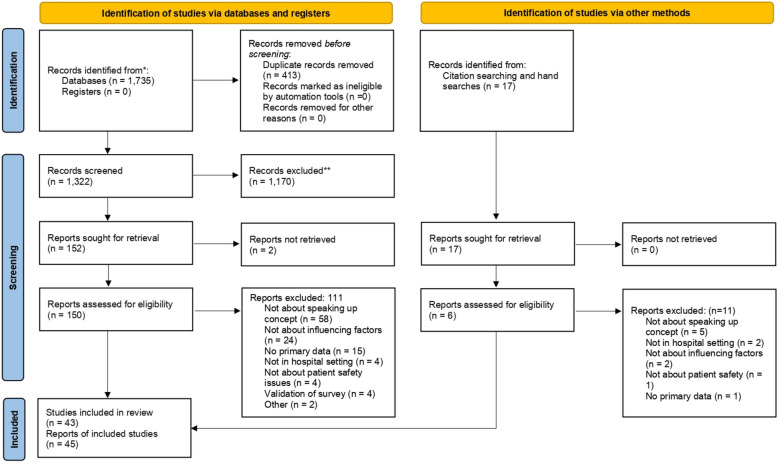
Methods: A systematic review was conducted in November 2024, searching databases: PubMed, Scopus and Web of Science. Following PRISMA guidelines and the three stages for thematic synthesis, we developed the classification of influencing factors. Out of 1,735 articles identified articles, 413 duplicates were removed, 1,322 titles and abstracts were screened, and 152 full texts (plus six additional articles) were assessed. Ultimately, 45 articles met the inclusion criteria.
Results: The review categorised influencing factors into four categories: individual (29 articles, 64%), relational (21 articles, 47%), contextual (19 articles, 42%), and organisational (26 articles, 58%). These categories encompass motivating, hindering and trade-off factors affecting speaking up among healthcare professionals in hospitals.
Conclusions: The multi-layered framework highlights the dynamic interplay of factors influencing speaking up among healthcare professionals. A systems approach is essential for identifying barriers and enablers and designing effective speaking up interventions. This framework serves as a foundation for more focused research and practical guidance, enabling healthcare leaders to address barriers across all categories. By fostering environments that support open communication, organisations can enhance patient safety and quality of care.
Keywords: Open communication; Patient safety; Quality of care; Speaking up.
© 2024. The Author(s).
Conflict of interest statement
Declarations. Ethics approval and consent to participate: Not applicable. Consent for publication: Not applicable. Competing interests: The authors declare no competing interests.
References
-
- Reid J, Bromiley M. Clinical human factors: the need to speak up to improve patient safety. Nurs Stand. 2012;26:35–40. - PubMed
-
- Rabol LI, Andersen ML, Ostergaard D, Bjorn B, Lilja B, Mogensen T. Descriptions of verbal communication errors between staff. An analysis of 84 root cause analysis-reports from Danish hospitals. BMJ Qual Saf. 2011;20:268–74. - PubMed
-
- Sutcliffe KM, Lewton E, Rosenthal MM. Communication failures: an insidious contributor to medical mishaps. Acad Med. 2004;79:186–94. - PubMed
-
- Maxfield D, Grenny J, McMillan R, Patterson K, Switzler A. The seven crucial conversations for healthcare. 2005.
Publication types
MeSH terms
LinkOut - more resources
Full Text Sources
Medical
Miscellaneous
