


Innate immune memory in chronic HIV and HIV-associated neurocognitive disorders (HAND): potential mechanisms and clinical implications
- PMID: 39733092
- PMCID: PMC11846772
- DOI: 10.1007/s13365-024-01239-2
Innate immune memory in chronic HIV and HIV-associated neurocognitive disorders (HAND): potential mechanisms and clinical implications
Abstract
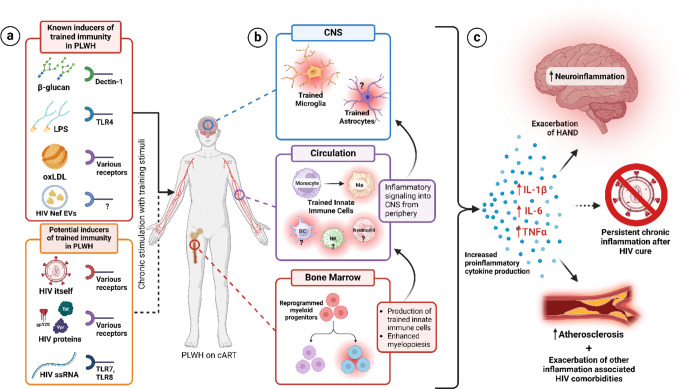
Although antiretroviral therapy (ART) has dramatically improved the outlook of the HIV/AIDS pandemic, people living with HIV (PLWH) on suppressive therapy are still at higher risk for a range of comorbidities including cardiovascular disease (CVD) and HIV-associated neurocognitive disorders (HAND), among others. Chronic inflammation and immune activation are thought to be an underlying cause of these comorbidities. Many of the factors thought to drive chronic inflammation and immune activation in HIV overlap with factors known to induce trained immunity. Trained immunity is a form of innate immune memory that metabolically and epigenetically reprograms innate immune cells to mount enhanced inflammatory responses upon secondary encounter with unrelated inflammatory stimuli. While this phenotype has been characterized in a variety of disease states in animals and humans, very little is known about its potential contribution to chronic HIV pathogenesis. In this review, a broad overview of innate immune memory in the periphery and the central nervous system (CNS) is provided and the evidence for trained immunity in the context of HIV is considered. In PLWH on ART, this phenotype could contribute to the chronic inflammation and immune activation associated with HIV comorbidities and could complicate HIV cure strategies due to the potential persistence of the phenotype after eradication of the virus. Further research into this immune state in the context of HIV may open the door for new therapeutics aimed at treating HIV comorbidities like HAND.
Keywords: Cytokines; HIV-associated neurocognitive disorders; Innate immune memory; Microglia; Monocytes; Neuroinflammation.
© 2024. The Author(s).
Conflict of interest statement
Declarations. Competing interests: The authors declare no competing interests.
Figures
References
-
- Adlam C, Broughton ES, Scott MT (1972) Enhanced resistance of mice to infection with bacteria following pre-treatment with Corynebacterium parvum. Nat New Biol 235:219–220. 10.1038/newbio235219a0 - PubMed
-
- Allen NJ, Barres BA (2009) Neuroscience: Glia - more than just brain glue. Nature 457:675–677. 10.1038/457675a - PubMed
-
- Ancuta P, Kamat A, Kunstman KJ, Kim EY, Autissier P, Wurcel A, Zaman T, Stone D, Mefford M, Morgello S, Singer EJ, Wolinsky SM, Gabuzda D (2008) Microbial translocation is associated with increased monocyte activation and dementia in AIDS patients. PLoS ONE 3:e2516. 10.1371/journal.pone.0002516 - PMC - PubMed
Publication types
MeSH terms
Substances
Grants and funding
LinkOut - more resources
Full Text Sources
Medical
