


Association of the triglyceride-glucose index with cardiovascular mortality risk and competing risks in arthritis patients
- PMID: 39733154
- PMCID: PMC11682356
- DOI: 10.1038/s41598-024-82925-3
Association of the triglyceride-glucose index with cardiovascular mortality risk and competing risks in arthritis patients
Abstract
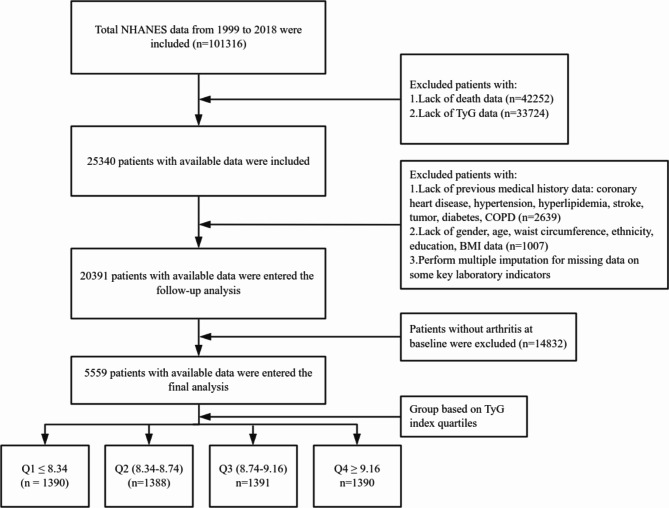
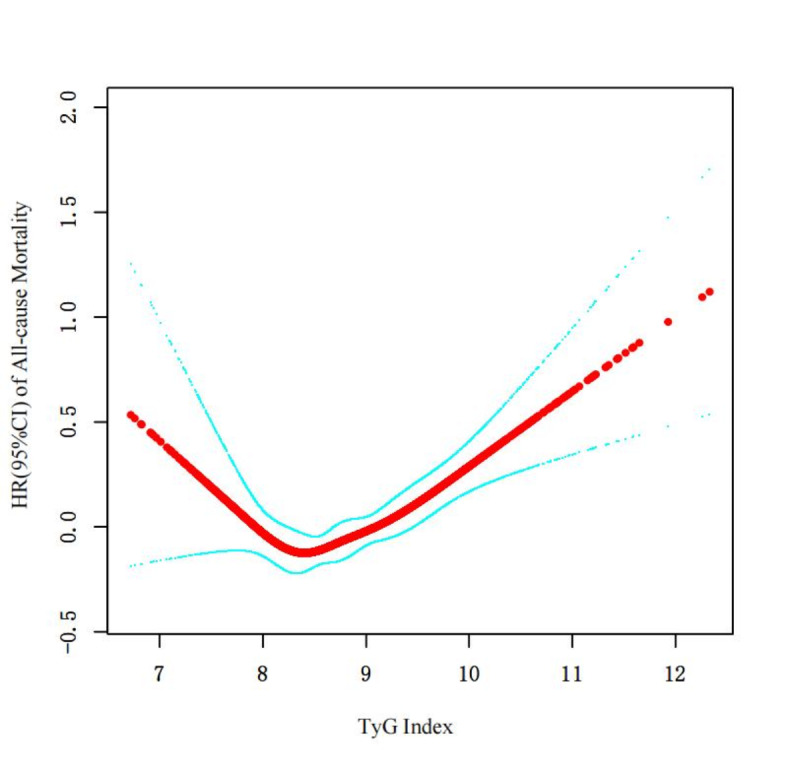
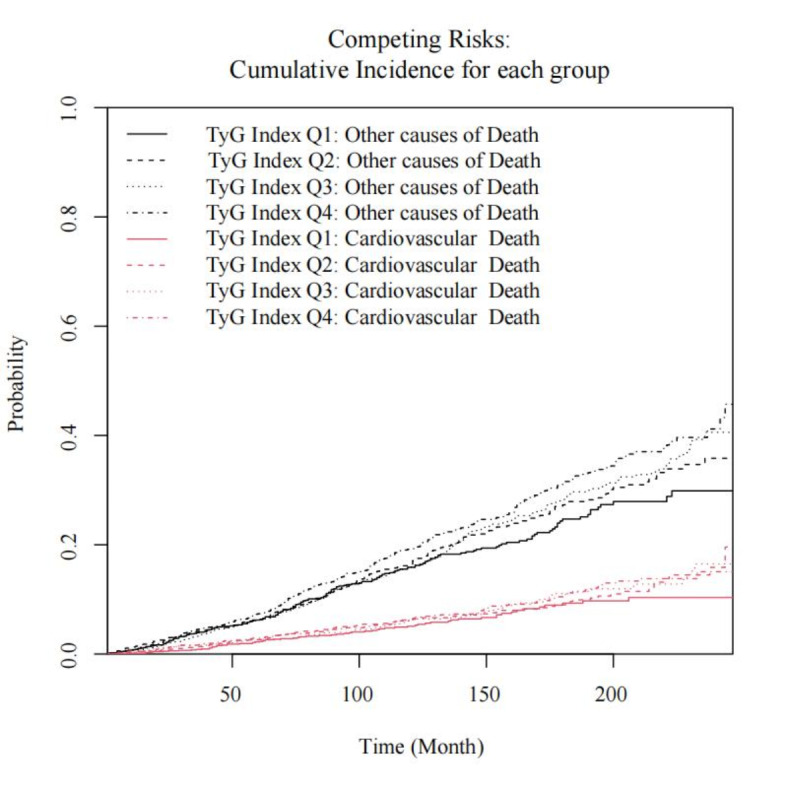
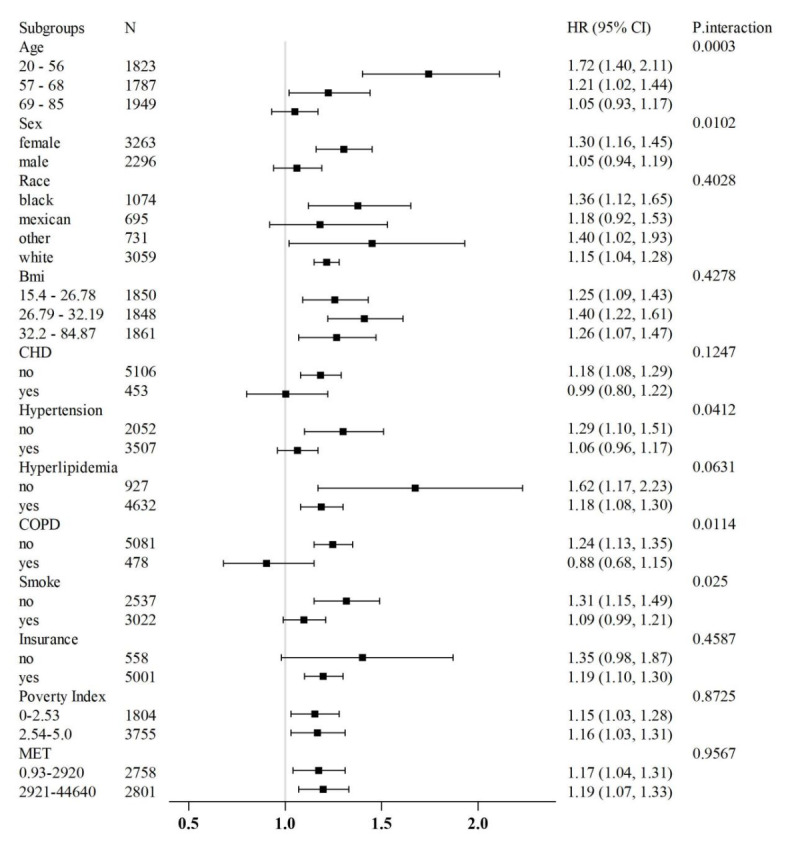
This study aims to investigate the relationship between the triglyceride-glucose index (TyG) and all-cause mortality as well as cardiovascular mortality in arthritis patients. Additionally, it seeks to analyze the nonlinear characteristics and threshold effects of TyG index. We included 5,559 adult participants with arthritis from the 1999-2018 National Health and Nutrition Examination Survey (NHANES). The TyG index was calculated using fasting triglycerides and glucose levels. We employed Cox proportional hazards models and restricted cubic spline analyses to examine the relationship between TyG index and all-cause mortality in arthritis patients. Competing risks models were used to analyze the association between TyG index and cardiovascular mortality as well as mortality from other causes. Over a median follow-up period of 7.8 years, 1,388 cases of all-cause mortality were recorded among arthritis patients, including 369 cases of cardiovascular mortality. After adjusting for confounding factors, TyG index was found to be nonlinearly positively associated with all-cause mortality (P = 0.0019), with a significant increase in mortality risk when TyG index ≥ 8.43. Compared to the quartile 2 of TyG index, the highest quartile was associated with a 36% increased risk of all-cause mortality (HR 1.36, 95% CI 1.12-1.65). Additionally, competing risks models indicated that high TyG index levels were significantly associated with increased risks of cardiovascular mortality and mortality from other causes. Subgroup analyses confirmed the robustness of the association between TyG index and cardiovascular mortality in arthritis patients. The TyG index is nonlinearly associated with all-cause mortality and represents a potential prognostic indicator for mortality risk in arthritis patients.
Keywords: All-cause mortality; Arthritis; Cardiovascular mortality; Competing risks; NHANES; Triglyceride-glucose index.
© 2024. The Author(s).
Conflict of interest statement
Declarations. Competing interests: The authors declare no competing interests.
Figures

References
-
- Ladang, A. et al. Biochemical Markers of Musculoskeletal Health and Aging to be assessed in clinical trials of drugs aiming at the treatment of Sarcopenia: Consensus Paper from an Expert Group Meeting Organized by the European Society for Clinical and Economic Aspects of Osteoporosis, Osteoarthritis and Musculoskeletal diseases (ESCEO) and the Centre Académique De Recherche et d’Expérimentation en Santé (CARES SPRL), under the auspices of the World Health Organization Collaborating Center for the Epidemiology of Musculoskeletal Conditions and Aging. Calcif Tissue Int.112 (2), 197–217 (2023). - PMC - PubMed
-
- Frieden, T. R. A. & Safer, Healthier, U. S. The Centers for Disease Control and Prevention, 2009–2016. Am. J. Prev. Med.52 (3), 263–275 (2017). - PubMed
-
- Sokka, T., Abelson, B. & Pincus, T. Mortality in rheumatoid arthritis: 2008 update. Clin. Exp. Rheumatol.26 (5 Suppl 51), S35–61 (2008). - PubMed
-
- Meune, C., Touzé, E., Trinquart, L. & Allanore, Y. Trends in cardiovascular mortality in patients with rheumatoid arthritis over 50 years: a systematic review and meta-analysis of cohort studies. Rheumatol. (Oxford). 48 (10), 1309–1313 (2009). - PubMed
MeSH terms
Substances
LinkOut - more resources
Full Text Sources
Medical
