


XbaI polymorphism in the APOB gene and its association with increased cholesterol in children and adolescents: Ouro Preto study
- PMID: 39733208
- PMCID: PMC11682059
- DOI: 10.1038/s41598-024-83099-8
XbaI polymorphism in the APOB gene and its association with increased cholesterol in children and adolescents: Ouro Preto study
Abstract
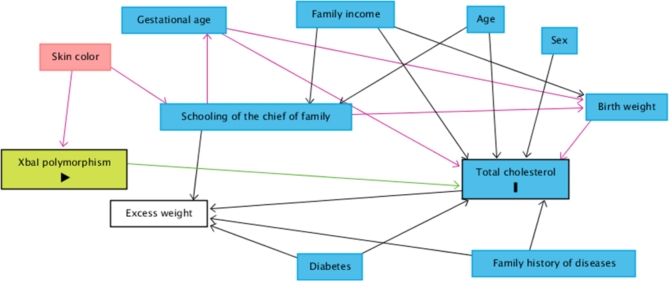
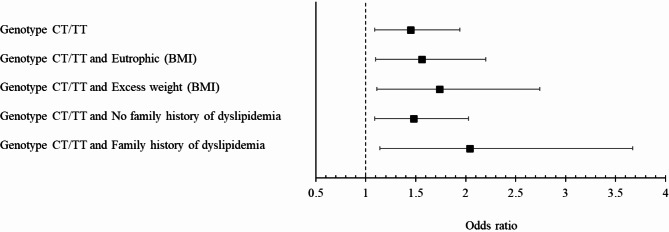
Atherosclerotic vascular changes can begin during childhood, providing risk for cardiovascular disease (CVD) in adulthood. Identifiable risk factors such as dyslipidemia accelerate this process for some children. The apolipoprotein B (APOB) gene could help explain the inter-individual variability in lipid levels among young individuals and identify groups that require greater attention to prevent CVD. A cross-sectional study was conducted with school-aged children and adolescents in Ouro Preto, Minas Gerais. The study evaluated cardiovascular risk factors' variables and XbaI polymorphism in the APOB gene for associations with increased total cholesterol (TC). The prevalence of increased TC was notably high, reaching 68.9% in the study population. Carriers of the variant T allele were 1.45 times more likely to develop increased TC in a dominant model (1.09-1.94, p = 0.011). After adjustments, excess weight and a family history of dyslipidemia interacted significantly with XbaI polymorphism in increased TC, resulting in Odds Ratio of 1.74 (1.11-2.71, p = 0.015) and 2.04 (1.14-3.67, p = 0.016), respectively. The results suggest that XbaI polymorphism in the APOB gene may affect the lipid profile of Brazilian children and adolescents and could contribute to the CVD in adulthood.
Keywords: Adolescent Health; Apolipoproteins B; Cardiovascular Risk Factor; Child Health; Hyperlipidemia; Single Nucleotide Polymorphism.
© 2024. The Author(s).
Conflict of interest statement
Declarations. Competing interests: The authors declare no competing interests. Ethics approval: This study was performed in line with the principles of the Declaration of Helsinki. Approval was granted by the Ethics Committee of Federal University of Ouro Preto (CAAE 28680020.0.0000.5150). Consent for publication: Informed consent was obtained from all individual participants included in the study and written informed consent was obtained from the parents.
Figures
References
-
- World Health Organization. Cardiovascular diseases (CVDs) - Newsroom Facts Sheet Detail. World Health Organization. https://www.who.int/en/news-room/fact-sheets/detail/cardiovascular-disea... (2021).
-
- Expert Panel on Integrated Guidelines for Cardiovascular Health. Risk Reduction in Children and Adolescents, National Heart, Lung, and Blood Institute. Expert panel on integrated guidelines for cardiovascular health and risk reduction in children and adolescents: summary report. Pediatrics128(Supl5), S213–S256. 10.1542/peds.2009-2107C (2011). - PMC - PubMed
-
- American Academy of Pediatrics. Cardiovascular risk reduction in high-risk pediatric populations. Pediatrics119(3), 618–621. 10.1542/peds.2006-3557 (2007). - PubMed
-
- de Ferranti, S. D. et al. Cardiovascular Risk Reduction in High-Risk Pediatric Patients: A Scientific Statement From the American Heart Association. Circulation139, e603–e634. 10.1161/CIR.0000000000000618 (2019). - PubMed
Publication types
MeSH terms
Substances
Grants and funding
- APQ-01933-21/Fundação de Amparo à Pesquisa do Estado de Minas Gerais
- APQ-01933-21/Fundação de Amparo à Pesquisa do Estado de Minas Gerais
- APQ-01933-21/Fundação de Amparo à Pesquisa do Estado de Minas Gerais
- APQ-01933-21/Fundação de Amparo à Pesquisa do Estado de Minas Gerais
- APQ-01933-21/Fundação de Amparo à Pesquisa do Estado de Minas Gerais
LinkOut - more resources
Full Text Sources
Medical
Miscellaneous
