


Mismatch repair, p53, and L1 cell adhesion molecule status influence the response to chemotherapy in advanced and recurrent endometrial cancer
- PMID: 39734232
- PMCID: PMC11684106
- DOI: 10.1186/s12885-024-13294-3
Mismatch repair, p53, and L1 cell adhesion molecule status influence the response to chemotherapy in advanced and recurrent endometrial cancer
Abstract
Objective: This study aimed to identify the recurrence and survival rates according to the mismatch repair (MMR), p53, and L1 cell adhesion molecule (L1CAM) status in patients with advanced and recurrent endometrial cancer (EC) receiving systemic chemotherapy.
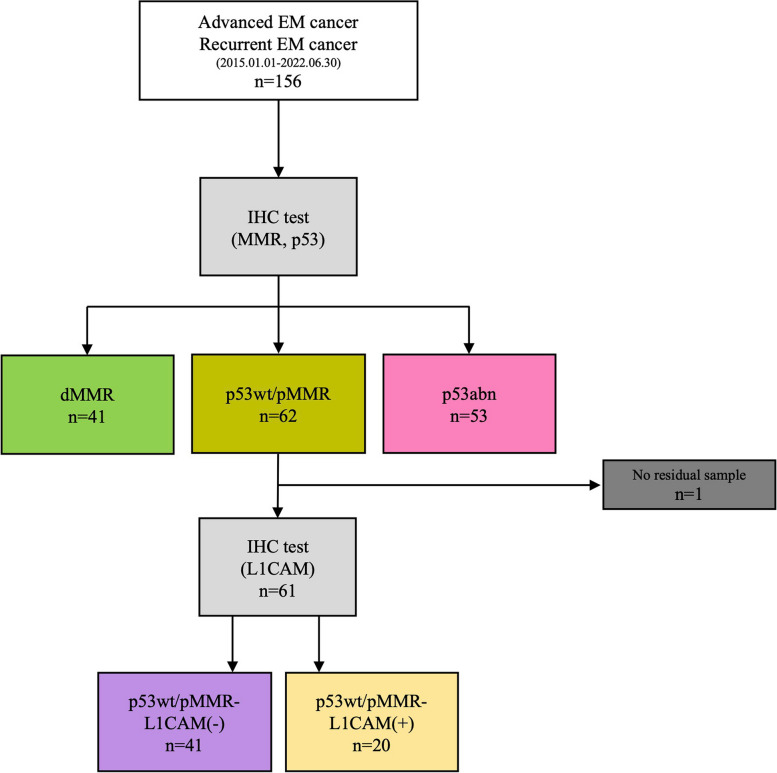
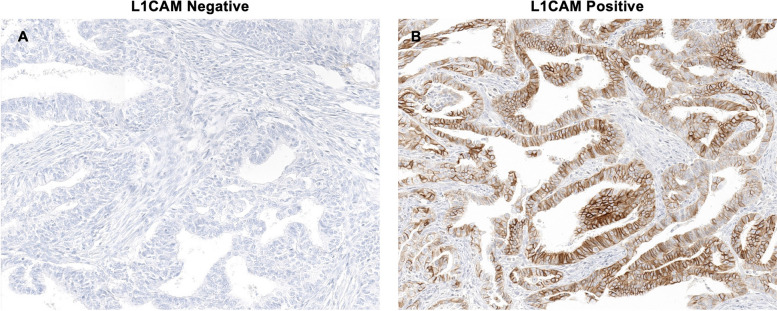
Methods: This single-center retrospective cohort study included chemotherapy-naïve patients with advanced-stage (III/IV) or recurrent EC between January 2015 and June 2022 (n = 156), who were administered chemotherapy as adjuvant therapy or first-line palliative treatment. MMR and p53 status were assessed, and L1CAM was tested using immunohistochemistry in the p53-wild and MMR-proficient (p53wt/pMMR) group. The primary outcomes were progression-free survival (PFS) and overall survival (OS).
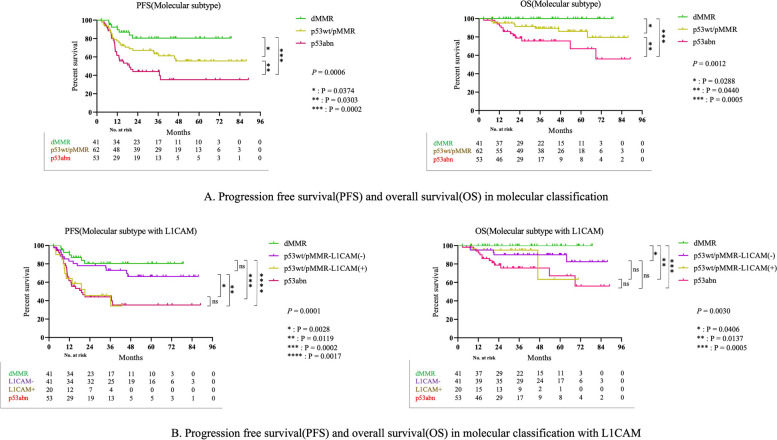
Results: Of the 156 patients, 62 (39.7%), 53 (34.0%), and 41 (26.3%) had p53wt/pMMR, abnormal p53 (p53abn), and MMR-deficient (dMMR) tumors, respectively. PFS and OS were longest in dMMR, followed by p53wt/pMMR, and were the least in p53abn tumors (PFS: p = 0.0006, OS: p = 0.0013). After p53wt/pMMR was classified according to positive or negative L1CAM status, the L1CAM negative group exhibited significantly shorter survival rates than the L1CAM positive group (PFS: p = 0.0001, OS: p = 0.0027). p53abn tumors were independent prognostic factors for poor PFS (PFS: p = 0.039 on multivariable analysis).
Conclusion: In chemotherapy-naïve patients with advanced and recurrent EC, there was a better prognosis in the order of MMR-D, p53wt/pMMR, and p53abn tumors after chemotherapy. L1CAM status is useful as a new marker to stratify p53wt/pMMR in advanced and recurrent groups.
Keywords: Endometrial neoplasms; Molecular classification; Neural cell adhesion molecule L1 (L1CAM); Prognosis; Recurrence; Survival.
© 2024. The Author(s).
Conflict of interest statement
Declarations. Ethics approval and consent to participate: Because of the non-interventional, retrospective nature of analyzed data and because our analysis involved an anonymized dataset, neither ethical review nor informed consent of the patients was required. However, the study protocol was reviewed and approved by a scientific steering committee to which all the authors belonged. Moreover, the study protocol was reviewed and approved by the Yonsei University Health System, Severance Hospital, IRB (ref. 4–2023-0263). Consent for publication: Not applicable. Competing interests: The authors declare no competing interests.
Figures
References
-
- Sung H, et al. Global Cancer Statistics 2020: GLOBOCAN estimates of incidence and mortality worldwide for 36 cancers in 185 countries. CA Cancer J Clin. 2021;71(3):209–49. - PubMed
-
- Talhouk A, et al. Confirmation of ProMisE: A simple, genomics-based clinical classifier for endometrial cancer. Cancer. 2017;123(5):802–13. - PubMed
MeSH terms
Substances
LinkOut - more resources
Full Text Sources
Research Materials
Miscellaneous
