


Exploring the relationships between self-efficacy, self-care, and glycaemic control in primary care diabetes management
- PMID: 39734764
- PMCID: PMC11672485
- DOI: 10.1177/20503121241310016
Exploring the relationships between self-efficacy, self-care, and glycaemic control in primary care diabetes management
Abstract
Objectives: Our study aimed to identify the complex interplay between self-efficacy, self-care practice, and glycaemic control among people with type 2 diabetes mellitus (PWDs) to inform the design of more targeted and effective behavioural interventions in primary care.
Methods: A cross-sectional descriptive study was performed with 294 PWDs managed in primary care. The Diabetes Management Self-Efficacy Scale (DMSES) and Summary of Diabetes Self-Care Activities (SDSCA) questionnaire measured patients' self-efficacy and self-care practice. Multivariate logistic regression models were developed to explore how SDSCA, DMSES, and their combined effect relate to glycaemic control, adjusting for patient characteristics. Network analysis in R software examined relationships between self-efficacy and self-care dimensions across glycaemic control subgroups using a Gaussian graphical model with the extended Bayesian information criterion.
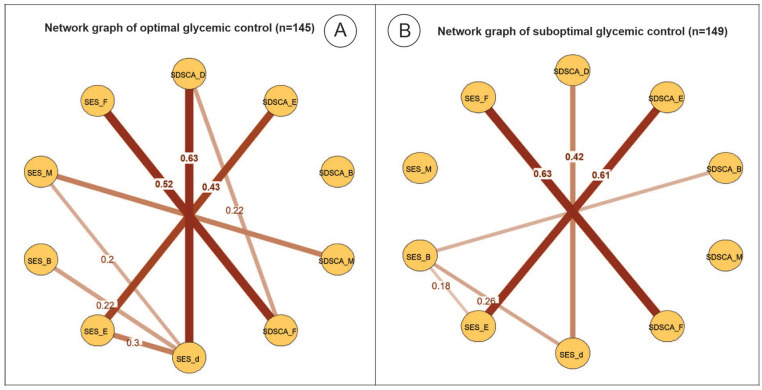
Results: Half the PWDs (50.7%) had suboptimal glycaemic control. Better glycaemic control was consistently associated with higher self-efficacy (odds ratio (OR) = 0.76, 95% confidence (CI) (0.60, 0.97), p = 0.03), shorter duration of diabetes (OR = 1.89, 95% CI (1.08, 3.31), p = 0.03), normal waist circumference (OR = 1.76, 95% CI (1.02, 3.05), p = 0.04), absence of diabetes complications (OR = 2.09, 95% CI (1.10, 3.98), p = 0.02), and treatment with oral hypoglycaemic agents (OR = 3.05, 95% CI (1.53, 6.09), p < 0.01). Network analysis among people with well-controlled HbA1c revealed that diet adherence and self-efficacy had the most robust connection, with diet self-efficacy strongly associated with most self-efficacy dimensions. Self-efficacy in exercise, blood glucose monitoring, and foot care are the most central factors in the network structures for PWDs with suboptimal glycaemic control.
Conclusions: Our study highlights the critical role of self-efficacy in diabetes primary care. For people with optimal glycaemic control, prioritising self-efficacy in diet adherence is crucial for sustaining glycaemic outcomes and supporting other self-care behaviours. Among those with suboptimal glycaemic control, enhancing self-efficacy in exercise, blood glucose monitoring, and foot care is essential. Targeted education programs, personalised counselling, and E-health tools can further empower patients to manage their diabetes more effectively.
Keywords: Type 2 diabetes; glycaemic control; network analysis; primary care; self-care; self-efficacy.
© The Author(s) 2024.
Conflict of interest statement
The author(s) declared no potential conflicts of interest with respect to the research, authorship, and/or publication of this article.
Figures
References
-
- International Diabetes Federation. IDF Diabetes Atlas, Tenth edition. Brussels, Belgium: International Diabetes Federation, 2021.
-
- Khue TN, Binh TTD, Van DKN, et al.. A cross-sectional study to evaluate diabetes management, control and complications in 1631 patients with type 2 diabetes mellitus in Vietnam (DiabCare Asia). Int J Diabetes Dev Ctries 2019; 40: 70–79.
-
- Vietnam Ministry of Health. Decision No. 5904/QD-BYT promulgating Guidelines for diagnosis, treatment and management of non-communicable diseases at commune health centers. Hanoi, Vietnam, 2019.
LinkOut - more resources
Full Text Sources
