


Intimate partner violence and its relation to sexual health outcomes across different adult populations: a systematic review
- PMID: 39735614
- PMCID: PMC11671811
- DOI: 10.3389/fsoc.2024.1498969
Intimate partner violence and its relation to sexual health outcomes across different adult populations: a systematic review
Abstract
Introduction: Intimate Partner Violence (IPV) significantly impacts adults' wellbeing, causing both physical and psychological harm. IPV has been consistently linked to adverse sexual health outcomes, including an increased risk of sexually transmitted infections, unintended pregnancies, and sexual dysfunction. This systematic review examines the evolving relationship between IPV and sexual health outcomes in adults from 2014 to 2024, addressing gaps in understanding across diverse populations and exploring the complex interplay between violence, sexuality, and health.
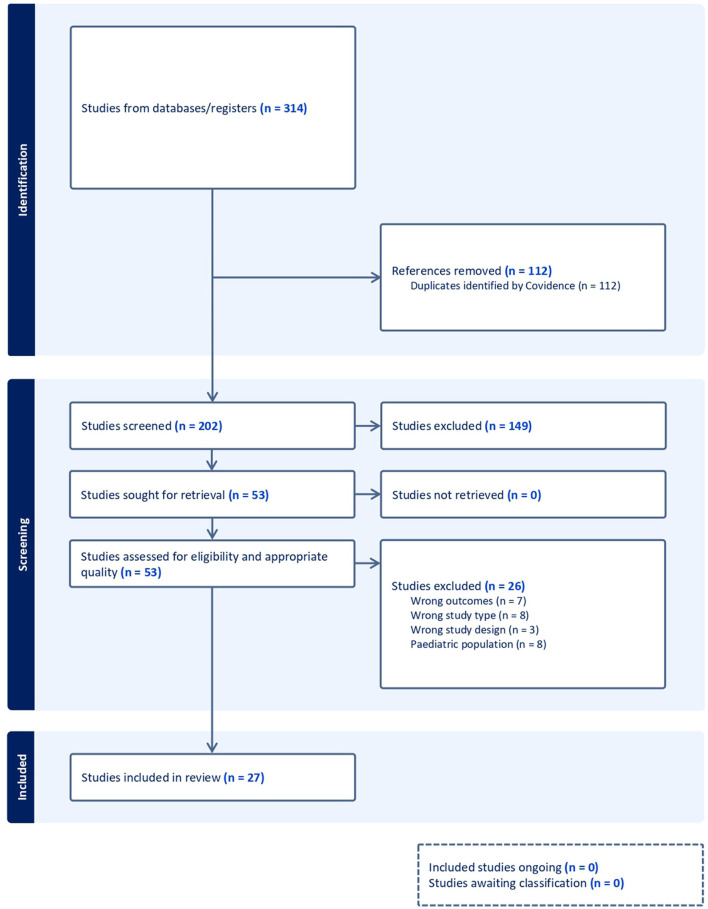
Methods: A comprehensive search of multiple databases was conducted for peer-reviewed articles published between January 2014 and February 2024. Studies examining the association between IPV and sexual health variables in adult populations (aged 18 and older) were included. The review followed PRISMA guidelines, and 27 articles met the inclusion criteria after full-text screening and quality assessment.
Results: IPV was consistently associated with poorer sexual health outcomes across diverse populations and contexts. Studies utilized various validated instruments to assess IPV and sexual health. Research primarily focused on cisgender heterosexual women, with limited studies on cisgender heterosexual men, men who have sex with men, and transgender individuals. IPV was linked to an increased risk of sexually transmitted infections, unintended pregnancies, sexual dysfunction, and decreased sexual satisfaction. The relationship between IPV and sexual health was influenced by factors such as gender identity, sexual orientation, and cultural context.
Discussion: The review highlights the complex relationship between IPV and sexual health, emphasizing the need for targeted interventions and culturally sensitive approaches. Significant research gaps exist, particularly regarding lesbian women and non-binary individuals. Future studies should employ mixed-methods approaches and consider intersectionality to provide a more comprehensive understanding of IPV's impact on sexual health across diverse populations.
Keywords: gender; intimate partner violence; sexual health; sexual orientation; systematic review.
Copyright © 2024 Calvillo, Marshall, Gafford and Montgomery.
Conflict of interest statement
The authors declare that the research was conducted in the absence of any commercial or financial relationships that could be construed as a potential conflict of interest.
References
-
- Agrawal A., Ickovics J. I., Lewis J., Magriples U., Kershaw T. (2009). “Prospective study of sexual, physical, and emotional violence and associated maternal and infant health risks among postpartum adolescents,” in Paper Presented at the 137th American Public Health Association Annual Meeting (Philadelphia, PA: ).
-
- Arrindell W. A., Boelens W., Lambert H. (1983). On the psychometric properties of the Maudsley Marital Questionnaire (MMQ): evaluation of self-ratings in distressed and “normal” volunteer couples based on the Dutch version. J. Pers. Individ. Differ. 4, 293–306. 10.1016/0191-8869(83)90151-4 - DOI
-
- Bahrami_Vazir E., Mohammad-Alizadeh-Charandabi S., Kamalifard M., Ghelichkhani F., Mohammadi A., Mirghafourvand M. (2020). The correlation between sexual dysfunction and intimate partner violence in young women during pregnancy. BMC Int. Health Hum. Rights 20:24. 10.1186/s12914-020-00245-9 - DOI - PMC - PubMed
Publication types
LinkOut - more resources
Full Text Sources
Miscellaneous
