


Endocrine disruptor chemicals exposure and female fertility declining: from pathophysiology to epigenetic risks
- PMID: 39735741
- PMCID: PMC11672798
- DOI: 10.3389/fpubh.2024.1466967
Endocrine disruptor chemicals exposure and female fertility declining: from pathophysiology to epigenetic risks
Abstract
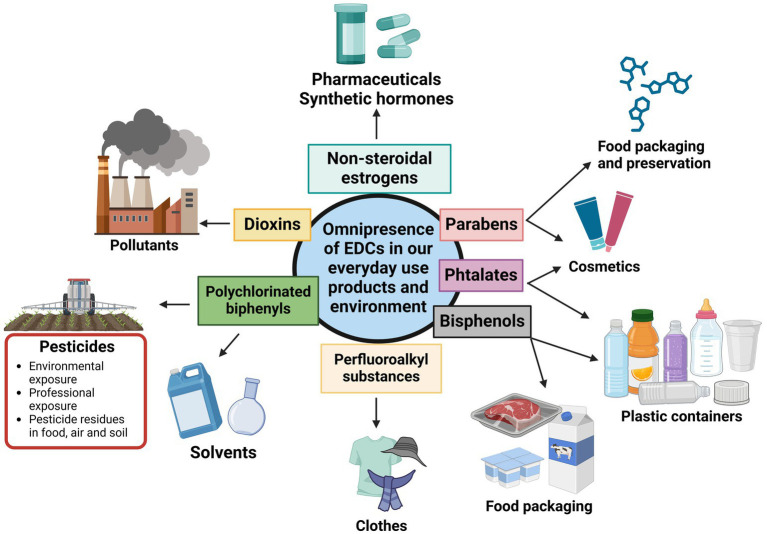
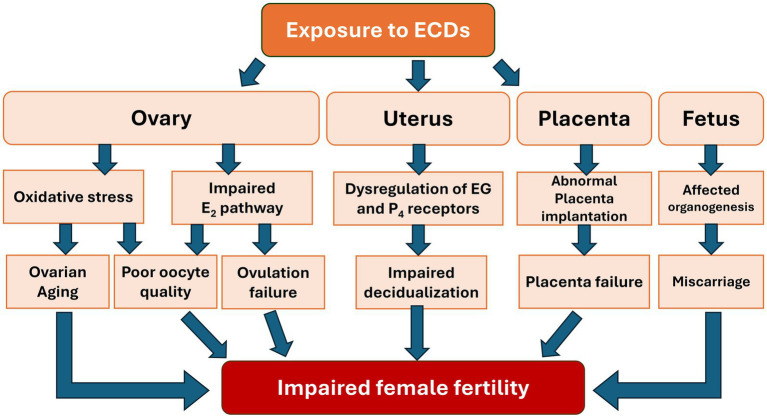
Over the last decades, human infertility has become a major concern in public health, with severe societal and health consequences. Growing evidence shows that endocrine disruptors chemicals (EDCs) have been considered as risk factors of infertility. Their presence in our everyday life has become ubiquitous because of their universal use in food and beverage containers, personal care products, cosmetics, phytosanitary products. Exposure to these products has an impact on human reproductive health. Recent studies suggest that women are more exposed to EDCs than men due to higher chemical products use. The aim of this review is to understand the possible link between reproductive disorders and EDCs such as phthalates, bisphenol, dioxins, and pesticides. In women, the loss of endocrine balance leads to altered oocyte maturation, competency, anovulation and uterine disorders, endometriosis, premature ovarian insufficiency (POI) or embryonic defect and decreases the in vitro fertilization outcomes. In this review, we consider EDCs effects on the women's reproductive system, embryogenesis, with a focus on associated reproductive pathologies.
Keywords: endocrine disrupting chemicals; endometriosis; epigenetic; female fertility; female reproductive disorder; infertility; pesticides.
Copyright © 2024 Tricotteaux-Zarqaoui, Lahimer, Abou Diwan, Corona, Candela, Cabry, Bach, Khorsi-Cauet and Benkhalifa.
Conflict of interest statement
The authors declare that the research was conducted in the absence of any commercial or financial relationships that could be construed as a potential conflict of interest.
Figures
References
-
- Universal Declaration of Human Rights. Paris: United Nations General Assembly; (1948). Available at: https://www.un.org/en/about-us/universal-declaration-of-human-rights
-
- Thoma M, Fledderjohann J, Cox C, Adageba RK. Biological and social aspects of human infertility: a global perspective In: Oxford research encyclopedia of global public health. Oxford: Oxford University Press; (2021)
-
- Wang Y, Fu Y, Ghazi P, Gao Q, Tian T, Kong F, et al. Prevalence of intimate partner violence against infertile women in low-income and middle-income countries: a systematic review and meta-analysis. Lancet Glob Health. (2022) 10:e820–30. doi: 10.1016/S2214-109X(22)00098-5, PMID: - DOI - PMC - PubMed
-
- Goal 3 | Department of Economic and Social Affairs. Available at: https://sdgs.un.org/goals/goal3 (Accessed 20th March 2024).
-
- Infertility . World Health Organization. Available at: https://www.who.int/news-room/fact-sheets/detail/infertility (Accessed 26th February 2024).
Publication types
MeSH terms
Substances
LinkOut - more resources
Full Text Sources
Medical
