


Gender-specific perception of job stressors and resources: a structural equation model-based secondary analysis
- PMID: 39735767
- PMCID: PMC11671497
- DOI: 10.3389/fpubh.2024.1463868
Gender-specific perception of job stressors and resources: a structural equation model-based secondary analysis
Abstract
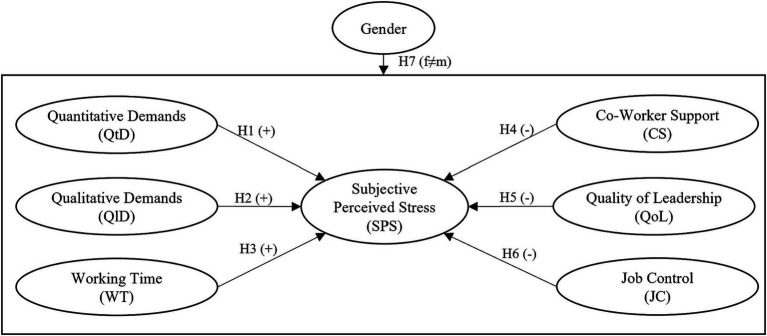
Objective: Stress is an extensive issue in modern society, affecting men and women differently. A better understanding of these patterns is required within the work context. Therefore, this study aimed to identify gender differences in the effects of stressors (quantitative demands, qualitative demands, working time) and resources (job control, quality of leadership, co-worker support) on subjective perceived stress across occupational groups.
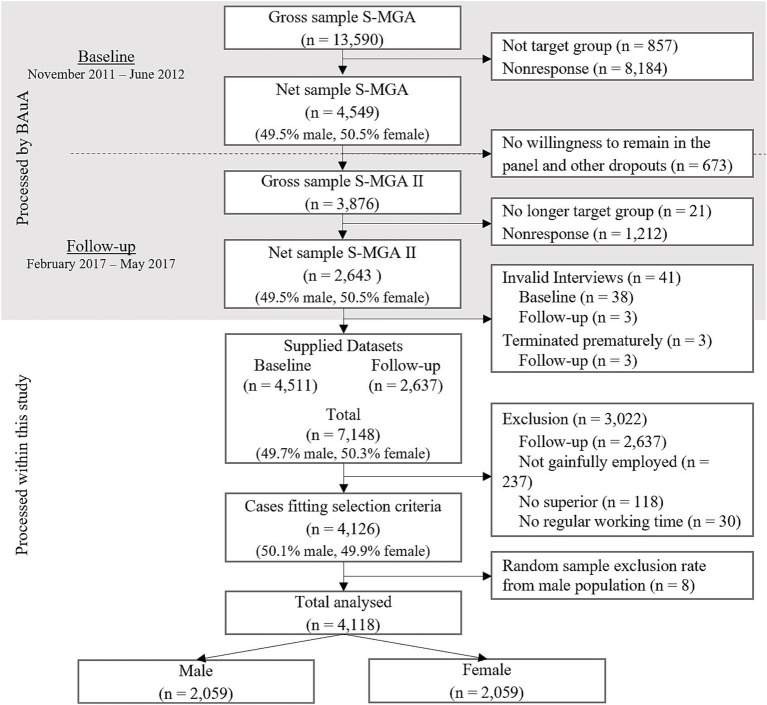
Methods: This study was conducted as a secondary data analysis based on the 'German Study on Mental Health at Work' data. The national representative cross-sectional sample included 4,118 employees. The data were analyzed using structural equation modeling.
Results: Correlations between quantitative demands, working time, co-worker support, quality of leadership, job control, and subjective perceived stress were first confirmed for a total sample of employees. Gender differences in these interactions were then analyzed using multi-group equation modeling and a gender-stratified sample. Men and women showed an increase in subjective perceived stress for high quantitative demands. This increase was more prominent for men. Women further showed an increase in subjective perceived stress in response to long working time. High co-worker support, quality of leadership, and job control had stress-reducing effects but did not result in significant gender differences. No association was found between qualitative demands and subjective perceived stress.
Conclusion: The results underline that not all working conditions significantly impact stress for both genders and gender differences exist only within the stressors. Hence, gendered strategies may only be required in some constellations. However, specific contexts require integrating gendered approaches in research and operational practice.
Keywords: co-worker support; gender; job demands; job resources; leadership; stress; work; work time.
Copyright © 2024 Heub, Schaller and Lange.
Conflict of interest statement
The authors declare that the research was conducted in the absence of any commercial or financial relationships that could be construed as a potential conflict of interest.
Figures
References
-
- Ernst G, Franke A, Franzkowiak P. Stress und Stressbewältigung. (2022). Available at: https://leitbegriffe.bzga.de/alphabetisches-verzeichnis/stress-und-stres... (Accessed on October 19th, 2023).
-
- Kaluza G. Stressbewältigung: Trainingsmanual zur psychologischen Gesundheitsförderung. Berlin, Heidelberg: Springer Berlin Heidelberg; (2018).
-
- Froböse I, Wallmann-Sperlich B. Der DKV-Report 2021 Wie gesund lebt Deutschland? [Internet]. (2021). Available from: https://www.dkv.com/downloads/DKV-Report-2021.pdf (Accessed October 14, 2023).
-
- Atkinson S, Boyon N. World mental health day 2022: A global advisor survey. (2022). Available at: https://www.ipsos.com/sites/default/files/ct/news/documents/2022-10/Ipso... (Accessed on October 28th, 2023).
-
- Anderson NB, Belar CD, Breckler SJ, Nordal KC, Ballard DW, Bufka LF, et al. . Stress In America: Paying with our health [internet] American Psychological Association; (2015). Washington, DC, U.S.
MeSH terms
LinkOut - more resources
Full Text Sources
Medical
