


SLC26A3 (DRA, the Congenital Chloride Diarrhea Gene): A Novel Therapeutic Target for Diarrheal Diseases
- PMID: 39736385
- PMCID: PMC12003007
- DOI: 10.1016/j.jcmgh.2024.101452
SLC26A3 (DRA, the Congenital Chloride Diarrhea Gene): A Novel Therapeutic Target for Diarrheal Diseases
Abstract
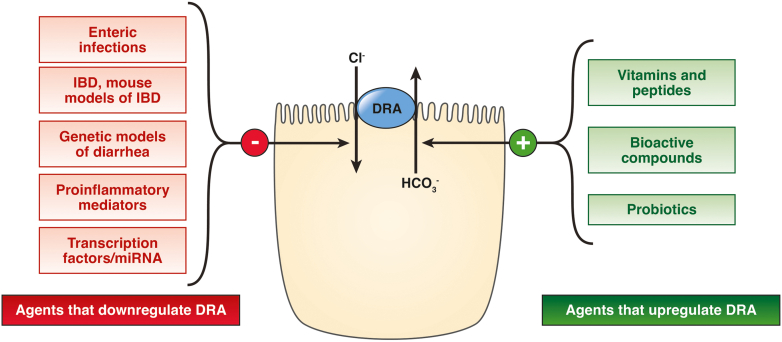
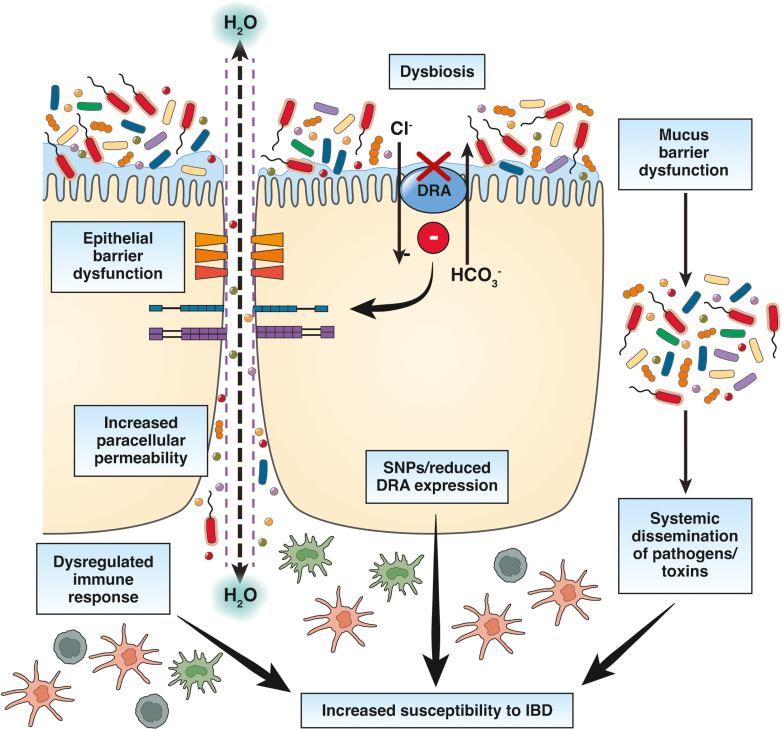
Diarrhea associated with enteric infections, gut inflammation, and genetic defects poses a major health burden and results in significant morbidity and mortality. Impaired fluid and electrolyte absorption or secretion in the intestine are the hallmark of diarrhea. Electroneutral NaCl absorption in the mammalian GI tract involves the coupling of Na+/H+ and Cl-/HCO3- exchangers. SLC26A3 (Down Regulated in Adenoma, DRA) is the major anion exchanger involved in luminal Cl- absorption and HCO3- secretion. Mutations in the SLC26A3 gene cause a severe disease called congenital chloride diarrhea (CLD). Multiple studies have shown that DRA function or expression is downregulated in infectious diarrheal disorders caused by EPEC, C rodentium, Salmonella, Clostridioides difficile and Cryptosporidium parvum infection. In addition, DRA levels are severely depleted in colonic mucosa of IBD patients and in mouse models of IBD (eg, DSS, TNBS, adoptive T-cell transfer, anti-CD-40, and IL-10 KO colitis). In addition, genetic defects exhibiting diarrhea including microvillus inclusion disease (MVID), keratin-8 depletion, knock-out mouse models of transcriptional factors (eg, CDX-2 and HNF1α/1β) also exhibit severe down regulation of DRA. Also, recent studies have shown that DRA is not only critical for chloride absorption but also plays a key role in maintaining gut epithelial barrier integrity, microbiome composition, and has now emerged as an IBD susceptibility gene. In this review, we provide strong evidence that DRA may serve as a novel therapeutic target with dual benefits in not only correcting diarrheal phenotype but also improving gut barrier integrity and inflammation in pathogen infection or IBD.
Keywords: Anion Transporter; Chloride/Bicarbonate exchanger; Electrolyte Absorption; Gut-Microbe Interactions; Infectious Diarrhea; Inflammatory Bowel Diseases.
Copyright © 2025 The Authors. Published by Elsevier Inc. All rights reserved.
Figures
References
-
- Alam N.H., Ashraf H. Treatment of infectious diarrhea in children. Pediatric Drugs. 2003;5:151–165. - PubMed
-
- Huttly S.R. The impact of inadequate sanitary conditions on health in developing countries. World health statistics quarterly Rapport trimestriel de statistiques sanitaires mondiales. 1990;43:118–126. - PubMed
-
- Vernia P., Gnaedinger A., Hauck W., et al. Organic anions and the diarrhea of inflammatory bowel disease. Dig Dis Sci. 1988;33:1353–1358. - PubMed
Publication types
MeSH terms
Substances
Supplementary concepts
Grants and funding
LinkOut - more resources
Full Text Sources
Medical
Research Materials
