


Impact of periodontal microRNAs associated with alveolar bone remodeling during orthodontic tooth movement: a randomized clinical trial
- PMID: 39736760
- PMCID: PMC11684316
- DOI: 10.1186/s12967-024-05933-x
Impact of periodontal microRNAs associated with alveolar bone remodeling during orthodontic tooth movement: a randomized clinical trial
Abstract
Background: Micro-RNAs (miRNAs) have been reported to play an important role during orthodontic tooth movement (OTM) through the regulation of periodontal soft and hard tissue homeostasis and functions. The aim of the present study was to assess the effects of miRNAs on OTM and to evaluate possible predictors that influenced the overall OTM amount at a 3-month follow-up.
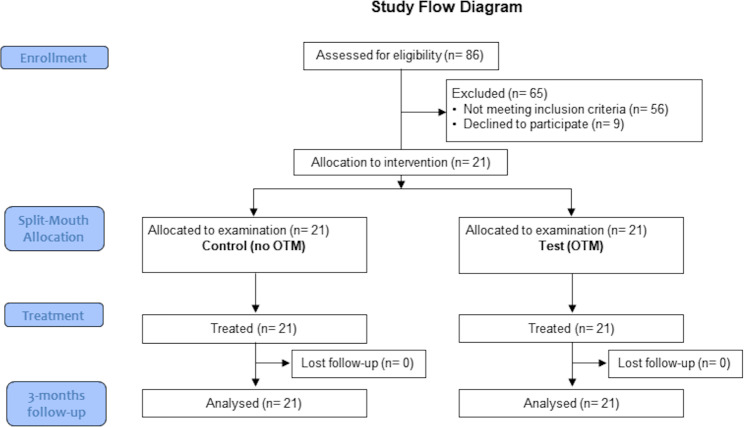
Methods: Through a split-mouth design, 21 healthy patients (mean age 13.2 ± 1.8 years) were enrolled in the present study. Clinical parameters and gingival crevicular fluid (GCF) sampling were performed on both compression and tension sides of a random canine to be distalized (test groups) at baseline and at 1 h, 1 day, 1 month and at 3-month after OTM, while the contralateral canine served as a control group. miRNAs - 7a-3p, -7a-2-3p, -7a-5p, -21-3p, -21-5p, -100-3p, -100-5p, -125b-2-3p, -125b-5p, -200b-3p, and - 200b-5p expression was analyzed using a real-time quantitative polymerase chain reaction (RT-PCR). Data were analyzed to assess miRNAs change following OTM. Spearman test, two-way ANOVA and a multivariate regression model were established to evaluate the correlation among miRNAs and clinical parameters and to explore possible predictors of OTM amount at 3-month follow-up.
Results: At 3-month follow-up, there was an increase of miRNA-7a-2-3p, -21-5p, -100-5p, a decrease of miRNA-125b-5p, 200b-3p and - 200b-5p in the compression side and an increase of miRNA-7a-3p, 100-5p in the tension side (p < 0.05). The two-way ANOVA revealed that OTM determined, on the compression side, a significant upregulation on miRNA-7a-3p (p = 0.017), -7a-2-3p (p = 0.023), -21-5p (p = 0.007), -100-5p (p = 0.025) and a significant downregulation of miRNA-125b-2-3p (p = 0.019) and - 200b-5p (p = 0.017). The multivariate model highlighted that high baseline miRNA-7a2-3p (p = 0.025), -21-5p (p = 0.014), -200b-3p (p = 0.041), young age (p = 0.042), lower bleeding on probing (BOP) (p = 0.021) and miRNA-125b-2-3p (p = 0.021) levels were significant predictors of OTM at 3-month follow-up.
Conclusions: In the present study, OTM significantly impacted the expression of the miRNAs analyzed, in both the tension and compression side of traction tooth at 3-month follow-up. High baseline miRNA-7a2-3p, -21-5p, -200b-3p, and lower miRNA-125b-2-3p, together with younger age and lower BOP, were significant predictors of OTM amount at 3-month follow-up.
Trial registration: ClinicalTrials.gov NCT06023433 (retrospectively registered).
Keywords: Biomarker; Clinical trial; Osteoclastogenesis; Periodontal ligament; Tooth movement; microRNA.
© 2024. The Author(s).
Conflict of interest statement
Declarations. Ethics approval and consent to participate: The ethical approval was obtained from the local Institutional Review Board of the University of Catania, Catania, Italy (24/12/PAR). Consent for publication: Not applicable. Competing interests: The authors declare that they have no competing interest. Competing interests: The authors declare that they have no competing interests.
References
-
- Kang Y-G, Nam J-H, Kim K-H, Lee K-S. FAK pathway regulates PGE2 production in compressed periodontal ligament cells. J Dent Res. 2010;89:1444–9. - PubMed
-
- Isola G, Matarese G, Cordasco G, Perillo L, Ramaglia L. Mechanobiology of the tooth movement during the orthodontic treatment: a literature review. Minerva Stomatol 2016. - PubMed
-
- Yamaguchi M. RANK/RANKL/OPG during orthodontic tooth movement. Orthod Craniofac Res. 2009;12:113–9. - PubMed
Publication types
MeSH terms
Substances
Associated data
Grants and funding
LinkOut - more resources
Full Text Sources
Medical
