


Seroprevalence of bovine Herpesvirus-1, bovine viral diarrhoea virus, Neospora caninum and Coxiella burnetii in dairy cows in Ethiopia
- PMID: 39736785
- PMCID: PMC11684144
- DOI: 10.1186/s13104-024-07059-1
Seroprevalence of bovine Herpesvirus-1, bovine viral diarrhoea virus, Neospora caninum and Coxiella burnetii in dairy cows in Ethiopia
Abstract
Background: The reproductive problem is an animal health-related bottleneck that constrains livestock genetic improvement efforts in tropical countries such as Ethiopia. The infectious causes of reproductive disorders are one cause of decreased reproductive efficiency. This study aimed to determine the seroprevalence to Bovine Herpesvirus-1 (BHV1), Bovine Viral Diarrhea Virus (BVDV), Neospora caninum (N. caninum) and C. burnetii (C. burnetii) exposures in dairy cows with reproductive disorders in selected areas of Ethiopia. Overall, 164 serum samples were collected from October 2018 to May 2019 from animals with a history of reproductive disorders. The collected sera were tested for antibody titers to Brucella species, N. caninum, BVDV, BHV1, C. burnetii and Chlamydophila abortus (C. abortus) using Rose Bengal and ELISA.
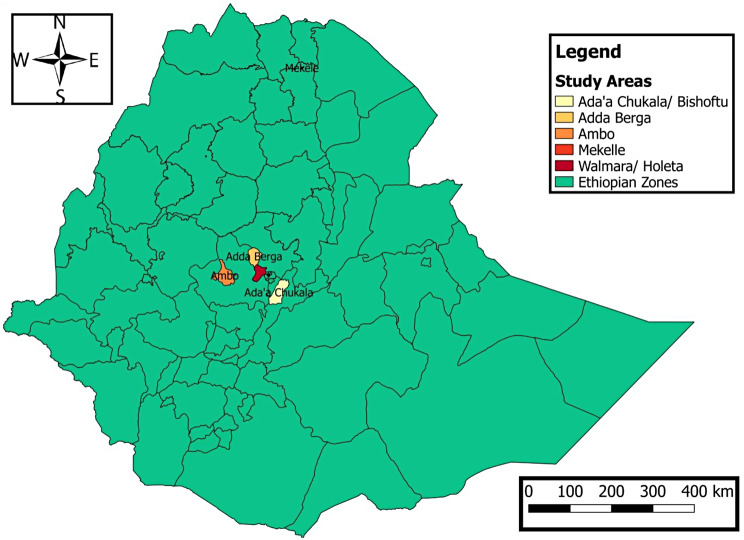
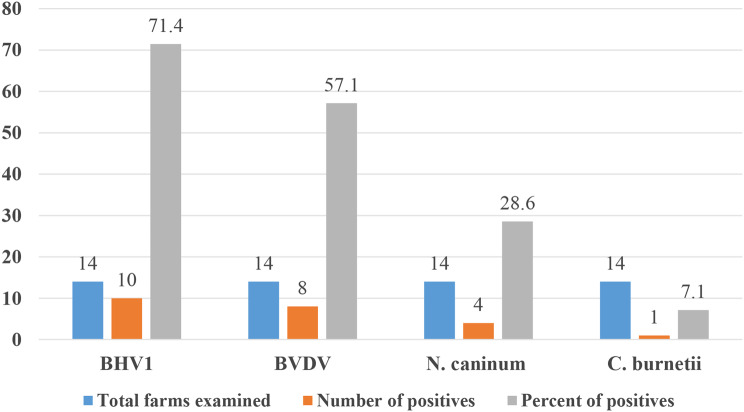
Results: The apparent seroprevalence of BHV1, BVDV, N. caninum and C. burnetii were 61%, 33.5%, 4.9% and 0.6%, respectively. Among the selected study areas, the mean apparent seroprevalence was significantly greater in Bishoftu (35.9%), Holeta (34.2%) and Adaberga (28.6%) than in Mekelle (9.9%) and Ambo (16.2%). Among the specific seroprevalence in specific areas, BHV1 was the most common in Adaberga, with an apparent seroprevalence of 92.9%. Similarly, the seroprevalence of BVDV was the highest in Holeta, with an apparent seroprevalence of 73.3%. On the other hand, no seropositive animal to Brucella spp. or C. abortus was found in these study areas.
Conclusion: BVDV and BHV1 seroprevalence was higher in dairy cattle with a history of reproductive disorder in Ethiopia as compared to the seroprevalence of N. caninum and C. burnetii.
Keywords: Dairy cattle; Ethiopia; Reproductive problems.
© 2024. The Author(s).
Conflict of interest statement
Declarations. Ethics approval and consent to participate: Ethical approval to conduct the study was obtained from the Ethiopian Institute of Agricultural Research. The Ethiopian Institute of Agricultural Research, established as federal agricultural research by Order No. 42 of 1966 and amended by Proclamation No. 79/1997 of the Federal Democratic Republic of Ethiopia, mandates research on animals, plants, and natural resources in the country. Before starting blood collection, letter of consent was read to district and areas leaders as well as farm owners stating the objectives of the research, and the right to refuse to participate in the research. Blood samples were then collected after verbal consent was obtained from these district and area leaders as well as farm owners. All research activities were conducted according to the rules and guidelines of the research institute. Consent for publication: Not applicable. Competing interests: The authors declare no competing interests.
Figures
Similar articles
-
Seroprevalence of antibodies for bovine viral diarrhoea virus, Brucella abortus and Neospora caninum, and their roles in the incidence of abortion/foetal loss in dairy cattle herds in Nakuru District, Kenya.BMC Vet Res. 2019 Mar 18;15(1):95. doi: 10.1186/s12917-019-1842-8. BMC Vet Res. 2019. PMID: 30885192 Free PMC article.
-
Serological evidence of Coxiella burnetii, Leptospira interrogans Hardjo, Neospora caninum and bovine pestivirus infections in a dairy cattle herd from the United Arab Emirates.Vet Ital. 2020 Dec 1;56(3):163-168. doi: 10.12834/VetIt.2257.12932.1. Vet Ital. 2020. PMID: 33543911
-
Reproductive disorders in relation to Neospora caninum, Brucella spp. and bovine viral diarrhoea virus serostatus in breeding and dairy farms of central and southern Ethiopia.Epidemiol Infect. 2013 Aug;141(8):1772-80. doi: 10.1017/S0950268812002191. Epub 2012 Oct 4. Epidemiol Infect. 2013. PMID: 23034138 Free PMC article.
-
Coxiella burnetii associated with BVDV (Bovine Viral Diarrhea Virus), BoHV (Bovine Herpesvirus), Leptospira spp., Neospora caninum, Toxoplasma gondii and Trypanosoma vivax in reproductive disorders in cattle.Rev Bras Parasitol Vet. 2019 Jun 13;28(2):245-257. doi: 10.1590/S1984-29612019032. Rev Bras Parasitol Vet. 2019. PMID: 31215610
-
Neospora caninum and bovine virus diarrhoea virus infections in Swedish dairy cows in relation to abortion.Vet J. 2000 Mar;159(2):201-6. doi: 10.1053/tvjl.1999.0446. Vet J. 2000. PMID: 10712809
References
-
- Ansari-lari M, Kafi M. Reproductive performance of Holstein dairy cows in Iran Reproductive performance of Holstein dairy cows in Iran. 2010;(May 2018). - PubMed
-
- López-Gatius F. Approaches to increase reproductive efficiency in artificially inseminated dairy cows. Anim Reprod [Internet]. 2013;10(3):143–7. Available from: http://www.cbra.org.br/pages/publicacoes/animalreproduction/issues/downl... (AR635).pdf.
-
- Clothier K, Anderson M. California Animal Health & Food Safety Lab System, School of Veterinary Medicine and. Theriogenology [Internet]. 2015; Available from: 10.1016/j.theriogenology.2015.11.001
-
- Mellado M, López R, de Santiago Á, Veliz FG, Macías-Cruz U, Avendaño-Reyes L, et al. Climatic conditions, twining and frequency of milking as factors affecting the risk of fetal losses in high-yielding Holstein cows in a hot environment. Trop Anim Health Prod. 2016;48(6):1247–52. - PubMed
-
- Penagos-Tabares F, Mahmood M, Sulyok M, Rafique K, Khan MR, Zebeli Q et al. Outbreak of aflatoxicosis in a dairy herd induced depletion in milk yield and high abortion rate in Pakistan. Toxicon [Internet]. 2024;246(March):107799. Available from: 10.1016/j.toxicon.2024.107799 - PubMed
MeSH terms
Substances
LinkOut - more resources
Full Text Sources
Miscellaneous
