


Prospects of e-Coaching as a Platform for Empowering Families of Person With Mental Disorder: A Qualitative Study
- PMID: 39736845
- PMCID: PMC11683820
- DOI: 10.1177/23779608241282161
Prospects of e-Coaching as a Platform for Empowering Families of Person With Mental Disorder: A Qualitative Study
Abstract
Introduction: In all countries, the burden of mental disorders (MDs) spans the entire life course. Smartphones are currently widely used by families with a history of MD looking for the required mental health information. The use of digital media is an alternative to improving the ability of families to care for person with MD at home.
Objectives: This study aimed to explore the opportunity and the benefits of e-coaching as a method and media for empowering families of MD person.
Methods: This study was a qualitative study that recruited 21 participants. The mean age was 45.7 years old, male 42.9%, and female 47.1%. They were divided into four groups: families who have a family member with MD, nurses who provide mental health services, mental health cadres, and government elements in Pekalongan, Central Java, Indonesia. An in-depth interview was applied to collect data. Further, the data were analyzed using thematic content analysis using Colaizzi's frame.
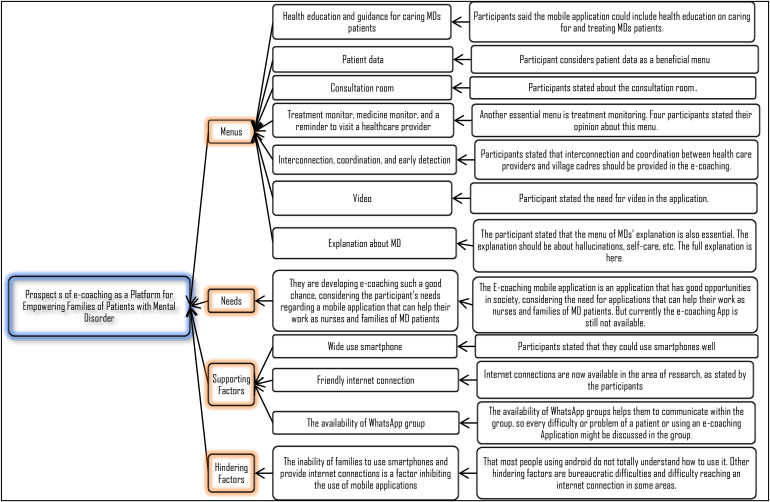
Results: There were four themes related to the possibility of using e-coaching to empower families with a family member with MD: menus, needs, supporting factors, and hindering factors. The use of information technology can be used to improve the ability to take care of families, especially in treating MDs at home with the e-coaching application.
Conclusions: The findings show that developing e-coaching as a method and media is beneficial for person, families, and healthcare providers. In an effort to increase families' capacity to treat MD at home, the findings of this study might be used to create an easy-to-use smartphone e-coaching application.
Recommendation: It is essential to establish e-coaching through a smartphone-based application in the Indonesian context. Additionally, to better treat MD person, nurses who provide mental health care should consider utilizing the mobile application.
Keywords: colaizzi's frame; e-coaching; family empowerment; mental disorder.
© The Author(s) 2024.
Conflict of interest statement
The authors declared no potential conflicts of interest with respect to the research, authorship, and/or publication of this article.
References
-
- Aass L. K., Skundberg-Kletthagen H., Schrøder A., Moen ØL. (2020). Young adults and their families living with mental illness: Evaluation of the usefulness of family-centered support conversations in community mental health care settings. Journal of Family Nursing, 26(4), 302–314. 10.1177/1074840720964397 - DOI - PMC - PubMed
-
- Aidemark J. (2022). Care by video consultations: Why or why not? Procedia Computer Science, 196, 400–408. 10.1016/j.procs.2021.12.029 - DOI
-
- Allemand M., Flückiger C. (2022). Personality change through digital-coaching interventions. Current Directions in Psychological Science, 31(1), 41–48. 10.1177/09637214211067782 - DOI
-
- Aree-Ue S., Roopsawang I., Saraboon Y., Youngcharoen P., Belza B., Kawinwonggowit V. (2022). A comprehensive health education plus monitoring support program for older adults with knee osteoarthritis coexisting with overweight and type 2 diabetes. International Journal of Nursing Sciences, 9(4), 512–520. 10.1016/j.ijnss.2022.08.002 - DOI - PMC - PubMed
LinkOut - more resources
Full Text Sources
Research Materials
Miscellaneous