


Risk stratification and contributing factors of deep vein thrombosis among patients admitted at Debre Markos comprehensive specialized hospital, Ethiopia in 2024
- PMID: 39736980
- PMCID: PMC11683679
- DOI: 10.3389/fmed.2024.1470212
Risk stratification and contributing factors of deep vein thrombosis among patients admitted at Debre Markos comprehensive specialized hospital, Ethiopia in 2024
Abstract
Introduction: Deep vein thrombosis is a serious condition and a leading cause of morbidity and mortality in hospitalized patients. Studies conducted in various hospitals in Ethiopia have reported that the prevalence rates of deep vein thrombosis range from approximately 5-10% among hospitalized patients. The risk stratification of deep vein thrombosis and the identification of associated risk factors are critical for assessing deep vein thrombosis in hospital settings. Wells scoring provides a valuable framework for assessing individual risk. This study aims to assess the risk stratification of deep vein thrombosis and to identify the risk factors among patients admitted at Debre Markos Comprehensive Specialized Hospital.
Method: A facility-based cross-sectional study was conducted from December 2023 to February 2024. The study included 423 adult patients, and the data were collected using a structured questionnaire and chart review. Ordinal logistic regression analysis was conducted after performing the model test.
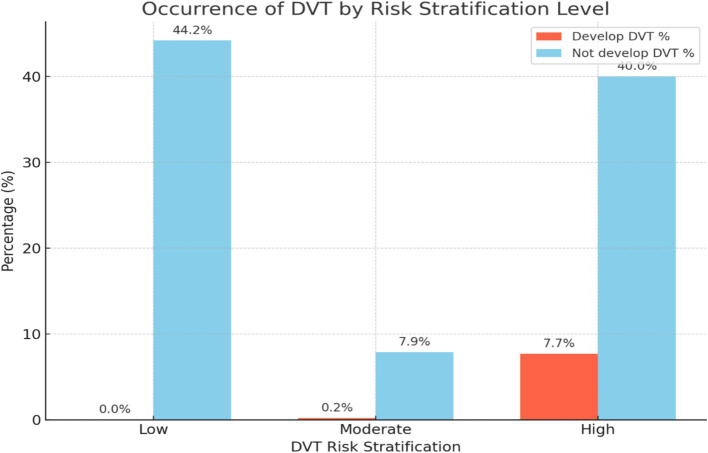
Result: The prevalence of deep vein thrombosis was found to be 7.9%, with 44.2% categorized as having no risk, 8.1% as moderate risk, and 47.7% as high risk for deep vein thrombosis stratification. Various risk factors, such as regular alcohol consumption (odd ratio 4.59, p = 0.032), a previous history of deep vein thrombosis (odd ratio 28.32, p = 0.000), the presence of a central catheter (odd ratio 12.92, p = 0.000), a severe lipid profile (odd ratio 3.8, p = 0.001), and a longer duration of stay in the ward (odd ratio 1.28, p = 0.000), were significantly associated with high risk for deep vein thrombosis stratification.
Conclusion: The prevalence of high-risk deep vein thrombosis stratification was found to be high, and the occurrence of deep vein thrombosis was also high within this risk group. Regular alcohol consumption, a previous history of deep vein thrombosis, the presence of a central catheter, a severe lipid profile, and a longer duration of stay in the ward were statistically significant for high-risk deep vein thrombosis stratification. This study highlights the importance of identifying patients who are at high risk for deep vein thrombosis stratification and addressing the risk factors for deep vein thrombosis stratification.
Keywords: Ethiopia; Wells Clinical Prediction Model; deep vein thrombosis; prevalence; stratification.
Copyright © 2024 Mitiku, Assefa Addis, Edmealem, Tsegaye, Biyazin and Abate.
Conflict of interest statement
The authors declare that the research was conducted in the absence of any commercial or financial relationships that could be construed as a potential conflict of interest.
Figures
References
-
- Palkar AV, Karnik ND. Risk stratification, prevalence by hand-held microdoppler and in-hospital mortality of deep venous thrombosis in indoor geriatric population. J Assoc Physicians India. (2013) 61:539–42. PMID: - PubMed
LinkOut - more resources
Full Text Sources
