. 2024 Dec 16:18:1478508.
doi: 10.3389/fnins.2024.1478508. eCollection 2024.

Adolescent circadian rhythm disruption increases reward and risk-taking

Affiliations

Adolescent circadian rhythm disruption increases reward and risk-taking

Lauren M DePoy et al. Front Neurosci. .

Abstract

Introduction: Circadian rhythm disturbances have long been associated with the development of psychiatric disorders, including mood and substance use disorders. Adolescence is a particularly vulnerable time for the onset of psychiatric disorders and for circadian rhythm and sleep disruptions. Preclinical studies have found that circadian rhythm disruption (CRD) impacts the brain and behavior, but this research is largely focused on adult disruptions. Here, we hypothesized that adolescent CRD would have a greater effect on psychiatric-related behaviors, relative to adult disruption.

Methods: We determined the long-term behavioral and neurobiological effects of CRD during early adolescence by exposing mice to 12 h shifts in the light/dark cycle. Adult mice were exposed to the same CRD paradigm. Behavior testing began approximately 4 weeks later for both groups. To identify possible mechanisms, we also measured gene expression in brain regions relevant to circadian rhythms, mood and reward.

Results: CRD during early adolescence, but not adulthood, persistently increased exploratory drive (risk-taking behavior) and cocaine preference when tested later in life. Interestingly, we found sex differences when intravenous cocaine self-administration was tested. While female mice with a history of adolescent CRD had a greater propensity to self-administer cocaine, as well as increased motivation and cue-induced reinstatement, male adolescent CRD mice had reduced motivation and extinction responding. Importantly, we found that transcripts in the SCN were affected by adolescent CRD and these were largely distinct across sex.

Conclusion: Overall, adolescent CRD in mice caused persistent increases in risky behavior, cocaine reward and cocaine self-administration, which suggests that CRD during adolescence may predispose individuals toward substance use disorders. Future research is required to elucidate how adolescent CRD affects behaviors relevant to mood-and substance use-related disorders across the 24-h day, as well as to identify intervention strategies to alleviate disruption during adolescence and novel therapeutic approaches once symptoms have begun.

Keywords: adolescence; anxiety; circadian disruption; cocaine; reward; risk-taking.


Conflict of interest statement

The authors declare that the research was conducted in the absence of any commercial or financial relationships that could be construed as a potential conflict of interest. The author(s) declared that they were an editorial board member of Frontiers, at the time of submission. This had no impact on the peer review process and the final decision.

Figures
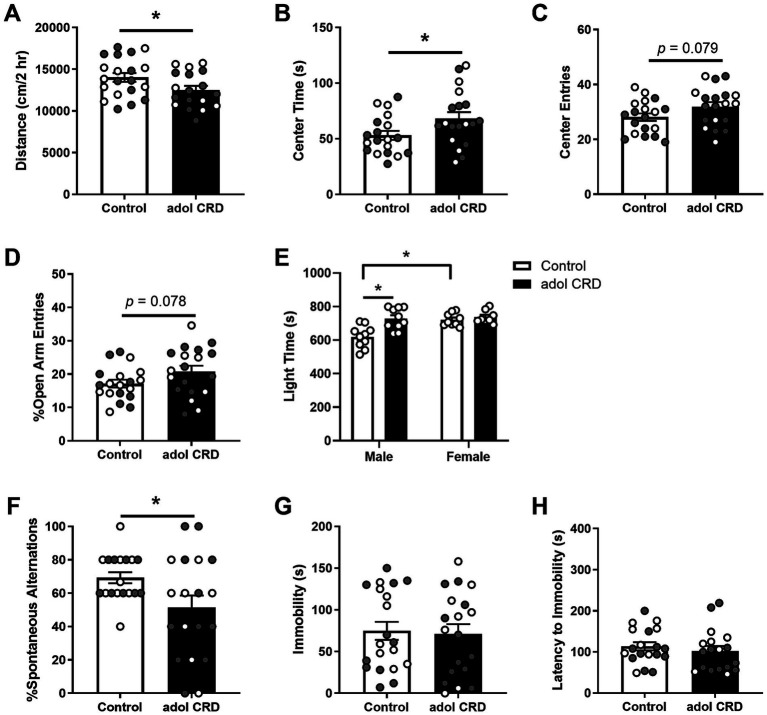
Figure 1
Figure 1
Adolescent CRD decreased locomotor activity in a novel environment (A). Adolescent CRD tended to increase exploratory drive in the open field (B,C), EPM (D), and LD box (E). Furthermore, adolescent CRD decreased spontaneous alternations in the T-maze, a measure of spatial working memory (F). There was no effect of adolescent CRD in the FST (G,H). Individual data points are shown for each sample with males indicated by gray-filled circles and females by open circles. Mean ± SEM, n = 18–20, *p ≤ 0.05.
Figure 2
Figure 2
CRD during adulthood had no effect on locomotor activity in a novel environment (A). Adult CRD had no effect on exploratory drive in the open field (B,C), EPM (D), or LD Box (E). Furthermore, adult CRD had no effect on spontaneous alternations in the T-maze (F) or immobility in the FST (G). However, adult CRD reduced latency to immobility in males in the FST (H). Individual data points are shown for each sample with males indicated by gray-filled circles and females by open circles. Mean ± SEM, n = 20–22, *p ≤ 0.05.
Figure 3
Figure 3
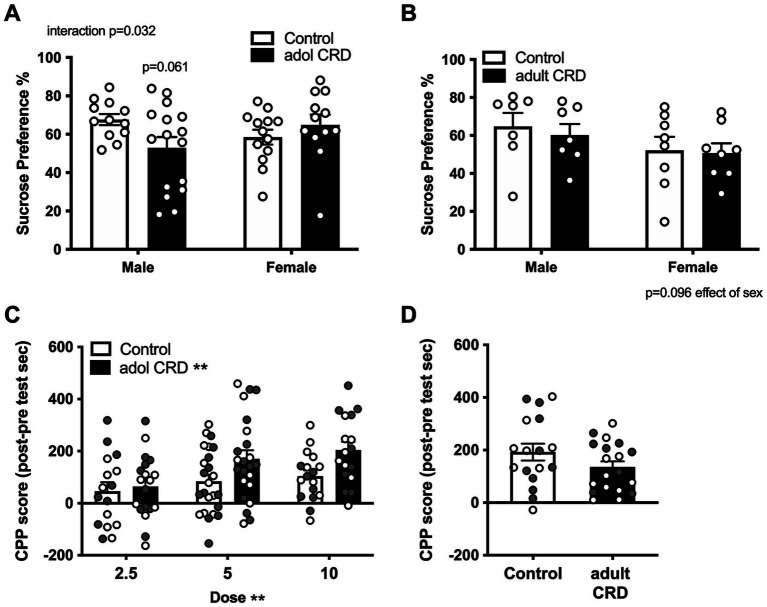
Effects of adolescent CRD and adult CRD on natural and cocaine reward. Adolescent CRD also altered sucrose preference, decreasing preference compared to controls in male mice, but not female mice (A). There was no effect of adult CRD (B) on sucrose preference. Adolescent CRD (C), but not adult CRD (D) increased cocaine CPP. Individual data points are shown for each sample with males indicated by gray-filled circles and females by open circles. Mean ± SEM, n = 12–16 for sucrose preference and 16–24 for CPP, *p ≤ 0.05.
Figure 4
Figure 4
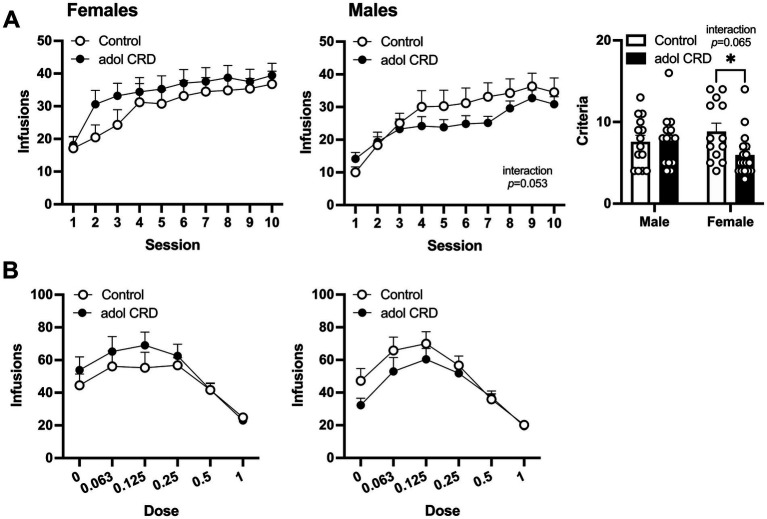
Effects of adolescent CRD on cocaine self-administration. (A) In females, adolescent CRD had no effect on the acquisition of cocaine self-administration (left). There was a trend for an interaction between the effects of adolescent CRD and session on the acquisition of cocaine self-administration in males (middle). Females with adolescent CRD reached the criteria for cocaine self-administration faster than controls (right). (B) Control and adolescent CRD female and male mice self-administered cocaine similarly in a dose–response curve. Mean ± SEM, n = 13–18, *p ≤ 0.05.
Figure 5
Figure 5
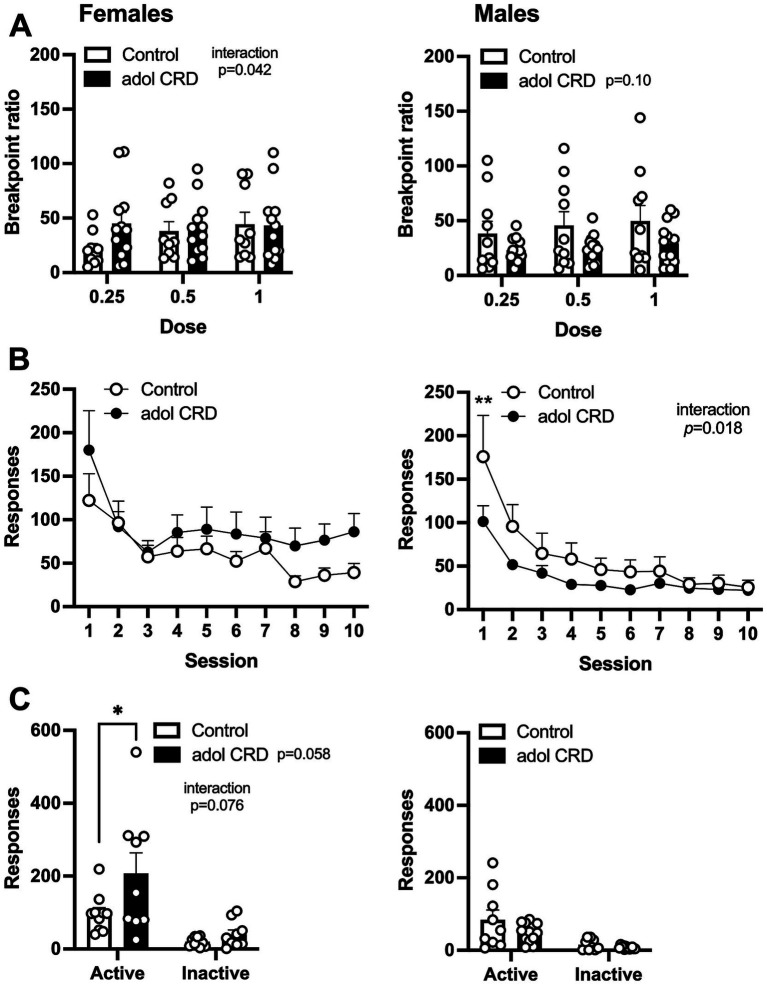
Effects of adolescent CRD on motivation, extinction, and cue-induced reinstatement. (A) There was a significant interaction between the effects of adolescent CRD and dose for motivation (breakpoint ratio) to self-administer cocaine in females, but no significant post-hocs were found (left). In males, there was a trend for adolescent CRD to reduce motivation to self-administer cocaine (right). (B) There was no effect of adolescent CRD on responding during extinction in female mice (left), while male mice with a history of CRD had reduced extinction responding (right). (C) For cue-induced reinstatement, responding was increased on the previously active lever in females with adolescent CRD (left), but no effect was found in males (right). Mean ± SEM, n = 9–13, *p ≤ 0.05.
Figure 6
Figure 6
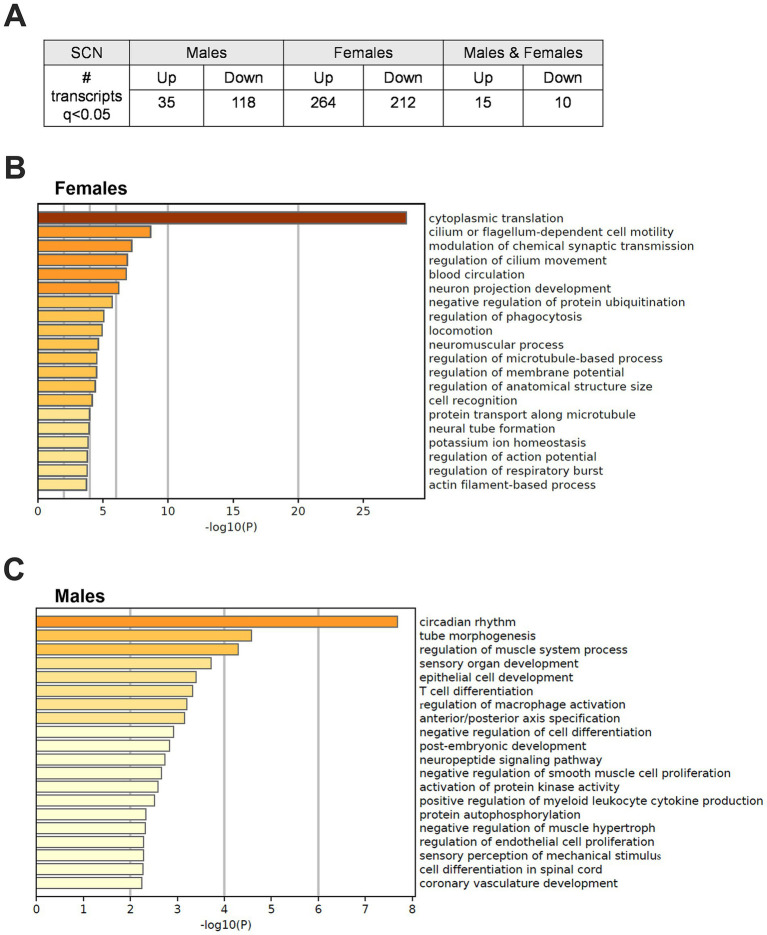
Differentially expressed transcripts following adolescent CRD in the SCN at ZT6. (A) Table listing the number of transcripts that are differentially expressed (DE) at ZT6 in adolescent CRD mice compared to controls in the SCN of males, females, or both combined at q < 0.05. (B) Metascape-derived heatmaps of biological processes enriched for DE transcripts (q < 0.05) in females and (C) males.

References

    1. Abarca C., Albrecht U., Spanagel R. (2002). Cocaine sensitization and reward are under the influence of circadian genes and rhythm. Proc. Natl. Acad. Sci. 99, 9026–9030. doi: 10.1073/pnas.142039099, PMID: - DOI - PMC - PubMed
    1. Albrecht A., Müller I., Ardi Z., Çalışkan G., Gruber D., Ivens S., et al. . (2017). Neurobiological consequences of juvenile stress: A GABAergic perspective on risk and resilience. Neurosci. Biobehav. Rev. 74, 21–43. doi: 10.1016/j.neubiorev.2017.01.005 - DOI - PubMed
    1. Ameen R. W., Warshawski A., Fu L., Antle M. C. (2022). Early life circadian rhythm disruption in mice alters brain and behavior in adulthood. Sci. Rep. 12:7366. doi: 10.1038/s41598-022-11335-0, PMID: - DOI - PMC - PubMed
    1. Andretic R., Chaney S., Hirsh J. (1999). Requirement of circadian genes for cocaine sensitization in Drosophila. Science 285, 1066–1068. doi: 10.1126/science.285.5430.1066 - DOI - PubMed
    1. Baird T. J., Gauvin D. V. (2000). Characterization of cocaine Self-administration and pharmacokinetics as a function of time of day in the rat. Pharmacol. Biochem. Behav. 65, 289–299. doi: 10.1016/S0091-3057(99)00207-5 - DOI - PubMed