


Evaluation of serum galectin-3 concentration as a potential biomarker in exudative-type age-related macular degeneration
- PMID: 39738409
- PMCID: PMC11685824
- DOI: 10.1038/s41598-024-83499-w
Evaluation of serum galectin-3 concentration as a potential biomarker in exudative-type age-related macular degeneration
Erratum in
-
Author Correction: Evaluation of serum galectin-3 concentration as a potential biomarker in exudative-type age-related macular degeneration.Sci Rep. 2025 Mar 18;15(1):9363. doi: 10.1038/s41598-025-92480-0. Sci Rep. 2025. PMID: 40102473 Free PMC article. No abstract available.
Abstract
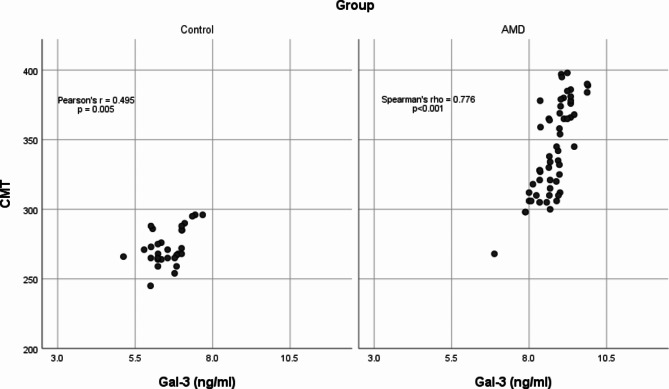
To investigate the effect of serum galectin-3 on naive neovascular AMD and its use as a serum marker by revealing the variation in this molecule between patient and control groups. Fifty-six naive neovascular AMD patients and 30 healthy control age-matched healthy subjects were included in this prospective case‒control study. Blood samples were obtained and used for analysis of complete blood count; High sensitivity C-reactive protein (HsCRP), erythrocyte sedimentation rate (ESR), low-density lipoprotein (LDL), high-density lipoprotein (HDL), triglyceride (TG), total cholesterol, homocysteine, HbA1c and galectin-3 levels. The average HsCRP level in the AMD group was significantly higher than that in the control group (p < 0.001). The median leukocyte count was significantly higher in the AMD group than in the control group (p < 0.001). Total cholesterol, LDL and TG levels were significantly higher in the AMD group than in the control group (p < 0.001; in all comparisons). The mean HDL level was significantly lower in the AMD group than in the control group (p < 0.001). The mean galectin-3 level was 8.79 ± 0.55 in the AMD group and 6.55 ± 0.55 in the control group. There was a statistically significant increase in galectin-3 levels in the AMD group (p < 0.001). There was a significant positive correlation between CMT and galectin-3 levels in the control (r = 0.495, p = 0.005) and AMD (r = 0.776, p < 0.001) groups. This study reports that serum Gal-3 concentration was higher in the AMD group compared to the control group and positively correlated with CMT.
Keywords: Age-related macular degeneration; Anjiography; Optic cohorence tomography; Serum galectin-3.
© 2024. The Author(s).
Conflict of interest statement
Declarations. Competing interests: The authors declare no competing interests. Ethics approval and consent to participate: The study protocol was approved by the local human research ethics committee from Recep Tayyip Erdogan University. Protocol number and date 2021/166 and 05.10.2021. All patients included in this study gave their informed consent, which adhered to the tenets of the Declaration of Helsinki, and written informed consent was obtained from all subjects. Consent was obtained from the patients. Consent was also obtained from our institution. Consent for publication: Consent was obtained from the patients. Consent was also obtained from our institution.
Figures
References
-
- Fine, S. L., Berger, J. W., Maguire, M. G. & Ho, A. C. Age-related macular degeneration. New. Engl. J. Med.342, 483–492 (2000). - PubMed
-
- Klein, R., Peto, T., Bird, A. & Vannewkirk, M. R. The epidemiology of age-related macular degeneration. Am. J. Ophthalmol.137, 486–495 (2004). - PubMed
-
- Kuehn, B. M. Gene discovery provides clues to cause of agerelated macular degeneration. JAMA293, 1841–1845 (2005). - PubMed
-
- Anderson, D. H., Mullins, R. F., Hageman, G. S. & Johnson, L. V. A role for local inflammation in the formation of drusen in the aging eye. Am. J. Ophthalmol.134, 411–431 (2002). - PubMed
-
- Campochiaro, P. A. Ocular neovascularization and excessive vascular permeability. Expert Opin. Biol. Ther.4, 1395–1402 (2004). - PubMed
Publication types
MeSH terms
Substances
LinkOut - more resources
Full Text Sources
Medical
Research Materials
Miscellaneous
