. 2024 Dec 30;14(1):32027.
doi: 10.1038/s41598-024-83689-6.

Temporal evolution of insecticide resistance and bionomics in Anopheles funestus, a key malaria vector in Uganda

Affiliations

Temporal evolution of insecticide resistance and bionomics in Anopheles funestus, a key malaria vector in Uganda

Ambrose Oruni et al. Sci Rep. .

Abstract

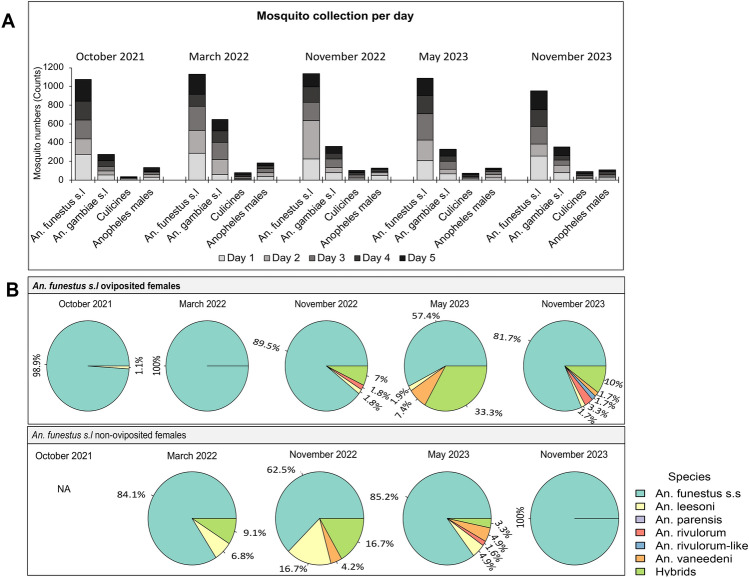
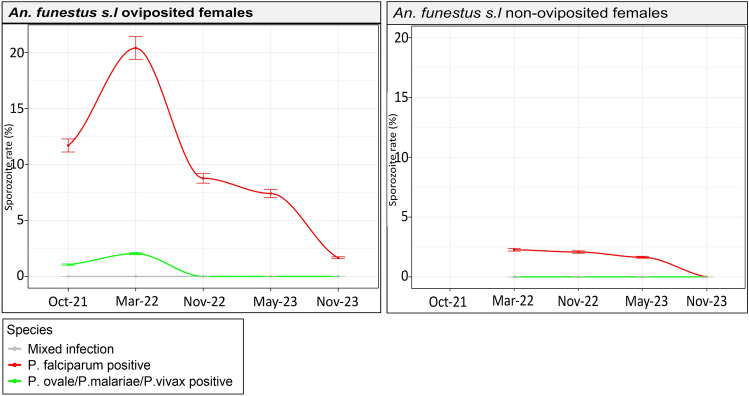
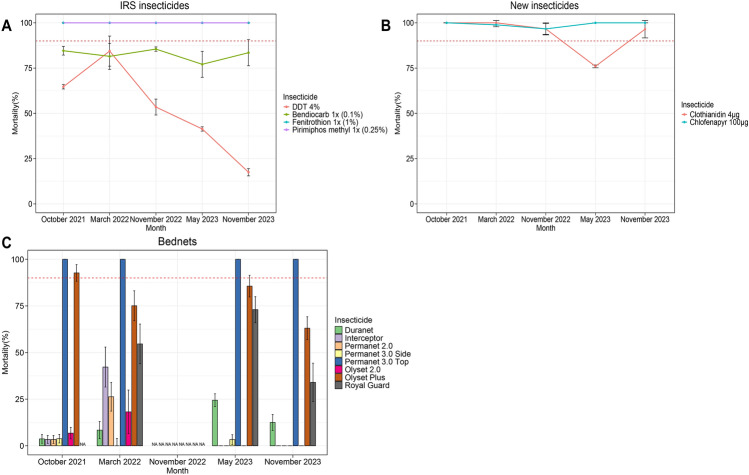
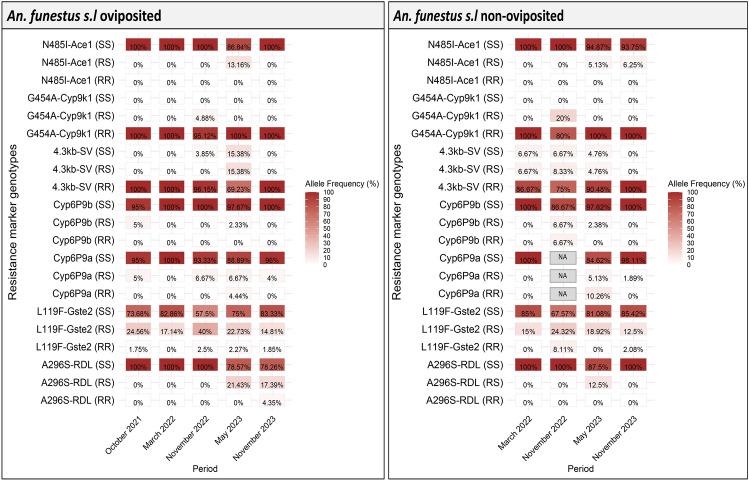
Insecticide resistance escalation is decreasing the efficacy of vector control tools. Monitoring vector resistance is paramount in order to understand its evolution and devise effective counter-solutions. In this study, we monitored insecticide resistance patterns, vector population bionomics and genetic variants associated with resistance over 3 years from 2021 to 2023 in Uganda. Anopheles funestus s.s was the predominant species in Mayuge but with evidence of hybridization with other species of the An. funestus group. Sporozoite infection rates were relatively very high with a peak of 20.41% in March 2022. Intense pyrethroid resistance was seen against pyrethroids up to 10-times the diagnostic concentration but partial recovery of susceptibility in PBO synergistic assays. Among bednets, only PBO-based nets (PermaNet 3.0 Top and Olyset Plus) and chlorfenapyr-based net (Interceptor G2) had high mortality rates. Mosquitoes were fully susceptible to chlorfenapyr and organophosphates, moderately resistant to clothianidin and resistant to carbamates. The allele frequency of key P450, CYP9K1, resistance marker was constantly very high but that for CYP6P9A/b were very low. Interestingly, we report the first detection of resistance alleles for Ace1 gene (RS = ~ 13%) and Rdl gene (RS = ~ 21%, RR = ~ 4%) in Uganda. The qRT-PCR revealed that Cytochrome P450s CYP9K1, CYP6P9A, CYP6P9b, CYP6P5 and CYP6M7 were consistently upregulated while a glutathione-S-transferase gene (GSTE2) showed low expression. Our study shows the complexity of insecticide resistance patterns and underlying mechanisms, hence constant and consistent spatial and temporal monitoring is crucial to rapidly detect changing resistance profiles which is key in informing deployment of counter interventions.

Keywords: Anopheles funestus; Genetic markers; Insecticide resistance; Phenotypes; Temporal; Uganda.


Conflict of interest statement

Competing interests: The authors declare no competing interests.

Figures
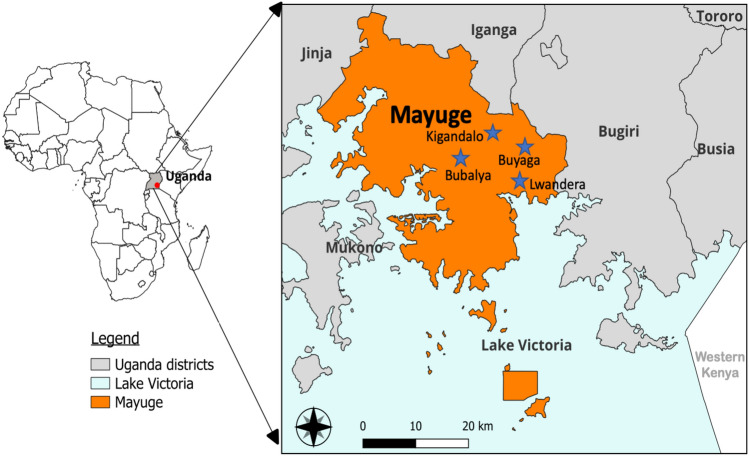
Fig. 1
Fig. 1
Map of mosquito collection sites within Mayuge district. Mayuge district is demarcated from other neighbouring districts by brown colour. The villages where households were recruited are marked with a blue star. The map was generated using free and open source QGIS software version 3.38.
Fig. 2
Fig. 2
Abundance and composition of mosquito vectors in Mayuge. Total number of mosquito vectors collected over a five-day period for each time point (A) and An. funestus s.l species composition in ovipoisted and non-oviposited females over five time points from 2021 to 2023 (B).
Fig. 3
Fig. 3
Sporozoite infection rates in field collected (F0) An. funestus mosquitoes. Plasmodium sporozoite infection rates in oviposited and non-oviposited wild An. funestus populations over five time points from 2021 to 2023. Error bars indicate a 5% error of the mean.
Fig. 4
Fig. 4
Mortality rates from F1 bioassays against pyrethroids. Point mortality rates of An. Funestus mosquitoes exposed to pyrethroids-only and pyrethroids + synergists. Error bars in the line graph and bar chart indicate confidence intervals calculated by SEM and NA indicate tests that were not performed. The red dotted horizontal line is 90% mortality cut-off, below which is confirmed resistance.
Fig. 5
Fig. 5
Mortality rates from F1 bioassays against insecticides used in IRS and bednets. Point mortality rates for insecticides DDT, Bendiocarb, Pirimiphos-methyl (A); clothianidin and chlorfenapyr (B) and LLINs (C). Error bars in both line and bar graph indicate confidence intervals calculated by SEM. NA indicate tests that were not performed. The dotted red horizontal line is 90% mortality cut-off, below which is confirmed resistance.
Fig. 6
Fig. 6
Insecticide resistance marker prevalence across five time points from 2021 to 2023. Point prevalence of major insecticide resistance markers in An. funestus. The different genotypes are shown in brackets and represented as; SS for homozygous susceptible/wild type, RS for heterozygous and RR for homozygous resistant/mutant.
Fig. 7
Fig. 7
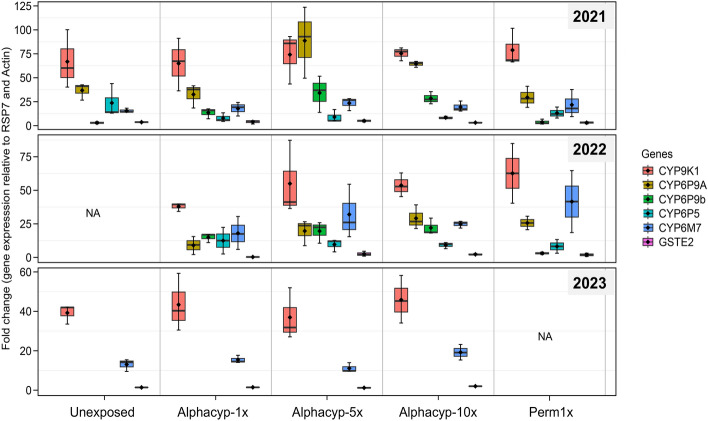
Fold change analysis of the expression of key genes across three years. Box plot shows the mean fold change expression of six key genes from three biological replicates. Error bars represent SEM. Abbreviated labels on the x-axis are; “Alphacyp” = Alpha-cypermethrin and “Perm” = Permethrin with the corresponding insecticide intensity of 1×, 5× and 10× as explained in Table 1. NA means the group was no assessed. Genes CYP6P9A, CYP6P9b and CYP6P5 were not analysed in 2023.

References

    1. WHO. World Malaria Report 2023. (2023).
    1. Kamya, M. R. et al. Dramatic resurgence of malaria after 7 years of intensive vector control interventions in Eastern Uganda. PLOS Glob. Public Health4, e0003254 (2024). - PMC - PubMed
    1. WHO. IMPLICATIONS OF INSECTICIDE RESISTANCE ON MALARIA VECTOR CONTROL Implications of Insecticide Resistance on Malaria Vector Control Project. (2016).
    1. Riveron, J. M. et al. Insecticide resistance in malaria vectors: An update at a global scale. in Towards Malaria Elimination—A Leap Forward (InTech, 2018). 7, 149–175 10.5772/intechopen.78375.
    1. Hancock, P. A. et al. Mapping trends in insecticide resistance phenotypes in African malaria vectors. PLoS Biol. 18(6), e3000633 (2020). - PMC - PubMed

Publication types

LinkOut - more resources