


The reciprocal relationship between social exclusion and basic psychological needs through cross-lagged analysis
- PMID: 39738607
- PMCID: PMC11686116
- DOI: 10.1038/s41598-024-83274-x
The reciprocal relationship between social exclusion and basic psychological needs through cross-lagged analysis
Abstract
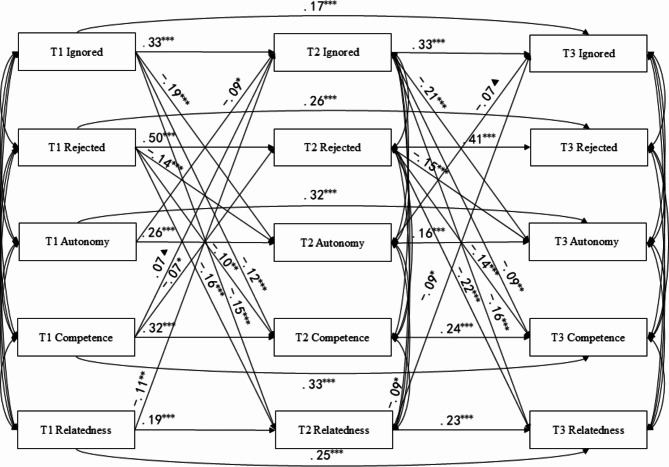
Social exclusion has wide-ranging and detrimental effects. This study recruited 771 Chinese college students (Mage = 19.65 years, SDage = 1.04, 74.19% females). The findings of two cross-lagged panel models, administered at three different points in time, indicated a negative association between social exclusion (including being ignored and rejected) and basic psychological needs (autonomy, competence, and relatedness). Specifically, both being ignored and rejected significantly predicted decreases in autonomy, competence, and relatedness needs. Moreover, relatedness needs significantly predicted decreases in being ignored, while autonomy needs predicted decreases in being ignored. Additionally, competence needs at T1 positively predicted being ignored but negatively predicted being rejected at T2. This study was based on Self-Determination Theory (SDT) and expanded its application within the realm of social exclusion. The findings offer novel intervention strategies for reducing social exclusion and promoting well-being.
Keywords: Basic psychological needs; Cross-lagged panel model; Social exclusion.
© 2024. The Author(s).
Conflict of interest statement
Declarations. Competing interests: The authors declare no competing interests.
Figures

References
-
- Williams. Ostracism. Ann. Rev. Psychol.58(1), 425–452. 10.1146/annurev.psych.58.110405.085641 (2007). - PubMed
-
- Williams. Chapter 6 Ostracism. In Advances in Experimental Social Psychology, Vol. 41, 275–314 (Elsevier, 2009). 10.1016/S0065-2601(08)00406-1
-
- Molden, D. C., Lucas, G. M., Gardner, W. L., Dean, K. & Knowles, M. L. Motivations for prevention or promotion following social exclusion: Being rejected versus being ignored. J. Personal. Soc. Psychol.96(2), 415–431. 10.1037/a0012958 (2009). - PubMed
-
- Leary. Varieties of Interpersonal Rejection (2005).
-
- Stenseng, F., Belsky, J., Skalicka, V. & Wichstrøm, L. Social exclusion predicts impaired self-regulation: A 2-year longitudinal panel study including the transition from preschool to school: social exclusion and self-regulation. J. Pers.83(2), 212–220. 10.1111/jopy.12096 (2015). - PubMed
Publication types
MeSH terms
Grants and funding
LinkOut - more resources
Full Text Sources
