


Investigating skeletal muscle micro-trauma with time-dependent diffusion and the random permeable barrier model
- PMID: 39738708
- PMCID: PMC11686215
- DOI: 10.1038/s41598-024-83644-5
Investigating skeletal muscle micro-trauma with time-dependent diffusion and the random permeable barrier model
Abstract
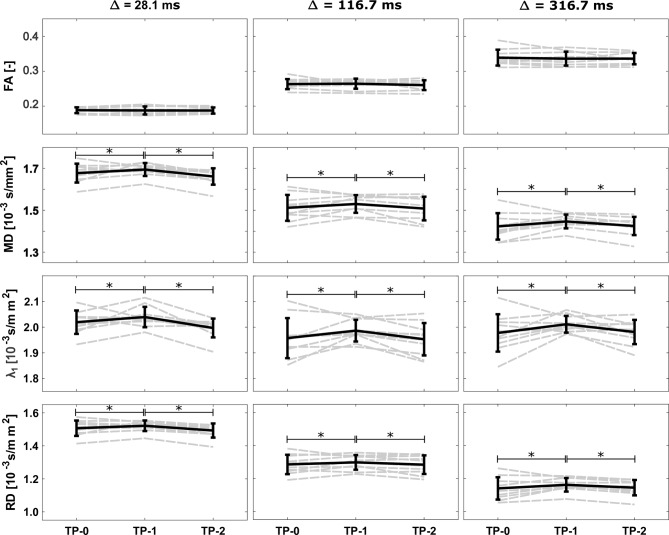
Repeated muscle micro-trauma may cause severe muscle damage. Diffusion tensor imaging (DTI) exhibits sensitivity to microstructural changes in skeletal muscle. We hypothesize that longer diffusion times enhance sensitivity to micro-trauma and that membrane permeability increases with micro-trauma. We obtained DTI scans of the thighs in ten male runners 1 week before (TP-0), 24-48 h after (TP-1), and 2 weeks after (TP-2) they completed a marathon. Diffusion times were 28.1, 116.7, and 316.7 ms. The random permeable barrier model (RPBM) was fitted to the radial diffusivities to obtain estimates for fiber diameter and membrane permeability. Hamstring and quadriceps muscles were manually segmented. A linear mixed model assessed variations across time points and diffusion times within the DTI and RPBM parameters and assessed sensitivity to micro-trauma by comparing %-changes in DTI parameters at TP-1 and TP-2 to TP-0. All DTI parameters except FA significantly changed between TP-0 and TP-1, and between TP-1 and TP-2. The %-change did not differ between diffusion times. The permeability increased at TP-1 and TP-2 compared to TP-0. In conclusion, longer diffusion times did not improve sensitivity to micro-trauma. The increased permeability post-marathon underscores the potential of RPBM-derived parameters as a biomarker for micro-trauma and muscle injuries.
© 2024. The Author(s).
Conflict of interest statement
Declarations. Competing interests: H.E.K. reports research support from Philips Healthcare during the conduct of the study, and trial support from ImagingDMD-UF outside the submitted work. All reimbursements for H.E.K. were received by the LUMC. No personal financial benefits were received. All other authors do not hold any competing interest.
Figures



References
Publication types
MeSH terms
Grants and funding
LinkOut - more resources
Full Text Sources
