The impact of gender-affirming interventions on eating disorder diagnosis risk among transgender and gender-diverse individuals
- PMID: 39741205
- PMCID: PMC11688434
- DOI: 10.1038/s43856-024-00704-7
The impact of gender-affirming interventions on eating disorder diagnosis risk among transgender and gender-diverse individuals
Abstract
Background: The objective of this study is to evaluate the risk of being diagnosed with an eating disorder among transgender and gender-diverse (TGD) individuals, specifically examining how this risk differs following gender-affirming medical therapy (GAMT).
Methods: The study utilizes electronic medical record (EMR) data from the TriNetX database. A total of 90,955 TGD individuals were identified in the TriNetX database. TGD individuals were divided into cohorts according to gender-affirming interventions they received. To assess the risk of eating disorder diagnoses across groups, we applied a Cox proportional hazards model with gender-affirming care as a time-varying covariate.
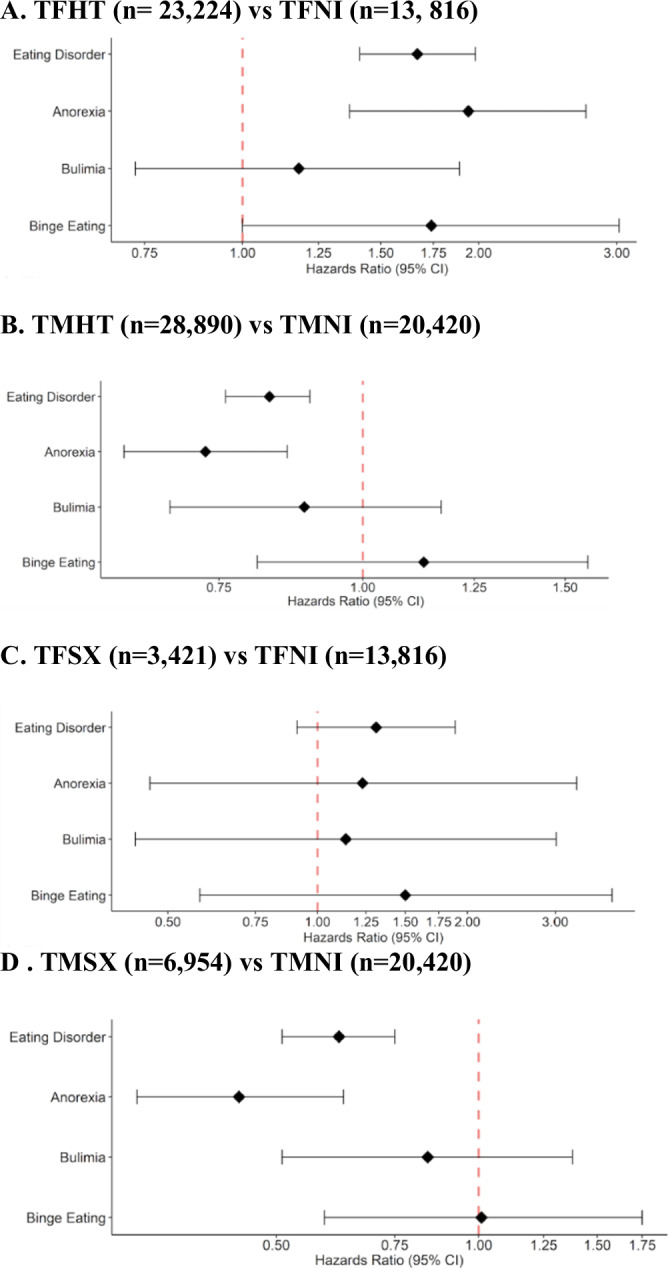
Results: Here we show that transfeminine individuals receiving hormone therapy (HT) have a significantly higher likelihood of being diagnosed with an eating disorder compared to those without intervention (HR:1.67, 95% CI:1.41, 1.98). Conversely, transmasculine individuals on HT exhibit a reduced risk of being diagnosed with an eating disorder relative to those without intervention (HR: 0.83, 95% CI: 0.76, 0.90).
Conclusions: After undergoing gender-affirming medical therapy, the risk of eating disorder diagnosis increases for transfeminine individuals and decreases for transmasculine individuals. The observed differences in risk between transfeminine and transmasculine individuals on GAMT may be attributed to factors such as gendered societal norms, variations in screening practices, and the physiological effects of hormone therapy on eating disorder symptomatology. Further research is needed to clarify these influences and support tailored interventions.
Plain language summary
Transgender and gender-diverse (TGD) individuals are at a higher risk of developing eating disorders, but the effects of gender-affirming interventions on this risk is not well known. Our study used data from nearly 91,000 TGD individuals to explore how hormone therapy and surgical transitioning might influence eating disorder diagnosis risk. We found that transfeminine individuals (those assigned male at birth who identify as female) on hormone therapy were more likely to be diagnosed with an eating disorder, while transmasculine individuals (those assigned female at birth who identify as male) on hormone therapy were less likely to receive such a diagnosis compared to TGD individuals not on hormone therapy. This difference in risk between transfeminine and transmasculine individuals may be explained by gendered societal norms, variations in screening practices, and the physiological effects of hormone therapy on eating disorder symptoms. Our findings highlight the need for supportive care and careful screening for eating disorders in TGD individuals receiving gender-affirming interventions.
© 2024. The Author(s).
Conflict of interest statement
Competing interests: The authors declare no competing interests.
Figures
References
-
- Gordon, A. R., Austin, S. B., Krieger, N., Hughto, J. M. W. & Reisner, S. L. “I have to constantly prove to myself, to people, that I fit the bill”: Perspectives on weight and shape control behaviors among low-income, ethnically diverse young transgender women. Soc. Sci. Med.165, 141–149 (2016). - DOI - PMC - PubMed
Grants and funding
LinkOut - more resources
Full Text Sources