


Chronic Primary Pelvic Pain Syndromes in Women: A Comprehensive Review
- PMID: 39742169
- PMCID: PMC11688162
- DOI: 10.7759/cureus.74918
Chronic Primary Pelvic Pain Syndromes in Women: A Comprehensive Review
Abstract
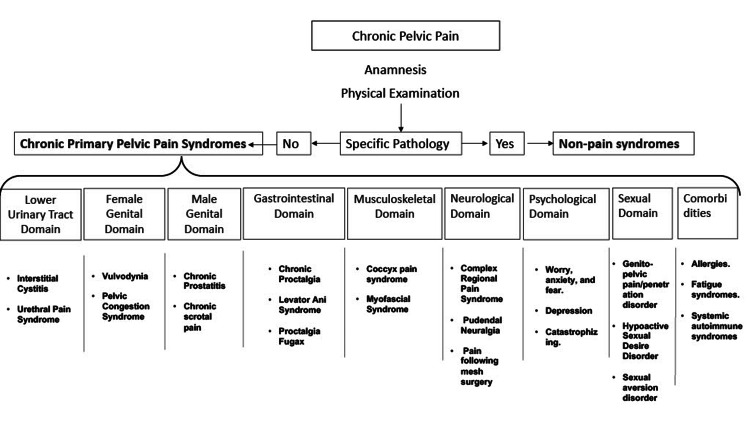
Chronic pelvic pain (CPP) in women is a multifactorial and complex condition. It often remains undiagnosed or inadequately treated. Despite its high prevalence, CPP continues to be a taboo subject, leading to delays in seeking medical care. Chronic primary pelvic pain syndromes (CPPPS) are pain conditions without an obvious underlying diagnosis, including painful bladder syndrome, vulvodynia, genito-pelvic pain/penetration disorder, levator ani syndrome, proctalgia fugax, myofascial syndrome, pudendal neuralgia, and coccyx pain syndrome. A comprehensive review of the literature was conducted to understand the most common forms of CPPPS in women, focusing on diagnostic criteria, pathophysiology, and treatment options. Due to the complexity of CPPPS and varied treatment responses, management requires a multidisciplinary approach. Although various treatment modalities exist, no single strategy is universally effective, emphasizing the need for individualized care. Future research should prioritize refining diagnostic criteria and investigating new therapeutic strategies.
Keywords: anorectal diseases; chronic pelvic pain syndrome; rehab; sexual problems; treatment choices.
Copyright © 2024, Pinto et al.
Conflict of interest statement
Conflicts of interest: In compliance with the ICMJE uniform disclosure form, all authors declare the following: Payment/services info: All authors have declared that no financial support was received from any organization for the submitted work. Financial relationships: All authors have declared that they have no financial relationships at present or within the previous three years with any organizations that might have an interest in the submitted work. Other relationships: All authors have declared that there are no other relationships or activities that could appear to have influenced the submitted work.
Figures
References
-
- "A day-to-day struggle": a comparative qualitative study on experiences of women with endometriosis and chronic pelvic pain. Hawkey A, Chalmers KJ, Micheal S, Diezel H, Armour M. https://doi.org/10.1177/09593535221083846 Fem Psychol. 2022;32:482–500.
-
- Edn. presented at the EAU Annual Congress Amsterdam, the Netherlands 2022. Arnhem, The Netherlands: EAU Guidelines Office; 2022. EAU guidelines on urological infections.
-
- A standard for terminology in chronic pelvic pain syndromes: a report from the chronic pelvic pain working group of the International Continence Society. Doggweiler R, Whitmore KE, Meijlink JM, et al. Neurourol Urodyn. 2017;36:984–1008. - PubMed
Publication types
LinkOut - more resources
Full Text Sources