Role of Genetic Testing in Diagnosis and Prognosis Prediction in Hypertrophic Cardiomyopathy in Korea
- PMID: 39742874
- PMCID: PMC11685281
- DOI: 10.3346/jkms.2024.39.e313
Role of Genetic Testing in Diagnosis and Prognosis Prediction in Hypertrophic Cardiomyopathy in Korea
Abstract
Background: Hypertrophic cardiomyopathy (HCM) needs careful differentiation from other cardiomyopathies. Current guidelines recommend genetic testing, but genetic data on differential diagnoses and their relation with clinical outcomes in HCM are still lacking. This study aimed to investigate the prevalence of genetic variants and the proportion of other cardiomyopathies in patients with suspected HCM in Korea and compare the outcomes of HCM according to the presence of sarcomere gene mutation.
Methods: We enrolled 1,554 patients with suspected HCM having left ventricular hypertrophy on transthoracic echocardiography between April 2012 and February 2023. Patients who declined genetic testing or who had pure apical HCM without a familial history were excluded. Genetic testing was performed using a next-generation sequencing panel or whole-exome sequencing for cardiomyopathies. We performed cardiovascular magnetic resonance if the diagnosis was inconclusive. Genotype-positive HCM was defined as sarcomere gene mutations of pathogenic or likely pathogenic variants. Adverse clinical outcomes were defined as a composite of all-cause death, resuscitated cardiac arrest, heart failure-related admission, appropriate implantable cardioverter defibrillator shocks, and stroke.
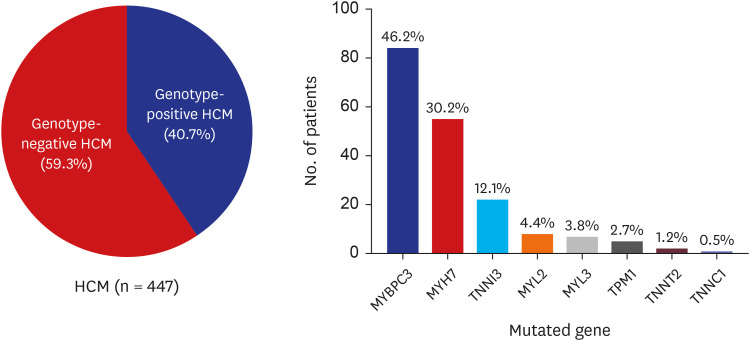
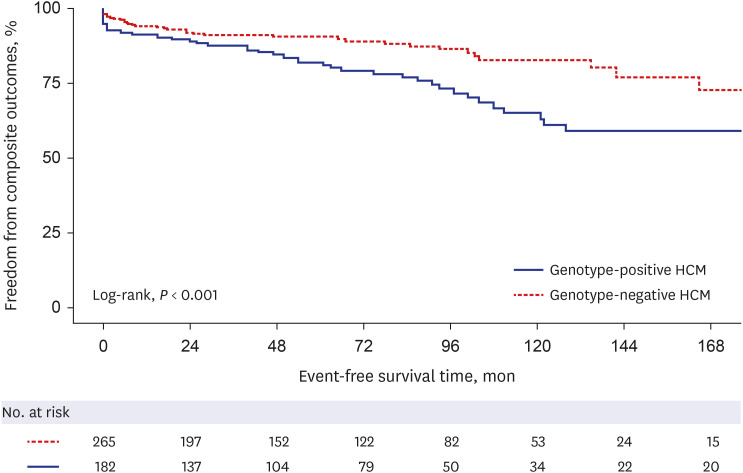
Results: Of 492 patients (mean age 49.6 ± 14.7 years, 29.4% women) who underwent genetic testing, 214 (43.5%) had disease-causing gene mutations. After combining gene tests, multi-imaging modality, and clinical information, 447 (90.9%) had HCM, and 27 (5.5%) had Fabry disease. Among the HCM patients, 182 (40.7%) were genotype-positive, and 265 (59.3%) were genotype-negative. Kaplan-Meier curve analysis showed that genotype-positive HCM patients experienced more composite outcomes (log-rank, P < 0.001). In multivariable Cox analysis, non-sustained ventricular tachycardia (NSVT) (hazard ratio [HR], 1.91; 95% confidence interval [CI], 1.17-3.12; P = 0.010), left ventricular ejection fraction (LVEF) < 50% (HR, 5.50; 95% CI, 2.68-11.27; P < 0.001), LA reservoir strain (HR, 0.96; 95% CI, 0.93-0.99; P = 0.037), and positive sarcomere gene mutation (HR, 1.70; 95% CI, 1.04-2.78; P = 0.034) were significantly association with composite outcomes. Sarcomere gene mutation had incremental value for predicting adverse outcomes added on NSVT and LVEF < 50%.
Conclusion: Genetic testing is helpful in diagnosing HCM, and sarcomere gene mutations in HCM are significantly associated with clinical outcomes.
Keywords: Cardiomyopathy, Hypertrophic; Genetic Testing; Genotype; Hypertrophy, Left Ventricular; Sarcomere Gene Mutations.
© 2024 The Korean Academy of Medical Sciences.
Conflict of interest statement
The authors have no potential conflicts of interest to disclose.
Figures



References
-
- Ommen SR, Mital S, Burke MA, Day SM, Deswal A, Elliott P, et al. 2020 AHA/ACC Guideline for the Diagnosis and Treatment of Patients With Hypertrophic Cardiomyopathy: Executive Summary: a report of the American College of Cardiology/American Heart Association Joint Committee on Clinical Practice Guidelines. Circulation. 2020;142(25):e533–e557. - PubMed
-
- Hoss S, Habib M, Silver J, Care M, Chan RH, Hanneman K, et al. Genetic testing for diagnosis of hypertrophic cardiomyopathy mimics: yield and clinical significance. Circ Genom Precis Med. 2020;13(2):e002748. - PubMed
-
- Elliott PM, Anastasakis A, Borger MA, Borggrefe M, Cecchi F, Charron P, et al. 2014 ESC Guidelines on diagnosis and management of hypertrophic cardiomyopathy: the Task Force for the Diagnosis and Management of Hypertrophic Cardiomyopathy of the European Society of Cardiology (ESC) Eur Heart J. 2014;35(39):2733–2779. - PubMed
-
- Ingles J, Burns C, Barratt A, Semsarian C. Application of genetic testing in hypertrophic cardiomyopathy for preclinical disease detection. Circ Cardiovasc Genet. 2015;8(6):852–859. - PubMed
MeSH terms
Substances
LinkOut - more resources
Full Text Sources
Medical
Miscellaneous