Review
. 2024 Dec 18:15:1506356.
doi: 10.3389/fphys.2024.1506356. eCollection 2024.

LIM kinases in cardiovascular health and disease

Affiliations
Review

LIM kinases in cardiovascular health and disease

Olubodun M Lateef et al. Front Physiol. .

Abstract

The Lim Kinase (LIMK) family of serine/threonine kinases is comprised of LIMK1 and LIMK2, which are central regulators of cytoskeletal dynamics via their well-characterized roles in promoting actin polymerization and destabilizing the cellular microtubular network. The LIMKs have been demonstrated to modulate several fundamental physiological processes, including cell cycle progression, cell motility and migration, and cell differentiation. These processes play important roles in maintaining cardiovascular health. However, LIMK activity in healthy and pathological states of the cardiovascular system is poorly characterized. This review highlights the cellular and molecular mechanisms involved in LIMK activation and inactivation, examining its roles in the pathophysiology of vascular and cardiac diseases such as hypertension, aneurysm, atrial fibrillation, and valvular heart disease. It addresses the LIMKs' involvement in processes that support cardiovascular health, including vasculogenesis, angiogenesis, and endothelial mechanotransduction. The review also features how LIMK activity participates in endothelial cell, vascular smooth muscle cell, and cardiomyocyte physiology and its implications in pathological states. A few recent preclinical studies demonstrate the therapeutic potential of LIMK inhibition. We conclude by proposing that future research should focus on the potential clinical relevance of LIMK inhibitors as therapeutic agents to reduce the burden of cardiovascular disease and improve patient outcomes.

Keywords: arterial stiffening; atherosclerosis; atrial fibrillation; cardiovascular disease; hypertension; vascular remodeling.


Conflict of interest statement

The authors declare that the research was conducted in the absence of any commercial or financial relationships that could be construed as a potential conflict of interest.

Figures
None
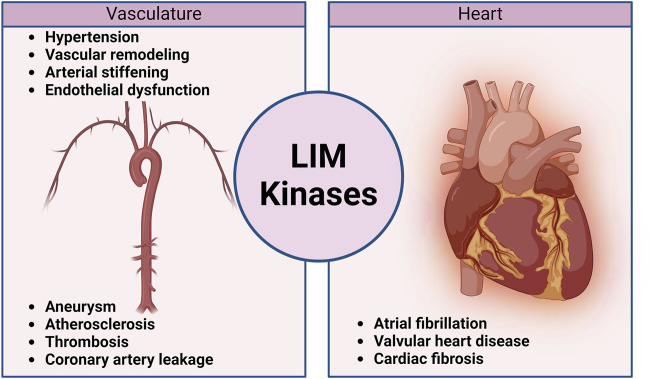
Schematic diagram illustrating the contribution of LIM kinases to the pathophysiology of cardiovascular diseases.
FIGURE 1
FIGURE 1
Activation of the LIMKs. Various upstream signaling pathways influence the LIMKs’ activation. For example, extracellular signals like VEGF, thrombin, and shear stress trigger the activation of RhoA, which subsequently phosphorylates ROCK. LIMK1 and LIMK2 undergo phosphorylation and activation by ROCK, and other kinases such as MRCK, PAK, p38, and MAPKAPK-2 at different phosphorylation sites as shown in the figure. LIMK activation leads to cofilin phosphorylation at Ser-3 resulting in the accumulation of F-actin. (VEGF: Vascular endothelial growth factor; ROCK: Rho-associated protein kinase; MRCK: myotonic dystrophy kinase-related Cdc42-binding kinases; Cdc42: cell division control protein 42; PAK: p21-activated kinases; MAPKAPK-2: mitogen-activated protein kinase-activated protein kinase-2).
FIGURE 2
FIGURE 2
Inactivation of the LIMKs. The activity of the LIMKs is inhibited through dephosphorylation by SSH1, Nischarin. LIMKs are polyubiquitinated and degraded by Rnf6, while interactions with binding partners (LATS1, BMPR-II, PAR-3, and β-arrestin) inhibit their phosphorylation and prevent them from phosphorylating cofilin. This negative regulation of LIMK reduces cofilin phosphorylation, thereby enhancing the actin-severing activity of cofilin. (SSH1: Slingshot 1; LATS1: Large tumor suppressor kinase 1; PAR-3: Protease-activated receptor-3; Rnf6: Ring finger protein 6; BMPR-II: Bone morphogenetic protein receptor II).
FIGURE 3
FIGURE 3
LIMK activity promotes VSMC migration. The activation of RhoA/ROCK by stimuli such as PDFG-BB leads to the phosphorylation of LIMK and inactivation of cofilin, thereby promoting actin polymerization. Concurrently, ROCK phosphorylates MLCP and inhibits its activity, resulting in increased phosphorylation of MLC and subsequent VSMC contraction. Activation of inflammatory cytokines such as CCR8, CKLF1, and CXCL12 also modulates cell migration via lamellipodia formation. These inflammatory processes likely promote VSMC migration in a LIMK-dependent manner. Whether inflammatory cytokines activate LIMK via Rac2 activation remains unknown. (PDFG-BB: Platelet derived growth factor BB; Arp 2/3: Actin related protein 2/3; CCR8: chemokine receptor-8; CKLF1: Chemokine-like factor 1; CXCL12: C-X-C motif chemokine 12; MLCP: Myosin light chain phosphatase).
FIGURE 4
FIGURE 4
LIMK acts as an integral regulator of endothelial cell migration. Angiogenesis modulators such as VEGF bind surface receptors in endothelial cells and trigger the activation of ROCK, PAK/NCK, and p38 signaling pathways. ROCK activation, stimulated by VEGF, facilitates LIMK-induced cofilin deactivation and subsequent actin polymerization, while PAK/NCK activation reinforces focal adhesion turnover. LIMK-mediated annexin1 phosphorylation and enhanced focal adhesion turnover promote endothelial cell migration. The phosphorylation of Hsp27, a key regulator of actin dynamics, further stimulates actin polymerization, contributing to endothelial cell migration. This signaling cascade exemplifies the role of angiogenic factors in orchestrating cellular processes involved in endothelial cell migration. (KDR: Kinase insert domain receptor; NCK: non-catalytic tyrosine kinase adaptor protein; HSP27: Heat shock protein 27).

References

    1. Abedi H., Zachary I. (1997). Vascular endothelial growth factor stimulates tyrosine phosphorylation and recruitment to new focal adhesions of focal adhesion kinase and paxillin in endothelial cells. J. Biol. Chem. 272, 15442–15451. 10.1074/jbc.272.24.15442 - DOI - PubMed
    1. Acevedo K., Li R., Soo P., Suryadinata R., Sarcevic B., Valova V. A., et al. (2007). The phosphorylation of p25/TPPP by LIM kinase 1 inhibits its ability to assemble microtubules. Exp. Cell Res. 313, 4091–4106. 10.1016/j.yexcr.2007.08.012 - DOI - PubMed
    1. Acevedo K., Moussi N., Li R., Soo P., Bernard O. (2006). LIM kinase 2 is widely expressed in all tissues. J. Histochem Cytochem 54, 487–501. 10.1369/jhc.5C6813.2006 - DOI - PubMed
    1. Adamson R. H., Curry F. E., Adamson G., Liu B., Jiang Y., Aktories K., et al. (2002). Rho and rho kinase modulation of barrier properties: cultured endothelial cells and intact microvessels of rats and mice. J. Physiology 539, 295–308. 10.1113/jphysiol.2001.013117 - DOI - PMC - PubMed
    1. Ailawadi G., Eliason J. L., Upchurch G. R. (2003). Current concepts in the pathogenesis of abdominal aortic aneurysm. J. Vasc. Surg. 38, 584–588. 10.1016/s0741-5214(03)00324-0 - DOI - PubMed

LinkOut - more resources
