


Artificial intelligence in triage of COVID-19 patients
- PMID: 39744742
- PMCID: PMC11688301
- DOI: 10.3389/frai.2024.1495074
Artificial intelligence in triage of COVID-19 patients
Abstract
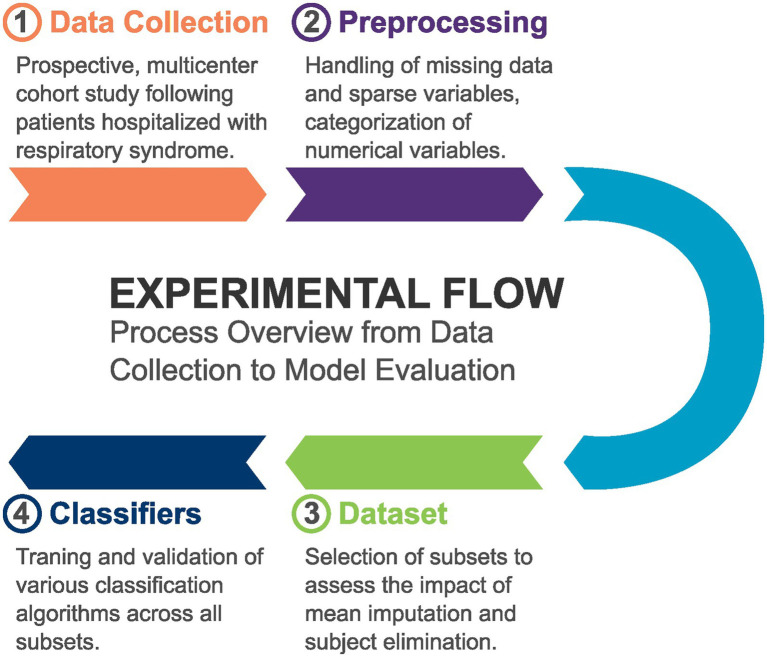
In 2019, COVID-19 began one of the greatest public health challenges in history, reaching pandemic status the following year. Systems capable of predicting individuals at higher risk of progressing to severe forms of the disease could optimize the allocation and direction of resources. In this work, we evaluated the performance of different Machine Learning algorithms when predicting clinical outcomes of patients hospitalized with COVID-19, using clinical data from hospital admission alone. This data was collected during a prospective, multicenter cohort that followed patients with respiratory syndrome during the pandemic. We aimed to predict which patients would present mild cases of COVID-19 and which would develop severe cases. Severe cases were defined as those requiring access to the Intensive Care Unit, endotracheal intubation, or even progressing to death. The system achieved an accuracy of 80%, with Area Under Receiver Operating Characteristic Curve (AUC) of 91%, Positive Predictive Value of 87% and Negative Predictive Value of 82%. Considering that only data from hospital admission was used, and that this data came from low-cost clinical examination and laboratory testing, the low false positive rate and acceptable accuracy observed shows that it is feasible to implement prediction systems based on artificial intelligence as an effective triage method.
Keywords: COVID-19; artificial intelligence; clinical data; machine learning; outcome prediction; prediction algorithms; triage.
Copyright © 2024 Oliveira, Rios, Araújo, Macambira, Guimarães, Sales, Rosa Júnior, Nicola, Nakayama, Paschoalick, Nascimento, Castillo-Salgado, Ferreira and Carvalho.
Conflict of interest statement
The authors declare that the research was conducted in the absence of any commercial or financial relationships that could be construed as a potential conflict of interest.
Figures
References
-
- Abadi M, Agarwal A, Barham P, Brevdo E, Chen Z, Citro C, et al. TensorFlow: a system for large-scale machine learning. 12th USENIX Symposium on Operating Systems Design and Implementation (2016).
-
- Buitinck L., Louppe G., Blondel M., Fabien P., Mueller A., Olivier G., et al. (2011). Scikit-learn: machine learning in Python. J. Mach. Learn. Res. 12, 2825–2830. http://scikit-learn.sourceforge.net
LinkOut - more resources
Full Text Sources
