


Corporate genome screening India (CoGsI) identified genetic variants association with T2D in young Indian professionals
- PMID: 39747296
- PMCID: PMC11697386
- DOI: 10.1038/s41598-024-84160-2
Corporate genome screening India (CoGsI) identified genetic variants association with T2D in young Indian professionals
Abstract
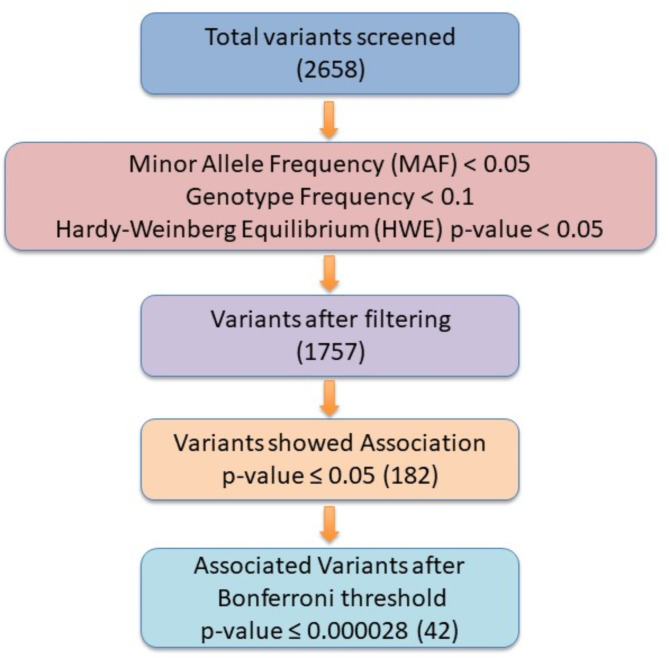
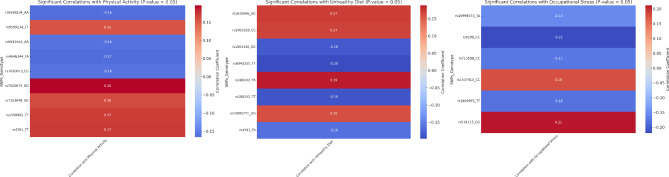
Rising cases of type 2 diabetes (T2D) in India, especially in metropolitan cities is an increasing concern. The individuals that were most affected are young professionals working in the corporate sector. However, the corporate sector has remained the least explored for T2D risk predisposition. Considering corporate employees' lifestyles and the role of gene-environment interaction in T2D susceptibility, the study aims to find genetic variants associated with T2D predisposition. In this first kind of study, 680 young professionals (284 T2D cases, and 396 controls) were diagnosed and screened for 2658 variants on an array designed explicitly for the CoGsI study. The variant filtering was done at Bonferroni p-value of 0.000028. The genetic data was analysed using PLINK v1.09, SPSS, R programming, VEP tool, and FUMA GWAS tool. Interestingly, 42 variants were associated with the T2D risk. Out of 42, three missense variants (rs1402467, rs6050, and rs713598) in Sulfotransferase family 1 C member 4 (SULT1C4), Fibrinogen Alpha Chain (FGA), and Taste 2 Receptor Member 38 (TAS2R38) and two untranslated region (UTR) variants (rs1063320 and rs6296) in Major Histocompatibility Complex, Class I, G (HLA-G) and 5-Hydroxytryptamine Receptor 1B (HTR1B) were associated with the T2D risk. CoGsI identified potential genomic markers increasing susceptibility to the early onset of T2D. Present findings provide insights into mechanisms underlying T2D manifestation in corporate professionals due to genetics interacting with occupational stress and urban lifestyles.
Keywords: Genetics; Genotyping; SNPs; Type 2 diabetes; Young professionals.
© 2024. The Author(s).
Conflict of interest statement
Declarations. Competing interests: The authors declare no competing interests. Ethical approval: All procedures performed were in accordance with the ethical standards of the institutional and/or national research committee and with the Helsinki Declaration 2013 and its later amendments or comparable ethical standards. Disclosures: Shah Fahad Husami and Tavleen Kaur are employees of Unlock Wellness Pvt. Ltd. Love Gupta, Garima Rastogi, Pooja Meena, Varun Sharma, and Hemender Singh are employees of NMC Genetics India Pvt. Ltd, the research organisation that conducted the study.
Figures
References
-
- Saad, B. et al. Introduction to diabetes and obesity. In Anti-diabetes and Anti-obesity Medicinal Plants and Phytochemicals: Safety, Efficacy, and Action Mechanisms 3–19 (2017).
MeSH terms
LinkOut - more resources
Full Text Sources
Medical
Research Materials
Miscellaneous
