


Neonatal intensive care admissions and exposure to satellite-derived air pollutants in the United States, 2018
- PMID: 39747402
- PMCID: PMC11696032
- DOI: 10.1038/s41598-024-84755-9
Neonatal intensive care admissions and exposure to satellite-derived air pollutants in the United States, 2018
Abstract
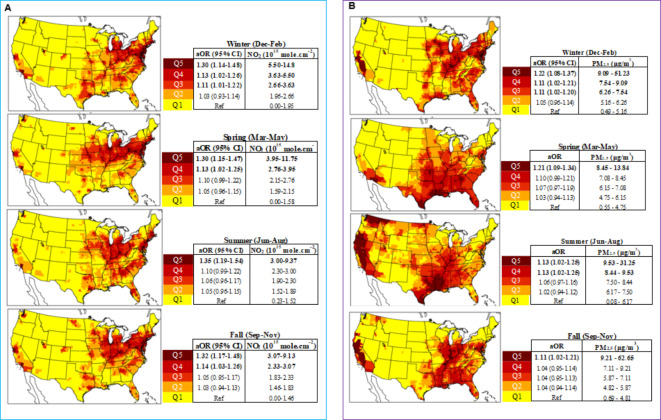
In the United States (US), neonatal intensive care units (NICUs) monitor and treat newborns for a variety of adverse health concerns including preterm status, respiratory distress and restricted growth. As such, NICU admission is an integrated measure of neonatal risk. We linked 2018 US national birth registry NICU admission data among singleton births with satellite and modelled air pollution levels for the month prior to birth to examine whether late-pregnancy exposure to ambient air pollutants is associated with adverse neonatal health outcomes. Regardless of season, higher ambient levels of nitrogen dioxide (NO2) and fine particulate matter < 2.5 microns (PM2.5) increased the likelihood of NICU admission 30-35% for NO2 and 11-22% for PM2.5 even after adjustment for parental characteristics. Results for ozone exposure were inconsistent with largely null or reduced risk except for summer months. Despite the relatively low-moderate US exposure levels, traffic-related pollutants near the end of pregnancy appear to increase overall adverse health risks for newborns, underscoring the need to reduce prenatal exposure to ambient pollutants.
© 2024. The Author(s).
Conflict of interest statement
Declarations. Competing interests: The authors declare no competing interests.
Figures

References
-
- Persson, C., Ericson, J., Salari, R., Eriksson, M. H. & Flacking, R. NICU parents’ mental health: a comparative study with parents of term and healthy infants. Acta Paediatr.112 (5), 954–966 (2023). - PubMed
-
- Coker, E. S. et al. A time series analysis of the ecologic relationship between acute and intermediate PM2.5 exposure duration on neonatal intensive care unit admissions in Florida. Environ. Res.196, 110374 (2021). - PubMed
-
- Jones, S. I., Pruszynski, J. E., Spong, C. Y. & Nelson, D. B. Traffic-related air pollution is associated with spontaneous extremely preterm birth and other adverse perinatal outcomes. Am. J. Obstet. Gynecol. (2023). - PubMed
MeSH terms
Substances
LinkOut - more resources
Full Text Sources
Medical
Research Materials
