


Clerkship Students' Use of Clinical Reasoning Concepts After a Pre-clinical Reasoning Course
- PMID: 39747771
- PMCID: PMC12045889
- DOI: 10.1007/s11606-024-09279-4
Clerkship Students' Use of Clinical Reasoning Concepts After a Pre-clinical Reasoning Course
Abstract
Background: Many medical schools have incorporated clinical reasoning (CR) courses into their pre-clinical curricula to address the quality and safety issue of diagnostic error. It is unknown how students use concepts and practices from pre-clinical CR courses once in clerkships.
Objective: We sought to understand how students utilize CR concepts from a pre-clinical course during clerkships and to identify facilitators and barriers to the use of reasoning concepts.
Design: We used structured interviews to gain insight into medical students' experiences with CR concepts in clerkships.
Participants: We interviewed 16 students who had completed a pre-clinical CR course and subsequently completed a neurology, internal medicine, or pediatrics clerkship.
Approach: We used constructivist grounded theory to perform a qualitative analysis and to develop a theoretical model to describe findings.
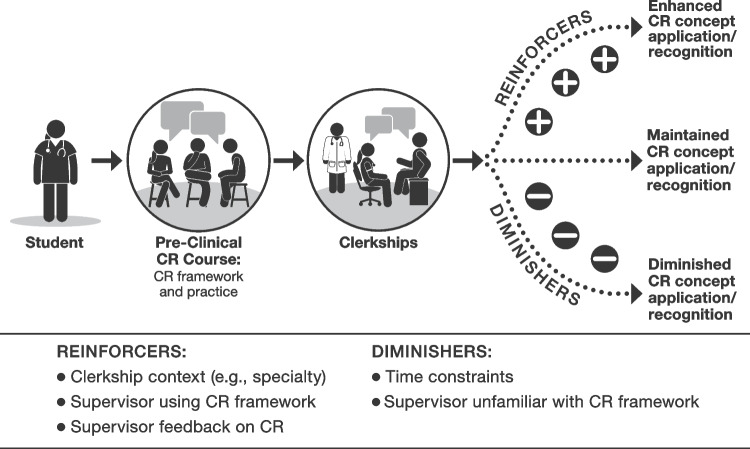
Key results: Insights fell into three main areas: (1) CR concept carryover, representing concepts taught in the CR course, such as problem representation, illness scripts, schema, and prioritized differential diagnosis, which were utilized in clerkships; (2) CR concept reinforcers, which included the clerkship setting and supervising physicians who emphasized and provided feedback on CR; and (3) CR concept diminishers, which included time constraints and supervisors who were unfamiliar with or did not reinforce CR concepts.
Conclusions: Concepts taught in a pre-clinical CR course influenced how students prepared for and navigated clinical encounters. Contextual factors both enhanced and inhibited the utilization of CR concepts. Our findings align with social learning theories including social cognitive theory and ecological psychology. This contextual view-taking into account interactions between personal, social, and environmental factors-can help educators integrate CR education from the classroom to the clinical setting.
Keywords: clinical clerkships; clinical learning environment; clinical reasoning; diagnosis; undergraduate medical education.
© 2024. This is a U.S. Government work and not under copyright protection in the US; foreign copyright protection may apply.
Conflict of interest statement
Declarations:. Conflict of Interest:: Denise M. Connor, MD, contributed to a professional development module on diagnostic disparities from the American College of Physicians. The other authors have no conflicts of interest to share. Ethical Approval:: The Institutional Review Board at the University of California, San Francisco, reviewed the study and approved it as exempt (Study #: 17–23622; Reference #: 261828). Prior Presentations:: None.
Figures
References
-
- Balogh EP, Miller BT, Ball JR, eds. The National Academies of Sciences, Engineering, and Medicine. Improving Diagnosis in Health Care. Washington, DC: National Academies Press; 2015. - PubMed
-
- Harendza S, Krenz I, Klinge A, Wendt U, Janneck M. Implementation of a Clinical Reasoning Course in the Internal Medicine trimester of the final year of undergraduate medical training and its effect on students’ case presentation and differential diagnostic skills. GMS Journal for Medical Education; 2017; 34(5):Doc66. - PMC - PubMed
