


MCTS2 and distinct eIF2D roles in uORF-dependent translation regulation revealed by in vitro re-initiation assays
- PMID: 39748120
- PMCID: PMC11790910
- DOI: 10.1038/s44318-024-00347-3
MCTS2 and distinct eIF2D roles in uORF-dependent translation regulation revealed by in vitro re-initiation assays
Abstract
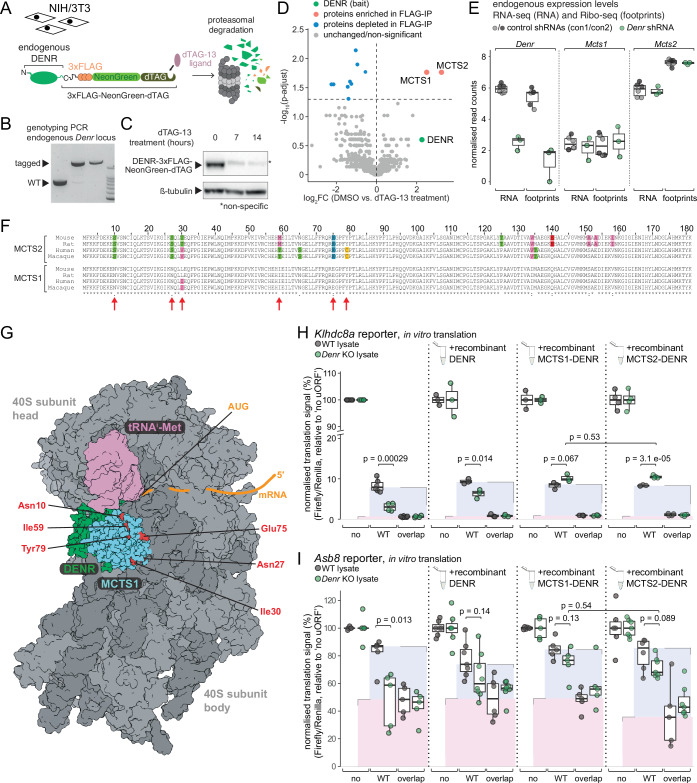
Ribosomes scanning from the mRNA 5' cap to the start codon may initiate at upstream open reading frames (uORFs), decreasing protein biosynthesis. Termination at a uORF can lead to re-initiation, where 40S subunits resume scanning and initiate another translation event downstream. The noncanonical translation factors MCTS1-DENR participate in re-initiation at specific uORFs, but knowledge of other trans-acting factors or uORF features influencing re-initiation is limited. Here, we establish a cell-free re-initiation assay using HeLa lysates to address this question. Comparing in vivo and in vitro re-initiation on uORF-containing reporters, we validate MCTS1-DENR-dependent re-initiation in vitro. Using this system and ribosome profiling in cells, we found that knockdown of the MCTS1-DENR homolog eIF2D causes widespread gene deregulation unrelated to uORF translation, and thus distinct to MCTS1-DENR-dependent re-initiation regulation. Additionally, we identified MCTS2, encoded by an Mcts1 retrogene, as a DENR partner promoting re-initiation in vitro, providing a plausible explanation for clinical differences associated with DENR vs. MCTS1 mutations in humans.
Keywords: DENR-MCTS1; In Vitro Translation; Re-Initiation; eIF2D; uORF.
© 2025. The Author(s).
Conflict of interest statement
Disclosure and competing interests statement. The authors declare no competing interests.
Figures
References
-
- Bohlen J, Fenzl K, Kramer G, Bukau B, Teleman AA (2020a) Selective 40S footprinting reveals cap-tethered ribosome scanning in human cells. Mol cell 79:561–574 - PubMed
MeSH terms
Substances
Grants and funding
LinkOut - more resources
Full Text Sources
Miscellaneous
