


Right ventricular myocardial work: proof-of-concept for the assessment of pressure-strain loops of patients with pre-capillary pulmonary hypertension
- PMID: 39748402
- PMCID: PMC11697866
- DOI: 10.1186/s12947-024-00335-x
Right ventricular myocardial work: proof-of-concept for the assessment of pressure-strain loops of patients with pre-capillary pulmonary hypertension
Abstract
Background: Right ventricular myocardial work (RVMW) assessed by transthoracic echocardiography allows to study the right ventricular (RV) function using RV pressure-strain loops. The assessment of these novel indexes of RVMW has not yet been exten sively studied, namely in pre-capillary pulmonary hypertension (PH) population.
Objectives: to evaluate the relationship between RVMW and invasive indices of right heart catheterization (RHC) in a cohort of patients with group I and group IV PH and to compare with a control group without PH.
Methods: A prospective registry of pre-capillary PH patients was used and compared with a control group without PH. In both groups, patients underwent same day RHC and echocardiographic assessment. Dedicated software for left ventricle myocardial work was used for the RV. RV global work index (RVGWI) was calculated as the area of the RV pressure-strain loops. From RVGWI, RV global constructive work (RVGCW), RV global wasted work (RVGWW), and RV global work efficiency (RVGWE) were estimated.
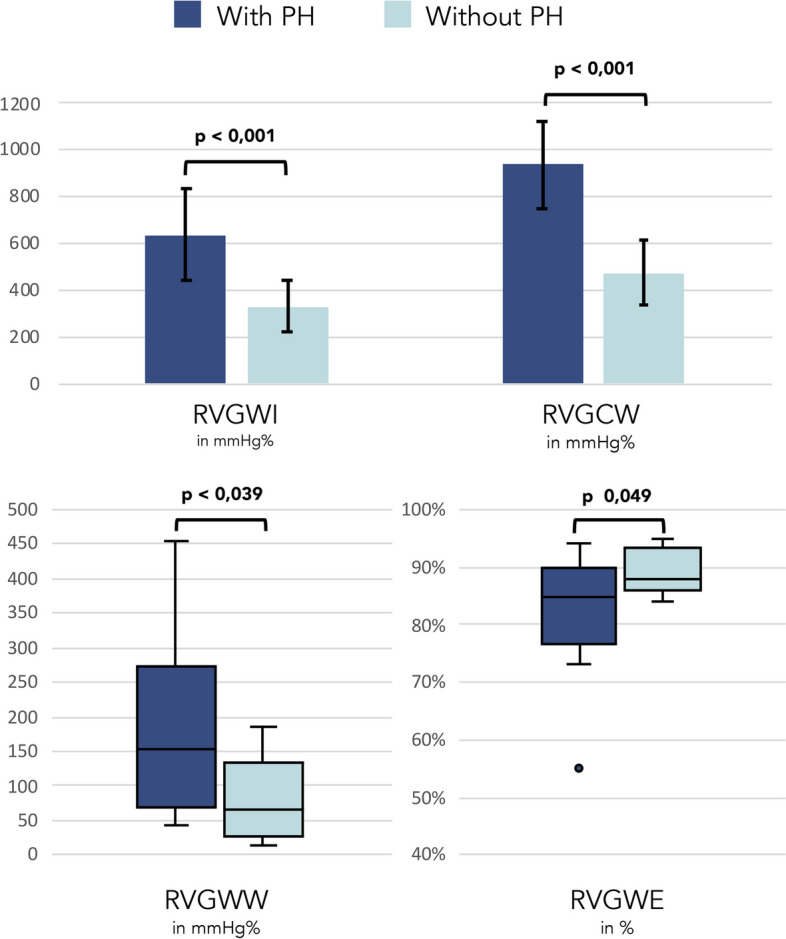
Results: 25 pts were included: 17 pts with PH were compared with 8 pts without PH. RVGWI, RVGCW and RVGWW were significantly higher in PH patients than in controls (p < 0,05), while RVGWE was significantly lower (p < 0,05). Significant correlations were found between mean pulmonary artery pressure, cardiac index, venous oxygen saturation, NT-proBNP and RVGCW, RVGWW and RVGWE; between pulmonary vascular resistance, cardiac output, right ventricular stroke work and RVGWI, RVGCW, RVGWW and RVGWE; between stroke volume and RVGWW and RVGWE; between pulmonary artery pulsatility index and RVGWI, RVGCW and RVGWW; between RA pressure and RVGWE.
Conclusions: Patients with pre-capillary PH present significantly higher RVGWI, RVGCW and RVGWW and lower RVGWE than patients without PH. Echocardiographic RVMW-derived indexes show significant correlation with invasive measurements and NT-proBNP. Larger studies are needed to assess the prognostic value of these novel indexes.
Keywords: Echocardiography; Myocardial work; Pulmonary hypertension; Right heart catheterization; Right ventricle function; Strain analysis.
© 2024. The Author(s).
Conflict of interest statement
Declarations. Competing interests: The authors declare no competing interests. This research received no specific grant from any funding agency in the public, commercial, or not-for-profit sectors. This research received no specific grant from any funding agency in the public, commercial, or not-for-profit sectors. The hospital ethics committee (ULS São José) approved the study protocol. All participants provided written informed consent and all procedures carried out in this study were conducted according to the Declaration of Helsinki guidelines. The data base used and analysed during the current study is available from the corresponding author on reasonable request. All authors read and approved the final manuscript.
Figures
References
-
- Humbert M, Kovacs G, Hoeper MM, et al. 2022 ESC/ERS guidelines for the diagnosis and treatment of pulmonary hypertension: developed by the task force for the diagnosis and treatment of pulmonary hypertension of the European Society of Cardiology (ESC) and the European Respiratory Society (ERS). Endorsed by the International Society for Heart and Lung Transplantation (ISHLT) and the European Reference Network on rare respiratory diseases (ERN-LUNG). Eur Heart J. 2022;43(38):3618–731. - DOI - PubMed
MeSH terms
LinkOut - more resources
Full Text Sources
Medical
Research Materials
