


Sex Differences, Menses-Related Symptoms and Menopause in Disorders of Gut-Brain Interaction
- PMID: 39748465
- PMCID: PMC11748819
- DOI: 10.1111/nmo.14977
Sex Differences, Menses-Related Symptoms and Menopause in Disorders of Gut-Brain Interaction
Abstract
Background: Disorders of gut-brain interaction (DGBI) predominate in women, but little is known about sex differences in menses-related or menopause symptoms.
Methods: Using data from the Rome Foundation Global Epidemiology Survey, we assessed Rome IV DGBI symptoms in individuals in 26 countries who met criteria for ≥ 1 of 5 DGBI: irritable bowel syndrome (IBS), functional dyspepsia (FD), functional constipation (FC), functional diarrhea (FDr), or functional bloating (FB). Participants included pre- and post-menopausal women with DGBI and age-matched men. Odds ratios estimated sex and age differences for symptom by sex or pre- vs. post-menopause in logistic regression; standardized mean difference (SMD) provided effect sizes.
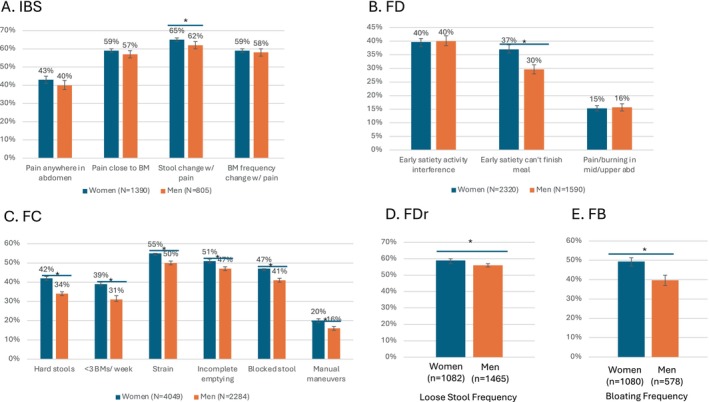
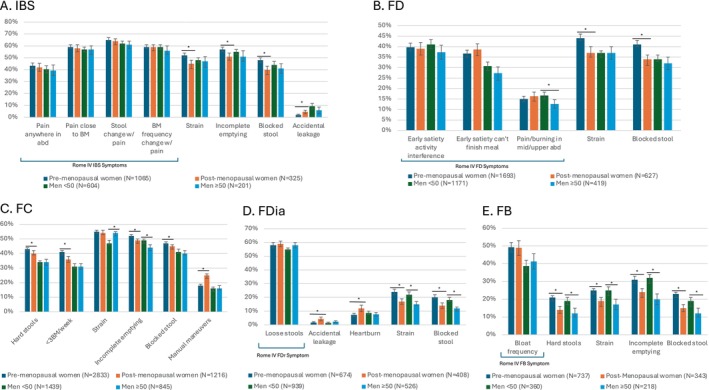
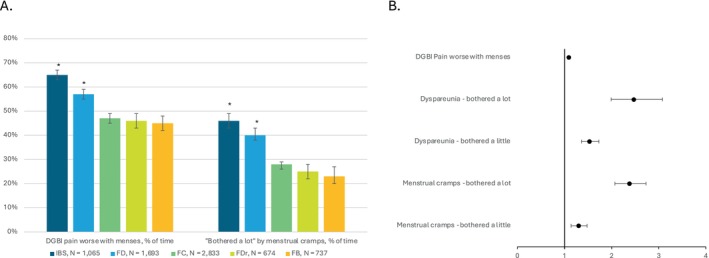
Key results: 14,570 participants met criteria for ≥ 1 of the 5 DGBI. Women exceeded men in most symptoms. In FD, women stopped eating due to early satiety more than men (11.1 vs. 8.9 days/month, SMD 0.21). Symptoms were generally increased in premenopausal women and younger men compared to older counterparts; however, only premenopausal IBS, FD, and FC women reported increased constipation-associated symptoms. Compared to premenopausal women, postmenopausal women had increased accidental stool leakage in IBS and FDr, and increased digital manual maneuvers in FC (18% vs. 25% frequency, SMD -0.25). IBS and FD had the most menses-associated symptoms.
Conclusions and inferences: Women had higher symptom frequency across the 5 DGBI compared to men. Our findings suggest that premenopausal women have greater visceral perception than postmenopausal women, although increased outlet symptoms in postmenopausal women indicate greater anorectal/pelvic dysfunction. While age alone has some influence on symptoms, female sex hormones may also increase visceral perception.
Keywords: Bloating; Chronic constipation; Disorders of gut–brain interaction; Functional dyspepsia; Gonadal Steroid Hormones; Irritable bowel syndrome; Postmenopause; Premenopause; Sex Characteristics; Visceral Hypersensitivity.
© 2025 The Author(s). Neurogastroenterology & Motility published by John Wiley & Sons Ltd.
Conflict of interest statement
The authors declare no conflicts of interest.
Figures
References
-
- Drossman D. A., “Functional Gastrointestinal Disorders: History, Pathophysiology, Clinical Features and Rome IV,” Gastroenterology S0016–5085, no. 16 (2016): 223–227. - PubMed
MeSH terms
Grants and funding
LinkOut - more resources
Full Text Sources
Medical
Miscellaneous
