


Efficacy of a pheromone-impregnated collar in controlling feline problem behaviors, and an assessment of adverse events associated with collar use
- PMID: 39748873
- PMCID: PMC11694449
- DOI: 10.3389/fvets.2024.1468634
Efficacy of a pheromone-impregnated collar in controlling feline problem behaviors, and an assessment of adverse events associated with collar use
Abstract
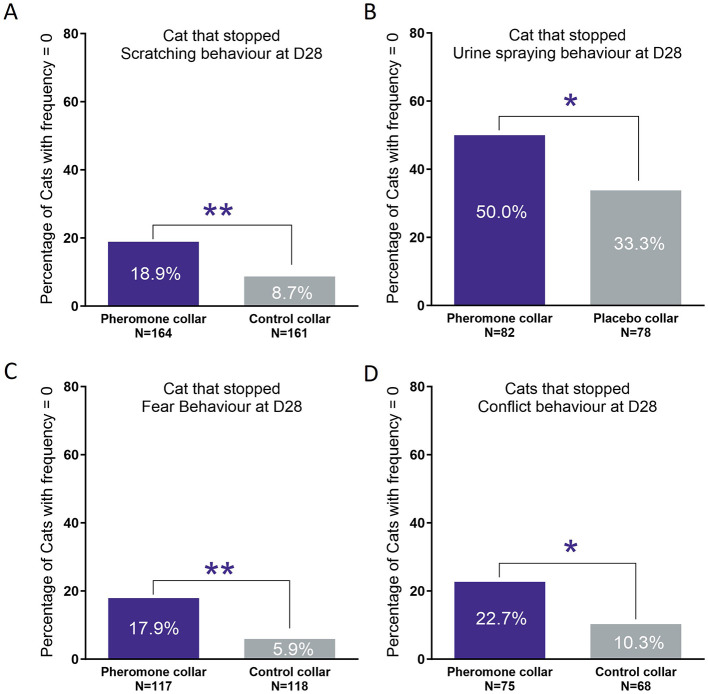
The aim of this study is to assess a pheromone complex-impregnated collar in the control of feline problem behaviors, and to assess the ease of use and tolerance of the collar compared with a regular collar. Six hundred and twenty-four cats from 459 households with one or more of four problem behaviors (problem urination, scratching, fear, or inter-cat conflict) were recruited to a 28-day study. Households were randomly assigned so that each cat received either a pheromone-impregnated polymer collar (containing 13% FELIWAY® Optimum) or a control regular silicone collar. Caregivers completed online questionnaires at recruitment and on days 7, 14, and 28 documenting the frequency and intensity of the problem behavior in the previous 7 days, and documenting any loss, problems and tolerance of the collar (pheromone-impregnated or control). Complete data was available for 491 cats for assessment of efficacy. Compared with the control collar, the pheromone collar produced significantly better improvement in problem urination (P = 0.0172), scratching (P = 0.0013), and inter-cat conflict (P = 0.0029). There was also a greater, but non-significant improvement in problem fear scores (P = 0.063). Collars had been removed definitively or lost from 12.1% of cats, for various reasons, by the end of the study, and potential adverse reactions were reported in 27.2% of cats, but again, with no difference in the overall frequency reported between the two collar groups. In a controlled study, a FELIWAY® Optimum-impregnated collar was shown to be effective in helping to manage a range of problem feline behaviors. The use of the pheromone collar was not associated with a higher level of adverse reaction reporting, but caregiver removal or loss of collars may present an obstacle for effective therapy through this means.
Keywords: FELIWAY®; cat; collar; pheromone; problem behavior.
Copyright © 2024 Endersby, Billy and De Jaeger.
Conflict of interest statement
SE, CB, and XD are employees of Ceva Santé Animale. The authors declare that this study received funding from Ceva Santé Animale. The funder had the following involvement in the study: study design, collection, analysis, interpretation of data, the writing of this article, or the decision to submit it for publication.
Figures



References
-
- Amat M, de la Torre JLR, Fatjó J, Mariotti VM, Van Wijk S, Manteca X. Potential risk factors associated with feline behaviour problems. Appl Anim Behav Sci. (2009) 121:134–9. 10.1016/j.applanim.2009.09.012 - DOI
-
- Fatjó JL, Ruiz-De-La-Torre J, Manteca X. The epidemiology of behavioural problems in dogs and cats: a survey of veterinary practitioners. Anim Welf. (2006) 15:179–85. 10.1017/S0962728600030268 - DOI
LinkOut - more resources
Full Text Sources
Miscellaneous
