


The Risks and Consequences of Skipping Meals for Low-income Mothers
- PMID: 39749138
- PMCID: PMC11694716
- DOI: 10.1007/s11113-022-09743-1
The Risks and Consequences of Skipping Meals for Low-income Mothers
Abstract
Objective: We test whether low-income mothers are more likely to skip breakfast, lunch and/or dinner and thereby increase their risk of overweight and obesity.
Background: Low-income mothers are significantly more likely to be overweight or obese relative to low-income women not raising children and all men, but the mechanisms generating these disparities remain unclear.
Method: Using 2006-2008 and 2014-2016 American Time Use Surveys restricted to 18-55-year-old respondents, we predict whether respondents eat breakfast, lunch, and/or dinner as a meal (i.e., eat as a primary activity during specified times) or as a snack (i.e., eat as a secondary activity during the same specified times). We then predict respondents' risk of overweight and obesity (corrected for bias in self-reports). All models examine conditional relationships between sex, presence of children in the home, and income category.
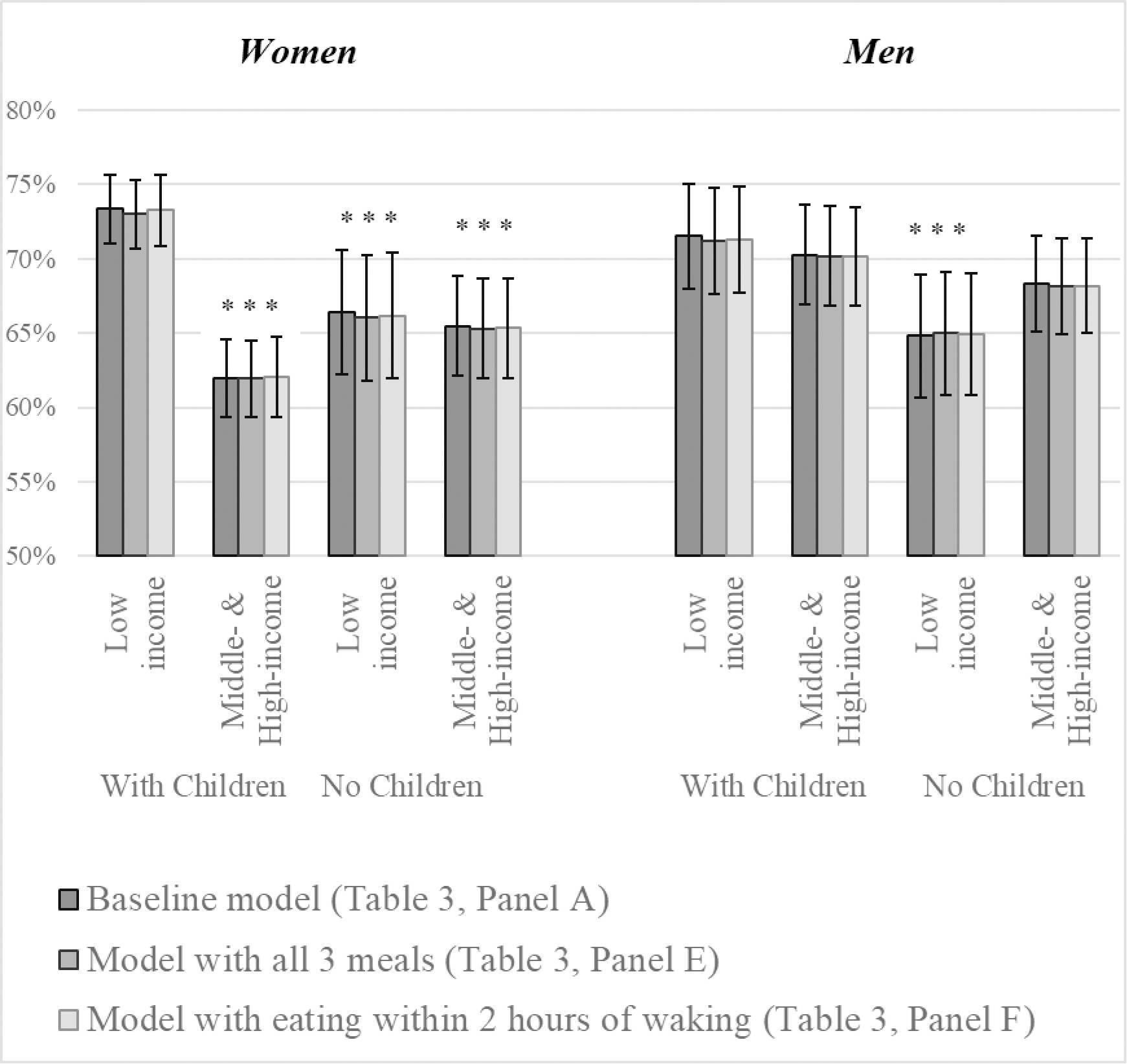
Results: While eating specific meals varies by pairwise combinations of sex, presence of children, and income category, low-income mothers are not significantly less likely to eat lunch or dinner meals, but they are significantly less likely to eat within two hours of waking relative to all other individuals. Yet including mealtime measures does not notably attenuate the significantly higher risk of overweight/obesity for low-income mothers.
Conclusion: Results highlight the complex interplay between gender, parenting, and income for food consumption behaviors, but disparities in overweight and obesity remain difficult to explain.
Keywords: Eating Behavior; Gender; Low Income; Meals; Motherhood; Overweight/Obesity.
Figures

References
-
- Anderson PM, Butcher KF, & Levine PB (2003). Maternal employment and overweight children. Journal of Health Economics, 22(3), 477–504. - PubMed
-
- Arendell T (2000). Conceiving and Investigating Motherhood: The Decade’s Scholarship. Journal of Marriage and Family, 62(4), 1192–1207. 10.1111/j.1741-3737.2000.01192.x - DOI
-
- Badun C, Evers S, & Hooper M (1995). Food security and nutritional concerns of parents in an economicallly disadvantaged community. Journal of the Canadian Dietetic Association, 56(2), 75–80.
Grants and funding
LinkOut - more resources
Full Text Sources