Evaluation of different PK/PD ratios of three enrofloxacin preparations on the clinical response of pneumonic calves
- PMID: 39749382
- PMCID: PMC11799083
- DOI: 10.4142/jvs.24161
Evaluation of different PK/PD ratios of three enrofloxacin preparations on the clinical response of pneumonic calves
Abstract
Importance: Enrofloxacin preparations are available for administration daily or every 3 days. This study presents clinical evidence to define which preparation is adequate to treat clinical cases of bovine respiratory disease (BRD) in calves.
Objective: To correlate the pharmacokinetics/pharmacodynamics (PK/PD) ratios of three pharmaceutical preparations of enrofloxacin with their clinical efficacy in treating BRD.
Methods: The PK/PD ratios of three enrofloxacin preparations were determined in healthy calves. Then, 48 BRD-affected calves initially treated IV with 2.2 mg/kg of flunixin-meglumine, were randomly assigned to treatment with: enrofloxacin dihydrate-hydrochloride (enro-C) 10% water suspension daily (10 mg/kg subcutaneous for three to six days); enro-C with alginate (enro-C/Al), and reference enrofloxacin (enro-R), both intended for treatment every 72-h in two occasions (10 mg/kg).
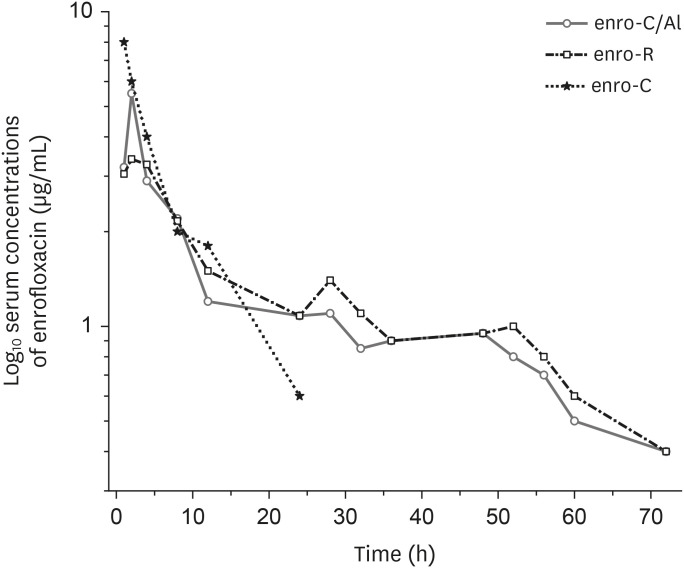
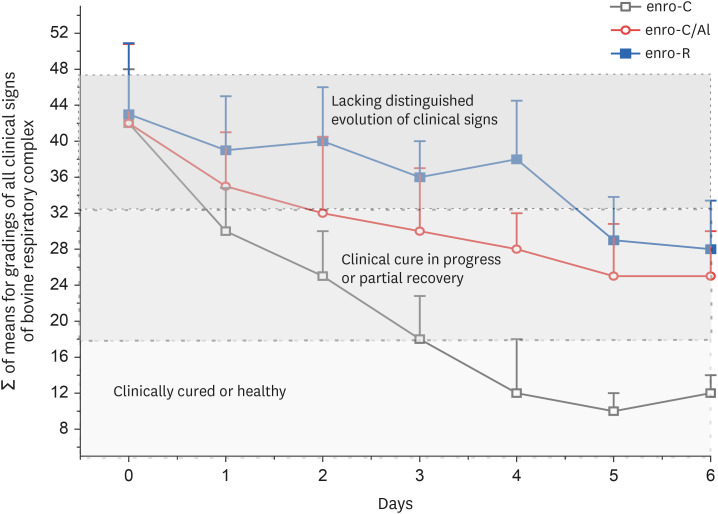
Results: The highest maximum plasma concentration (Cmax)/minimum inhibitory concentration (MIC) ratio was obtained with enro-C and the highest area under the curve (AUC)0-72/MIC ratio with enro-R, and enro-C/Al exhibited an AUC0-72/MIC smaller, but Cmax/MIC higher than enro-R. Based on repeated statistical measurements, clinical progress revealed that the best outcomes were observed with enro-C (p < 0.05), and no statistical differences resulted by comparing enro-C/Al with enro-R.
Conclusions and relevance: If the priority in calves affected by BRD is to speed up their recovery, and despite the more significant amount enro-C injected, using of lower doses of enrofloxacin as in the long-acting preparations is unsustainable. This study demonstrates that the clinical efficacy of enrofloxacin in cattle is optimally linked to Cmax/MIC rather than to AUC/MIC, which occurs better when injecting enro-C.
Keywords: Calves; PK/PD-ratios; bovine-respiratory disease; clinical efficacy; enrofloxacin.
© 2025 The Korean Society of Veterinary Science.
Conflict of interest statement
The authors declare no conflicts of interest.
Figures
References
-
- Svensson C, Lundborg K, Emanuelson U, Olsson SO. Morbidity in Swedish dairy calves from birth to 90 days of age and individual calf-level risk factors for infectious diseases. Prev Vet Med. 2003;58(3-4):179–197. - PubMed
-
- Dubrovsky SA, Van Eenennaam AL, Aly SS, Karle BM, Rossitto PV, Overton MW, et al. Preweaning cost of bovine respiratory disease (BRD) and cost-benefit of implementation of preventative measures in calves on California dairies: the BRD 10K study. J Dairy Sci. 2020;103(2):1583–1597. - PubMed
-
- van der Fels-Klerx HJ, Sørensen JT, Jalvingh AW, Huirne RB. An economic model to calculate farm-specific losses due to bovine respiratory disease in dairy heifers. Prev Vet Med. 2001;51(1-2):75–94. - PubMed
-
- Crosby S, Credille B, Giguère S, Berghaus R. Comparative efficacy of enrofloxacin to that of tulathromycin for the control of bovine respiratory disease and prevalence of antimicrobial resistance in Mannheimia haemolytica in calves at high risk of developing bovine respiratory disease. J Anim Sci. 2018;96(4):1259–1267. - PMC - PubMed
MeSH terms
Substances
Grants and funding
LinkOut - more resources
Full Text Sources
Medical