


At First Sight: Fetal Eye Movements Reveal a Preference for Face-Like Configurations From 26 Weeks of Gestation
- PMID: 39749645
- PMCID: PMC11696828
- DOI: 10.1111/desc.13597
At First Sight: Fetal Eye Movements Reveal a Preference for Face-Like Configurations From 26 Weeks of Gestation
Abstract
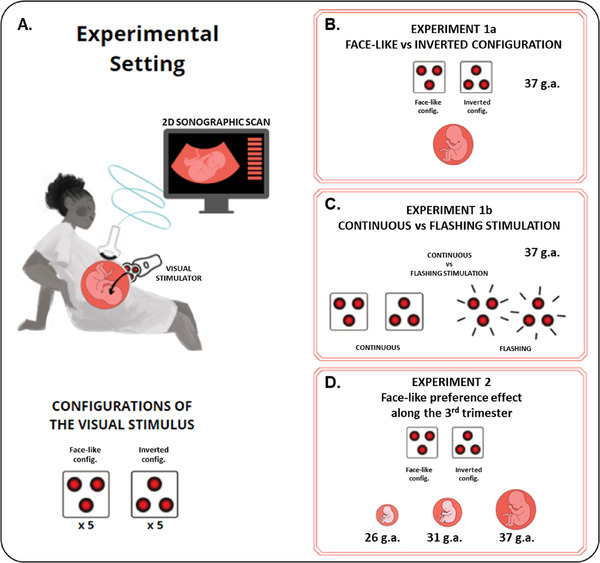
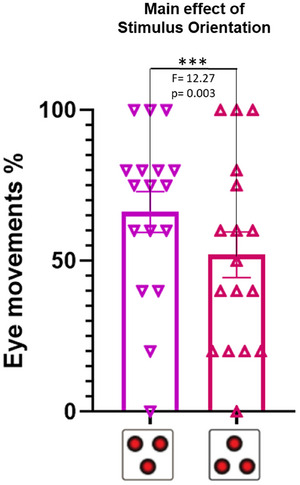
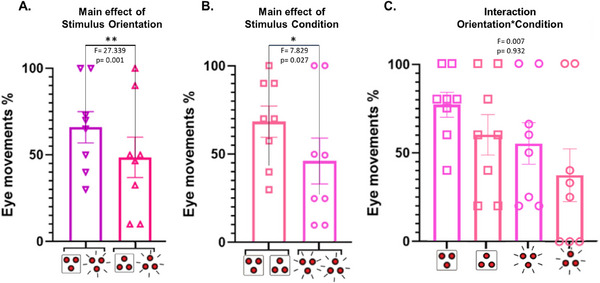
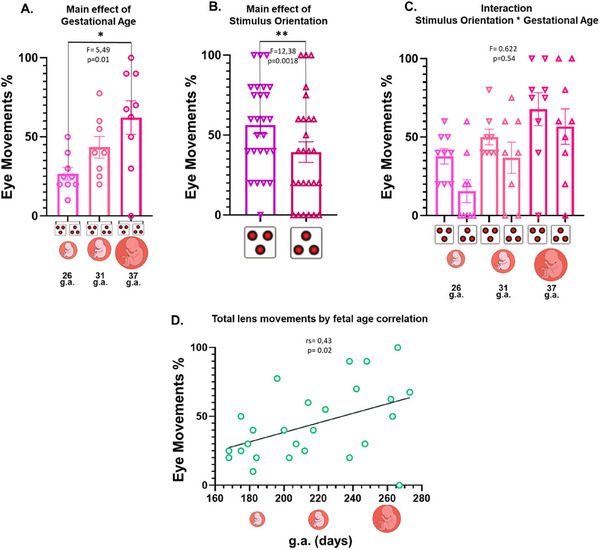
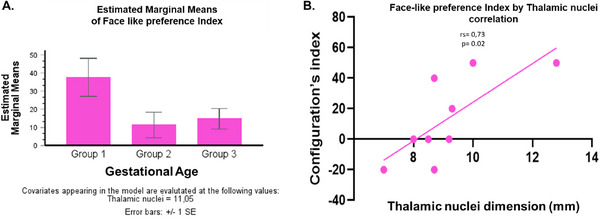
Previous research indicates that both adults and newborns show enhanced electrophysiological and behavioral responses to schematic face-like configurations (FCs-three dots composing a downward-pointing triangle), as compared to the inverted configurations (ICs). Even fetuses, when exposed to light stimuli projected through the uterine wall, preferentially orient their heads toward FCs rather than ICs. However, when this effect emerges along the third trimester of pregnancy and in relation to the maturation of which brain structures is still unknown. Here, to provide a sensitive measure of fetal preference for FCs along the whole third trimester, fetal lens movements in response to FCs and ICs was monitored with 2D-ultrasound. In a series of three experiments, fetuses were recruited at 26, 31, and 37 weeks of gestational age and were presented with both flashing and continuous light stimuli. Our results showed that significantly more lens movements were observed in response to continuous as compared to flashing light stimuli. Furthermore, lens movements linearly increased within the third trimester and, regardless of the time-point, significantly more lens movements were observed in response to FCs versus ICs. We also found a significant correlation in the first time-point, wherein the greater the FCs versus ICs differential response the larger the thalamic nuclei dimension. These findings suggest that FC preference is already present at the beginning of the third trimester, as soon as thalamocortical projections are established.
Keywords: 2D ultrasound; face‐like configuration preference; fetal eye‐movements; fetuses.
© 2025 The Author(s). Developmental Science published by John Wiley & Sons Ltd.
Conflict of interest statement
The authors declare no conflicts of interest.
Figures
References
-
- Atkinson, J. 2000. The Developing Visual Brain. Oxford: Oxford University Press.
-
- Balasubramanian, K. K. , Diotalevi F., Lorini C., et al. 2022. “A Transcutaneous Fetal Visual Stimulator.” IEEE Access 10: 45979–45996. 10.1109/ACCESS.2022.3169778. - DOI
-
- Cassia, V. M. , Simion F., and Umiltà C.. 2001. “Face Preference at Birth: The Role of an Orienting Mechanism.” Developmental Science 4, no. 1: 101–108. 10.1111/1467-7687.00154. - DOI
MeSH terms
Grants and funding
LinkOut - more resources
Full Text Sources
