


Antibiotic prescribing patterns at outpatient clinics in Western and Coastal Kenya
- PMID: 39752345
- PMCID: PMC11698307
- DOI: 10.1371/journal.pgph.0004109
Antibiotic prescribing patterns at outpatient clinics in Western and Coastal Kenya
Abstract
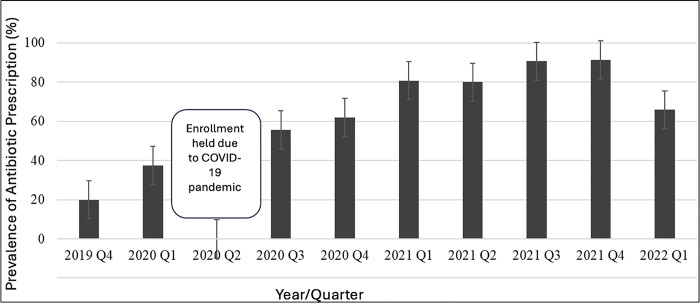
Antimicrobial resistant pathogens are a leading cause of morbidity and mortality worldwide, with overuse and misuse of antimicrobials being key contributors. We aimed to identify factors associated with antibiotic prescriptions among patients presenting to clinics in Kenya. We performed a retrospective, descriptive cohort study of persons presenting to outpatient clinics in Western and Coastal Kenya, including symptoms, physical exams, clinician assessments, laboratory results and prescriptions. We reviewed 1,526 visits among 1,059 people who sought care from December 2019-February 2022. Median age was 16 (IQR 6-35) and 22% were under 5. 30% of malaria RDTs were positive and 3% of dengue RT-qPCRs were positive. Antibiotics were prescribed in 73% of encounters overall and in 84% among children under 5. In 48% of visits antibiotics were prescribed without a provisional bacterial diagnosis. In the multivariable model, factors associated with increased odds of an antibiotic prescription were the clinic in Western Kenya (OR 5.1, 95% CI 3.0-8.8), age less than or equal to 18 (OR 2.1, 95% CI 1.4-3.2), endorsement of cardiorespiratory symptoms (OR 5.2, 95% CI 3.2-8.3), a negative malaria RDT (OR 4.0, 95% CI 2.5-6.8), and a provisional diagnosis that could be bacterial in etiology (OR 5.9, 95% CI 3.5-10.3). High rates of antibiotic prescriptions are common even when associated diagnoses are not bacterial. Compared to our 2014-2017 cohort, we found higher rates of antibiotic prescriptions among children. Improved diagnostics to rule in alternative diagnoses as well as stewardship programs are needed.
Copyright: © 2025 Kiener et al. This is an open access article distributed under the terms of the Creative Commons Attribution License, which permits unrestricted use, distribution, and reproduction in any medium, provided the original author and source are credited.
Conflict of interest statement
The authors have declared that no competing interests exist.
Figures
References
-
- Zhong X, Pate A, Yang Y-T, Fahmi A, Ashcroft DM, Goldacre B, et al. Impact of COVID-19 on broad-spectrum antibiotic prescribing for common infections in primary care in England: a time-series analyses using OpenSAFELY and effects of predictors including deprivation. The Lancet Regional Health–Europe. 2023;30. doi: 10.1016/j.lanepe.2023.100653 - DOI - PMC - PubMed
Grants and funding
LinkOut - more resources
Full Text Sources