


Mental health in Germany before, during and after the COVID-19 pandemic
- PMID: 39752443
- PMCID: PMC11698453
- DOI: 10.1371/journal.pone.0313689
Mental health in Germany before, during and after the COVID-19 pandemic
Abstract
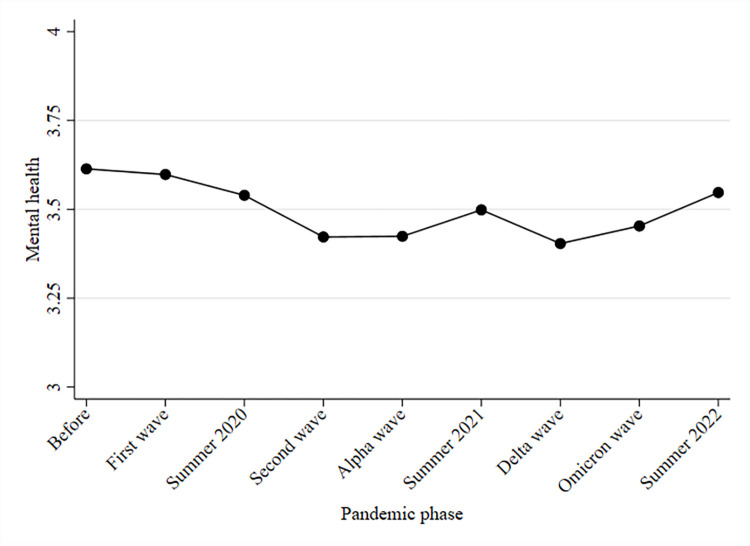
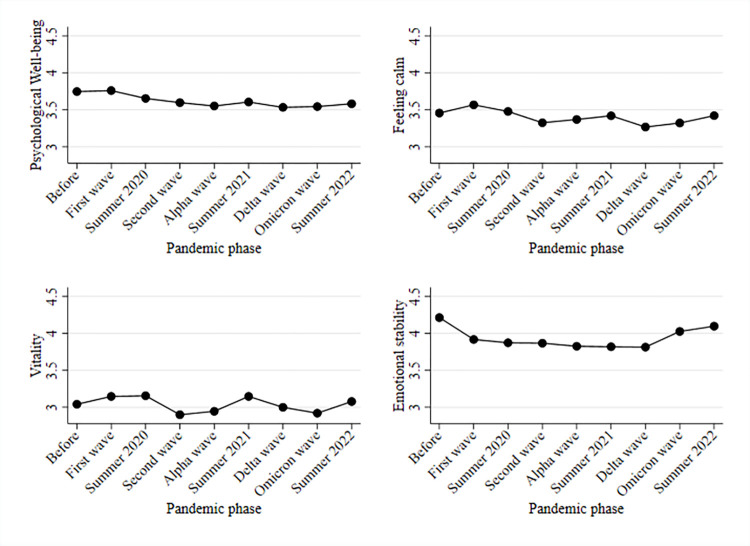
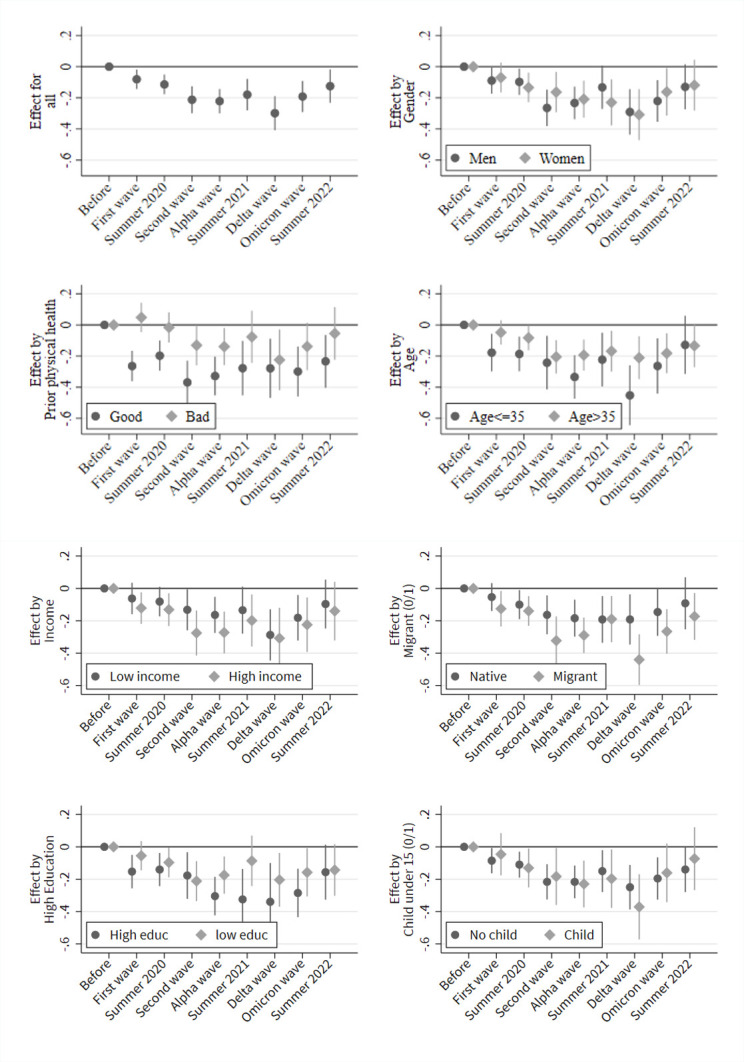
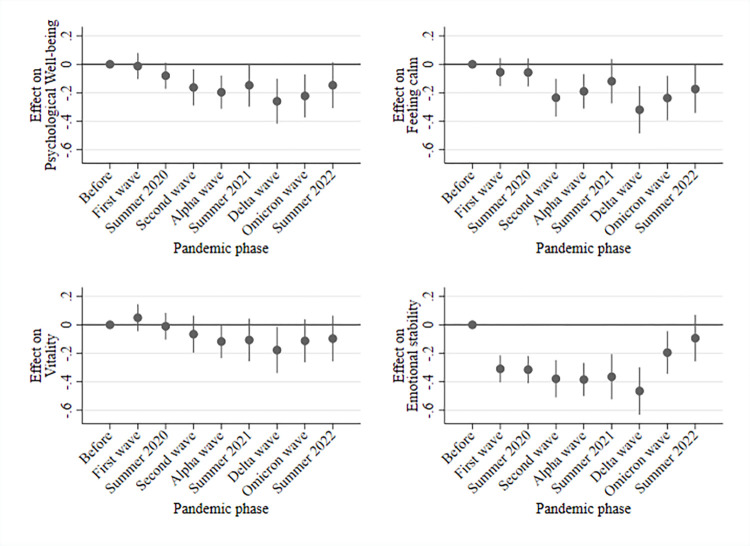
Based on nationally representative panel data (N person-years = 40,020; N persons = 18,704; Panel Labour Market and Social Security; PASS) from 2018 to 2022, we investigate how mental health changed during and after the COVID-19 pandemic. We employ time-distributed fixed effects regressions to show that mental health (Mental Health Component Summary Score of the SF-12) decreased from the first COVID-19 wave in 2020 onward, leading to the most pronounced mental health decreases during the Delta wave, which began in August 2021. In the summer of 2022, mental health had not returned to baseline levels. An analysis of the subdomains of the mental health measure indicates that long-term negative mental health changes are mainly driven by declines in psychological well-being and calmness. Furthermore, our results indicate no clear patterns of heterogeneity between age groups, sex, income, education, migrant status, childcare responsibilities or pre-COVID-19 health status. Thus, the COVID-19 pandemic appears to have had a uniform effect on mental health in the German adult population and did not lead to a widening of health inequalities in the long run.
Copyright: © 2025 Patzina et al. This is an open access article distributed under the terms of the Creative Commons Attribution License, which permits unrestricted use, distribution, and reproduction in any medium, provided the original author and source are credited.
Conflict of interest statement
The authors have declared that no competing interests exist.
Figures
References
-
- Cénat JM, Blais-Rochette C, Kokou-Kpolou CK, Noorishad PG, Mukunzi JN, McIntee SE, et al.. Prevalence of symptoms of depression, anxiety, insomnia, posttraumatic stress disorder, and psychological distress among populations affected by the COVID-19 pandemic: a systematic review and meta-analysis. Psychiatry Res. 2021; 295:113599. doi: 10.1016/j.psychres.2020.113599 - DOI - PMC - PubMed
-
- Cénat JM, Farahi SMMM, Dalexis RD, Darius WP, Bekarkhanechi FM, Poisson H, et al.. The global evolution of mental health problems during the COVID-19 pandemic: a systematic review and meta-analysis of longitudinal studies. J Affect Disord. 2022; 315:70–95. doi: 10.1016/j.jad.2022.07.011 - DOI - PMC - PubMed
-
- Etikan I, Musa SA, Alkassim RS. Comparison of convenience sampling and purposive sampling. Am J Theor Appl Stat. 2016; 5(1):1–4.
MeSH terms
LinkOut - more resources
Full Text Sources
Medical
